
Data quality has now become a key lever for growing a company’s business.
The gains to be had from managing the quality of your data efficiently, comprehensively and consistently are huge, and often unsuspected. Various tools exist on the market to meet these different needs for processing, updating and cleaning.
Whatever type of solution you choose, the most important thing is still to know the best practices in data quality and to be able to run a regular performance audit of how this data is managed.
Carrying out such a project involves several phases: choosing the quality dimensions to address and selecting the criteria used to assess them, writing the specifications, choosing the right analysis tools, structuring the quality approach step by step and running periodic control audits.
Here is a complete guide for anyone who wants to learn more about these issues. A few hours of reading are enough to cover the topic, and to find out how to improve the quality of your data quickly and reliably.
Need support?Duplicates, outdated information, missing data… Anomalies in marketing/CRM databases have very real consequences: less effective campaigns, biased analyses and decisions… Yet few companies have set up a genuine Data Quality approach.
Fortunately, there are solutions. Data consulting firms can help you at every level: audit, action plan, operational implementation, monitoring.
1. Data quality: definition and benefitsWhile the term is very much in vogue today, it is not unusual for some key elements of its definition to be poorly understood, even within marketing teams. So unless you are an expert on the subject, understanding the notion of “data quality” in full is a must, in particular to grasp all the operational and financial benefits that come with it.
2. Optimizing your data quality management: a review of best practicesGuaranteeing optimal quality over time relies first and foremost on managing your data in an efficient, documented and methodically structured way. Upstream, your teams can pull certain strategic levers to make these processes easier to set up. The 6 golden rules of data quality management round out this body of knowledge to make sure you start your project on the right footing.
3. Choosing data quality tools / providersThere are several ways to improve the quality of your data. Obviously, you can do it yourself or choose to go through an outside provider. It all depends on how complex your project is and on the time / budget you have. The market for data quality monitoring/management tools now has many solutions (open source and proprietary), and choosing the right one for your project takes real work scoping your needs.
4. Regular audits: the guarantee of quality data over the long termA key milestone in your quality approach, the audit lets you check at regular intervals that the quality of your data holds up as your business grows or as you add new tools to your portfolio of solutions.
Data quality: definition and benefits
What is Data Quality?
Data Quality refers to a company’s ability to keep its data sound over time, and therefore usable for marketing and sales operations. Data Quality is thus a way of managing data so that it remains viable over time. As everyone knows, time naturally erodes / degrades the quality of data, because customer data is a living material: people change email addresses, physical addresses, phone numbers, but also preferences, buying behavior, etc. A database that is not maintained ends up storing data that is no longer accurate, that no longer matches any reality. Data quality management is the set of practices and techniques used to keep the data in your customer or prospect files true.
But Data Quality management covers a broader field and relies on taking into account six dimensions or criteria, brought to light by the DAMA United Kingdom association:
- The completeness of the data: do you have all the data you need on your customers or prospects? Are all the attributes / fields you need filled in? Incomplete data is one of the main challenges organizations face in managing their databases.
- Its validity: does the available data follow a standard syntax? (for example: “av” vs “avenue”).
- Its accuracy: quite simply, is the data in your database correct? Does it reflect reality? Data can be perfectly complete and yet incorrect, so this criterion is essential. You may for example have the addresses of every individual on your list, but only 70% of these addresses may be valid.
- Consistency: is the data in your different databases consistent across them? For the same individual recorded in several databases, is the information the same from one database to the next?
- The availability of the data: is the data easily accessible to the people who need it in their work?
- The timeliness of the data: when was the data recorded or updated? This brings us back to what we were saying earlier: data naturally loses value over time, it degrades. All other things being equal, the more recent a piece of data is, the more valuable it is.
The quality of the available data is the foundation of effective marketing and sales activities. It is often said that data is the fuel of customer relationships, of the sales dialogue and of marketing efficiency. But that only holds true if the data is of good quality, in all the senses we have just listed.
Read alsoFind out how to build a Lead Scoring strategy.
Why is inaccurate data dangerous?
In data analysis jobs, maintaining data quality is a major issue. Every organization that does Big Data knows the risks and dangers of incorrect data. The concept of Data Quality is not yet another buzzword, it is something that really matters and describes a highly legitimate concern. And yet, it has to be said that Data Quality is rarely among companies’ top priorities.
Yet data on its own is not enough. What enables a company to improve its performance is not data as such, but quality data. Let’s put it bluntly: if you are not ready to maintain your data, you might as well not collect any data at all… You could even coin a slogan: data is either maintained or worthless. An infographic shared by Halo Business Intelligence showed that almost 40% of the data held by companies was inaccurate… Even more worrying, over 90% of companies admit that the customer data they have is inaccurate… In the Halo Business Intelligence study, 66% of the companies surveyed admit that incorrect data may have a negative impact on their business. They even put the likely cost at $8,200 000 on average… Granted, we are dealing with big fish here, but still.
Read alsoDiscover 15+ tools to build a prospect list.
Why and how does having poor quality data affect companies’ performance so much? The dangers associated with poor quality data are of two kinds. On the one hand, they generate financial costs; on the other, they damage the company’s reputation.
As the study mentioned above shows, inaccurate data first has a financial impact / cost. Without Data Quality, you end up making decisions and implementing strategies based on inaccurate facts. Let’s take an example that is both simple and commonplace. Say you want to create your next marketing campaign. To do so, you use the data available to target the right people. But if your data is incorrect, you will target the wrong people with the wrong offers. You will have relied on assumed behaviors that are not those of your contacts. Your marketing campaign is likely to flop. It will have cost you money, with no meaningful return on investment. Beyond that, having inaccurate data generates significant operational costs. If you have imprecise or inaccurate data on your customers, you will have to spend time trying to find the right information. And in business, time is money…
Obviously, setting up Data Quality management costs money and requires an investment from the company. At first, you will feel like you are losing more than you are gaining. But if in doubt, always remember that the cost of poor quality data will always be higher than any Data Quality strategy. Fixing errors caused by poor data quality always ends up costing more than limiting the risk of errors… On that subject, we should mention a study from 2011, rather academic admittedly, but fascinating nonetheless, which demonstrates with evidence that the costs associated with incorrect data are always higher than the costs of maintaining Data Quality.
Finally, as we said above, having poor quality data can also do serious damage to the company’s brand image. Quite simply, because poor data quality necessarily affects the quality of your communications, the quality of the dialogue you have with your customers. And, to put it crudely, it looks really bad to show your customers, through your messages, that the information you hold on them is completely wrong. It inevitably hurts your credibility. That is true in B2C, and even more so in B2B.
Read alsoDiscover 10 major trends in the world of B2B CRM software.
The benefits of Data Quality management
Not caring about Data Quality can have serious consequences for the company’s business. But beyond that, setting up Data Quality management brings several “positive” benefits. First, it allows an organization to cut costs in various departments. The Halo Business Intelligence study showed that organizations that managed Data Quality managed to reduce:
- Company spending by 10% to 20%
- IT costs by 40% to 50%
- Operating costs by 40%
Once again, most of these cost reductions result from a more relevant use of data. Planning, decisions and actions are more effective when they are driven by correct data. But Data Quality management also contributes directly or indirectly to improving economic performance (turnover, revenue). Because having quality data helps avoid major strategic mistakes, improve brand image and secure customer loyalty. Using accurate data improves the performance of your marketing campaigns and of your sales strategy.
Above all, having Data Quality management improves risk management. The risk of error is greatly reduced if you base your decisions on correct information. Data Quality limits the risk of error in many activities, from customer service to product development and even accounting! Having quality data makes employees’ lives easier and makes them more efficient. They no longer have to double-check information every time to make sure it is valid.
Read alsoFind out how to evolve B2B sales processes to meet the demands of the modern decision-maker.
The key components of effective Data Quality management
How do you put your data in order? How do you set up effective Data Quality management? There are different possible approaches. As a first step, your company must clearly state its needs and goals regarding the use of data.
There are three key components to consider in Data Quality management:
- Data governance
- Data Quality Assurance (QA)
- Data Quality control
1. Data governance
Every company should have a data governance team to monitor data quality, data updates and the procedures in place to maintain quality. In recent years it has become common to find a Chief Data Officer (CDO) in companies, tasked with keeping management informed of the data problems the company runs into.
A Data Management team must focus on the company’s strategic goals. It must constantly ask itself what the company’s key goals are and how to reach them. The answers to this question make it possible to define the data the company needs to grow. It also helps prioritize Data Quality goals.
Once you have defined your business goals in terms of data, you need to put the database in order. Several Data Quality programs can be deployed for this purpose. You can also outsource the cleaning of your databases by calling on a consulting firm specializing in customer data. The most important thing is to focus on the data that really makes sense for your organization and the pursuit of its goals, and to delete useless or irrelevant data. Companies often struggle to delete data, but effective Data Quality management means focusing exclusively on essential data.
Be aware that Data Quality management is not mainly about implementing your action plan with methods each more sophisticated than the last. Above all, you must also be able to weigh the cost of implementing Data Quality programs against the financial and reputational cost of using poor quality data. To be efficient, Data Quality management does not necessarily need to be expensive.
There is one last aspect of data governance not to overlook. As we know, most of the time it is human error that causes incorrect data. So it is also essential to make employees aware of the importance of Data Quality. Everyone in the organization needs to get involved and understand why data quality matters. This awareness work can prove far more effective at getting rid of incorrect data than implementing a sophisticated new piece of software.
Read alsoDiscover our top 10 email list cleaning tools.
2. Data Quality Assurance
Data Quality Assurance refers to all the day-to-day processes and techniques used to identify inaccurate, inconsistent and incomplete data, and therefore ultimately to guarantee that data quality is maintained over time.
Setting up a Data Quality Assurance approach makes it possible to ensure, day after day, that the data used by the company is of a high quality level and helps achieve the goals identified by the data governance team.
3. Data Quality control
Finally, you must also implement Data Quality control protocols. Quality control takes over from Data Quality Assurance. Controlling Data Quality means making sure that the data is accurate and that the databases are not cluttered with useless data. It is about controlling both the quality of the data and the way the company’s employees use it.
Data Quality Assurance measures the level of inconsistency, incompleteness and accuracy of the available data. The data control process, for its part, consists of deciding whether the data is useful, relevant, worth using. Let’s take an example. The person in charge of Data Quality Assurance will be the one who identifies the inconsistent data. The person responsible for control will be the one who decides to delete this data so that the company does not use it. Their role is to prevent the organization from using incorrect data.
Read alsoDiscover our complete guide to the art of setting up effective sales processes.
Data Quality best practices
With the explosion in the volume of available data and the growing role data plays in strategic decision-making, setting up solid Data Quality Management is becoming a must-do project. All the more so because using poor quality data generates considerable costs for companies.
In this guide, we will give you advice and share best practices to help you manage the quality of your data as well as possible.
Which strategic levers should you pull to improve the quality of your data?
Several strategic approaches have proven their worth and are used in companies recognized for the quality of their Data Quality management. All the levers we are going to present come from a proactive approach to controlling and steering Data Quality, much better than “reactive” approaches that consist of repairing the damage once it is done.
1. Entrust Data Quality management to the business teams
The main purpose of data is to feed the business. Data is the fuel of marketing, sales and customer relationships. For these reasons, Data Quality management should not be entrusted to the IT department but to the business units, which are the main users of the data.
These users are better qualified to set the data quality parameters, the data to collect and the data flows to create, and to identify the most important data, whose quality must be monitored very closely.
2. Appoint Data Stewards
The Data Steward is the person in charge of organizing and managing the company’s data. Their main goal is to guarantee the quality and integrity of the data stored in the information system. It is strongly recommended to choose a Data Steward from within the business units, someone who knows their issues, their specific needs and how they work.
Appointing Data Stewards makes it possible to tackle the risks of Data Quality degradation at the root.
3. Set up a data governance council
This group should be made up of representatives of the company’s different functions, data stakeholders and representatives of the IT department. Data Stewards can work closely with council members, or even be appointed full members of the council.
One of the main goals of this body is to set Data Quality approaches and policies and to make sure they are actually and correctly implemented across the whole company.
The council meets at regular intervals to analyze data governance results, take action in the event of problems / errors and set new quality targets.
4. Set up a firewall to control the quality of incoming data
For a company, data can be likened to a financial asset, so it makes perfect sense to put controls in place to make sure the data entering the information system is of sufficient quality.
These controls should also apply to every export or modification of data, since this processing can lead to a loss of “precision” in the data. As we have explained elsewhere, using poor quality data can cause serious problems downstream and have very harmful business impacts.
Setting up a virtual firewall makes it possible to detect and block bad data before it enters the information system. Corrupted data identified by the firewall can either be sent back to its original source to be modified, or be corrected before it enters.
Some Data Quality management solutions offer firewalls with customizable rules.
The golden rules before launching a Data Quality project
Before suggesting a few steps to follow to improve your Data Quality management system, we wanted to remind you of a few essential rules on the subject. Putting these rules into practice is the sine qua non condition for implementing an effective approach. Without further ado, here are the rules:
- Start small. As the saying goes, Start Small. You need a clear vision of your Data Quality Management setup from the outset, but you must take a gradual approach. Don’t try to do everything at once. Rank the deployment projects and order them in a clear roadmap.
- Data Quality is an ongoing process. A Data Quality management project is not a one-shot project, but an ongoing process meant to last and to evolve over time. A Data Quality Management project requires a change in your organization’s culture regarding data governance. That takes time. You will have to evolve your setup several times as part of a continuous improvement approach.
- Focus on quality goals and targets. You need to identify the criteria and metrics that matter for your organization. Which criteria must your data meet to qualify as quality data (accuracy, consistency, integrity, timeliness…)? Which KPIs should you use to measure how these criteria evolve?
- Prioritize your actions according to estimated ROI. You must first target the pain points, the Data Quality problems whose resolution is likely to deliver the highest ROI. This rule combines with the previous one. These are the actions you need to deploy first.
- There is never just one path. Data flows through the company from every direction, it draws on many sources / applications, runs through many integration services, feeds many databases. Data Quality management can be carried out from any level in your data flows; it depends on your data governance rules, your business needs, data ownership rules, the architecture of your systems, etc. There are very often several options on the table for implementing effective Data Quality management. There is never just one way.
Optimizing your Data Quality management in 5 steps
Data Quality management is a process that takes the form of a circle and involves several implementation phases. Here are the 5 main steps of the process. These steps are successive. For each of them, we give you a few specific tips.
1. Data Quality Assessment
The first step is to subject all the data stored by the company to a detailed inspection in order to identify the problem areas (errors, inconsistencies, duplicate data, empty fields) that hinder the pursuit of the company’s business goals.
For this step, it is advisable to call on a third party from outside the company, who will be able to make an objective diagnosis of the current situation. This first step is the foundation from which the whole Data Quality management approach can unfold.
It makes it possible to identify areas for improvement, work streams and the actions to carry out.
We recommend mixing:
- A top-down approach, which starts from pain points at business level and looks for their causes at data quality level.
- A bottom-up approach, which consists of analyzing the data to identify anomalies that have a negative impact on the pursuit of the company’s goals.
This work results in a report that clearly and precisely lists all the lessons brought to light. Wherever possible, this report should be shared with all stakeholders. It is the basic document that will make it possible to rank and order the priority work streams.
Read alsoDiscover our top 10 mailing list cleaning tools.
2. Measuring data quality
The report produced during the analysis makes it possible to focus on the most critical data, the data whose quality matters most.
You need to determine attributes and dimensions (accuracy, consistency, freshness, integrity, completeness) to measure the quality of this data, define indicators (the rate of incomplete data, for example) and quality thresholds (above which a piece of data can be qualified as quality data).
From this you can deduce the tools and techniques to deploy to reach the required quality level on the target data. A dashboard can be set up for each business unit based on the chosen metrics and thresholds.
3. Identify where data is controlled
When you develop an application or update an information system, you generally start by focusing on functionality before doing any Data Quality management.
Having defined the Data Quality metrics upstream will let you build Data Quality goals in from the start, that is, into the feature development cycle and tool implementation. This is by far the most effective approach, because the people responsible for rolling out features need to know what data each application requires.
A good knowledge of how data flows are structured across all the applications in the information system makes it possible to identify the most relevant places for inspection and daily controls. Almost every time, these are the points where data enters the system.
It is from this work of identifying control points that you will be able to deduce the target features you will need to implement.
4. Improving Data Quality in information systems
Data shared between data providers and consumers should be covered by contractual agreements that clearly define acceptable quality levels.
You can use the Data Quality metrics you have defined and incorporate them into service contracts. Defining quality and format standards helps data flow from one entity to another.
Metadata can be placed in a registry for Data Center Management, which will have to make sure the data is represented in a form that is acceptable and beneficial to both parties. It is up to Data Center Management to carry out gap analyses and align the business needs of both parties.
Data quality inspections can be carried out manually or through automated processes that check the quality level. Monitoring and corrective actions can be performed periodically, at a frequency set in the service contract.
5. Identify cases where Data Quality standards are not met and take the necessary corrective actions
When you identify a piece of data that does not meet the expected quality levels, corrective actions should be carried out by Data Quality tracking mechanisms similar to the bug tracking systems that exist in software development.
Reporting errors and tracking the actions taken to fix them can help feed performance reports. The key point is that the analysis should not rest only on the errors, but also on their causes.
That is how you will manage to identify the flaws in your processes. On top of this, there should be proactive data cleaning at regular intervals to identify errors that slipped under the radar or got into the system despite the controls.
It is important that Data Quality management happens at the highest level of the organization, using appropriate data management tools to make measurement, reporting and the continuous improvement process easier.
The chosen solution must also be able to align with the company’s business goals, which are necessarily specific to it.
Data Quality goals and management plans must be shared between producers, consumers, developers and operational staff.
Data Quality concerns everyone, not just one function of the company. It must become part of the company culture. Data entry processes must be clearly set at the highest level of the organization.
The best tools for your data quality
Data quality refers to the criteria and processes used to measure or improve the quality of data. With this in mind, many tools are available to manage, prepare and check data, each with its own specific features. We have listed for you a selection of the best solutions to help you improve the quality of your available data and make the most of its potential.
1. Data Management (including Data Quality) – Mostly for large companies
Data management is described by many as one of the major challenges of our century. The exponential growth of available data represents an ever-larger source of information.
The challenge is to manage to use it in a relevant way to support decision-making by companies or government organizations.
This need gave rise to data management. The term covers the entire process of acquiring, validating, storing, protecting and processing data in order to guarantee its accessibility, reliability and recency for its users.
Here is a list of the main tools best suited to large companies.
1. SAS
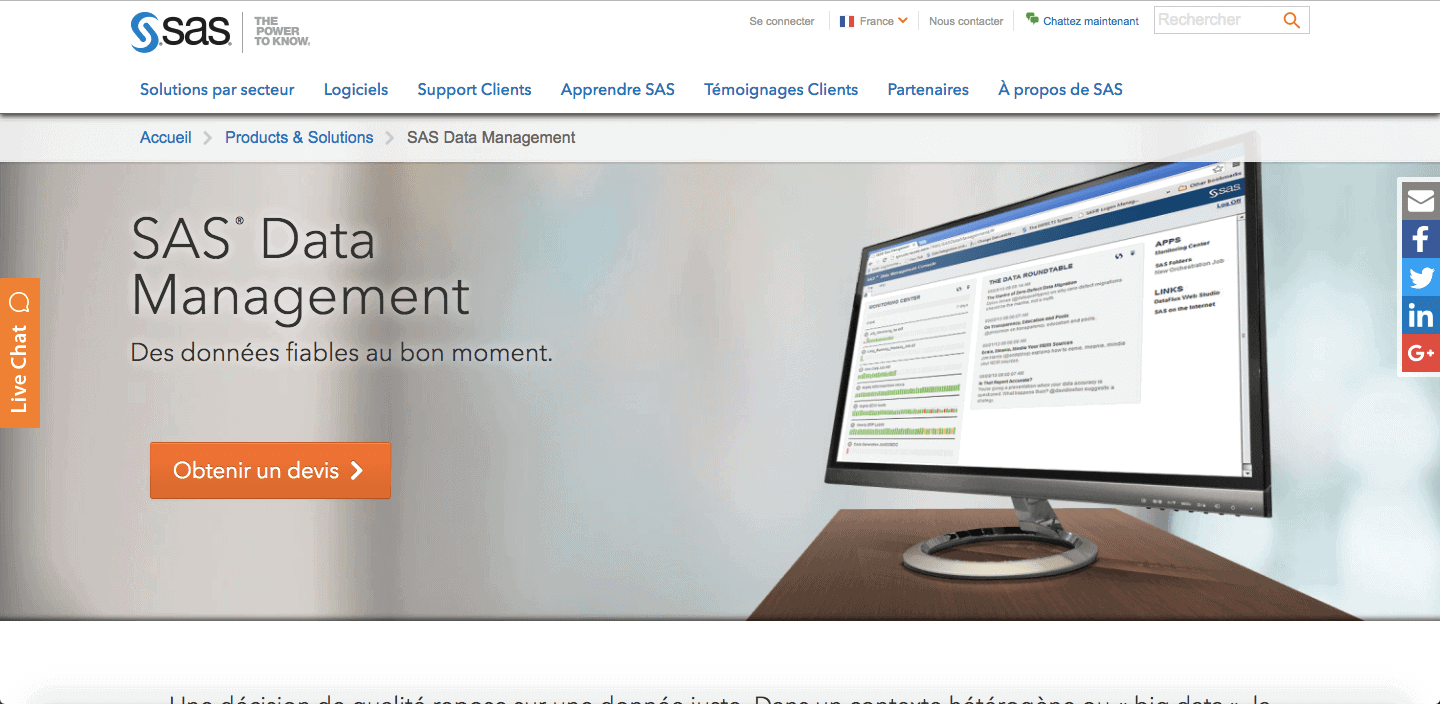
SAS is a complete data management software that lets you create and manage databases, run analytical processing on them, and create and distribute summary reports and listings. Large companies such as Honda, Bank of America and the NGO WWF use it.
Strengths:
- A complete tool for large companies
- Adapts to every industry
Price:
- From €7,000 /year for the basic features up to several hundred thousand €/year
2. Informatica
Informatica offers several solutions dedicated to integrating, analyzing and improving the quality of data. The company also offers cloud data storage services. It also offers a SaaS solution.
Strengths:
- Can be integrated with many data sources
- Ease of use and maintainability.
Price:
- Depending on the number of features.
3. Melissa
Melissa is a tool dedicated to data verification (identity, address, phone, email), essential for keeping a high level of data quality. They also offer services around location and demographic data.
Strengths:
- Can be combined with other internal tools (emailing solution, CRM…)
- Offers SaaS solutions
Price:
- On request
2. Data Preparation
Data Preparation covers all the data cleaning steps that ensure data consistency and quality. Preparation includes, for example, merging several data sources, filtering out useless data, consolidation, data aggregation and calculating additional values based on the raw data. Preparation matters when you know that inconsistent, poor quality data can distort the information derived from it. It can also make data analysis and exploration slow and unreliable. By preparing data upstream, companies are in a better position to make the most of its potential.
4. Google Dataprep
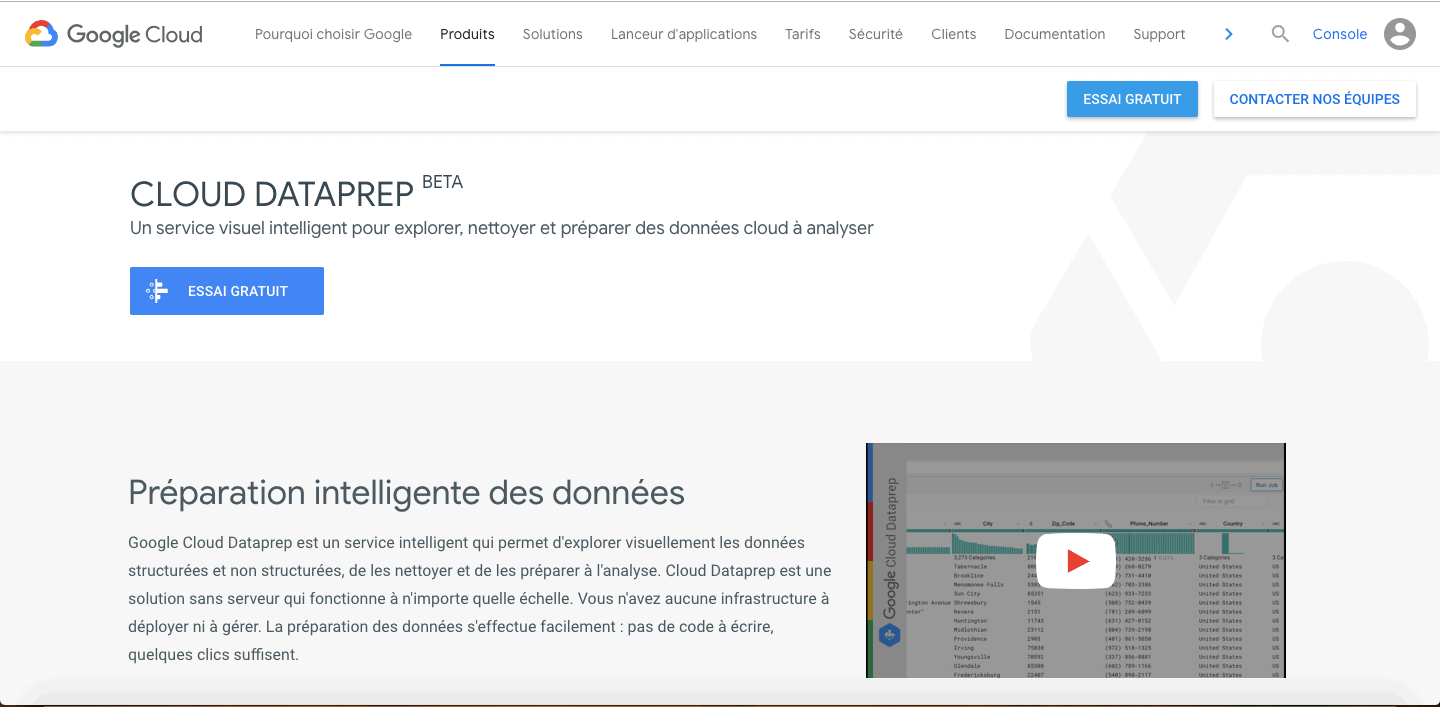
Cloud Dataprep is a smart, serverless visual service for exploring, cleaning and preparing data for analysis. You can import several files, merge them, clean, enrich, standardize…
Strengths:
- Easy to use
Price:
- On average €3 per hour of use
5. Talend Data Preparation
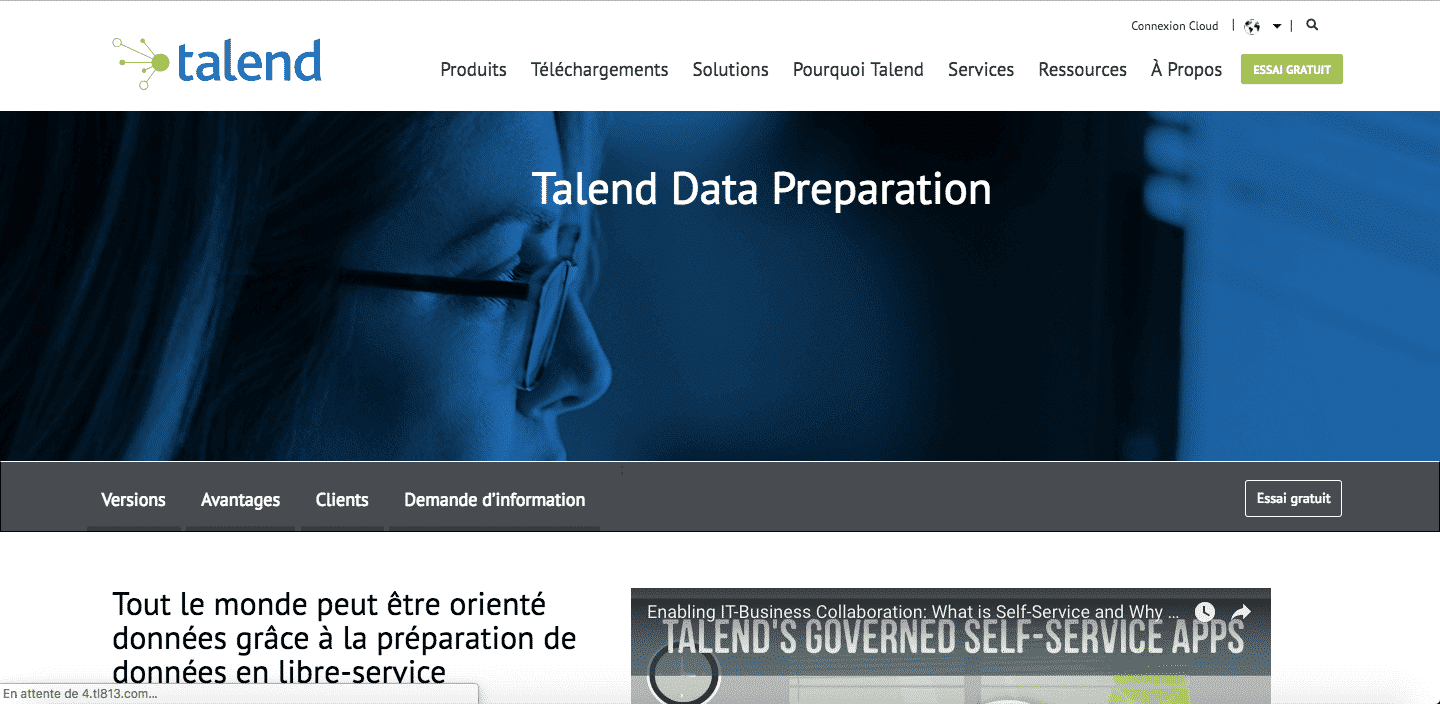
Talend Data Preparation is a solution for preparing data, as downloadable software or in the cloud, both paid. The free open source version is gone: Qlik, which now owns Talend, retired the open source edition of Talend Studio on January 31, 2024.
Strengths:
- There is a solution for every type of need
Price:
- On request
6. Dataiku
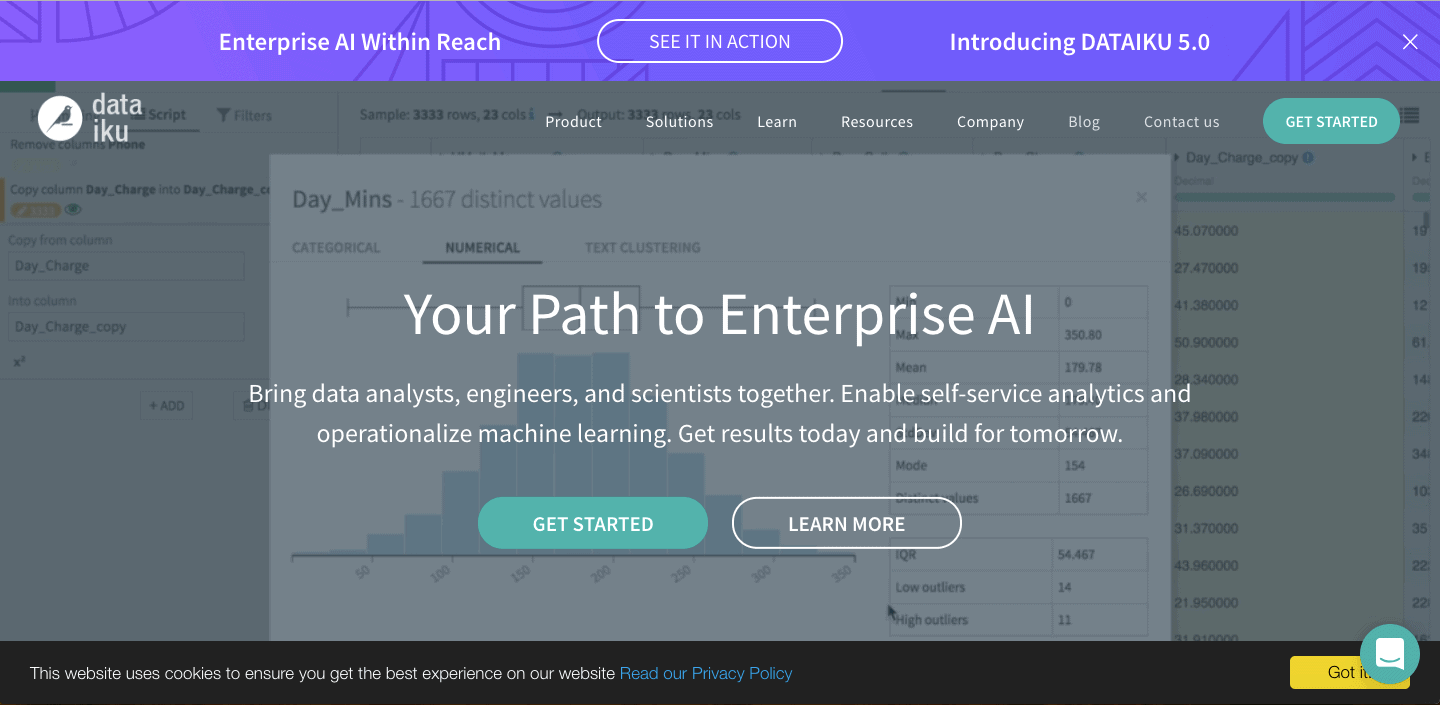
Dataiku is a data analysis tool, usable by both engineers and marketers, that performs well for data preparation. The interface is simple and interactive so that marketers find it easy to use, and advanced and technical enough to please IT engineers.
Strengths:
- Simple, intuitive interface for both engineers and marketers
Price:
- A free basic version
- On request for a more complete version
7. Qlik Sense
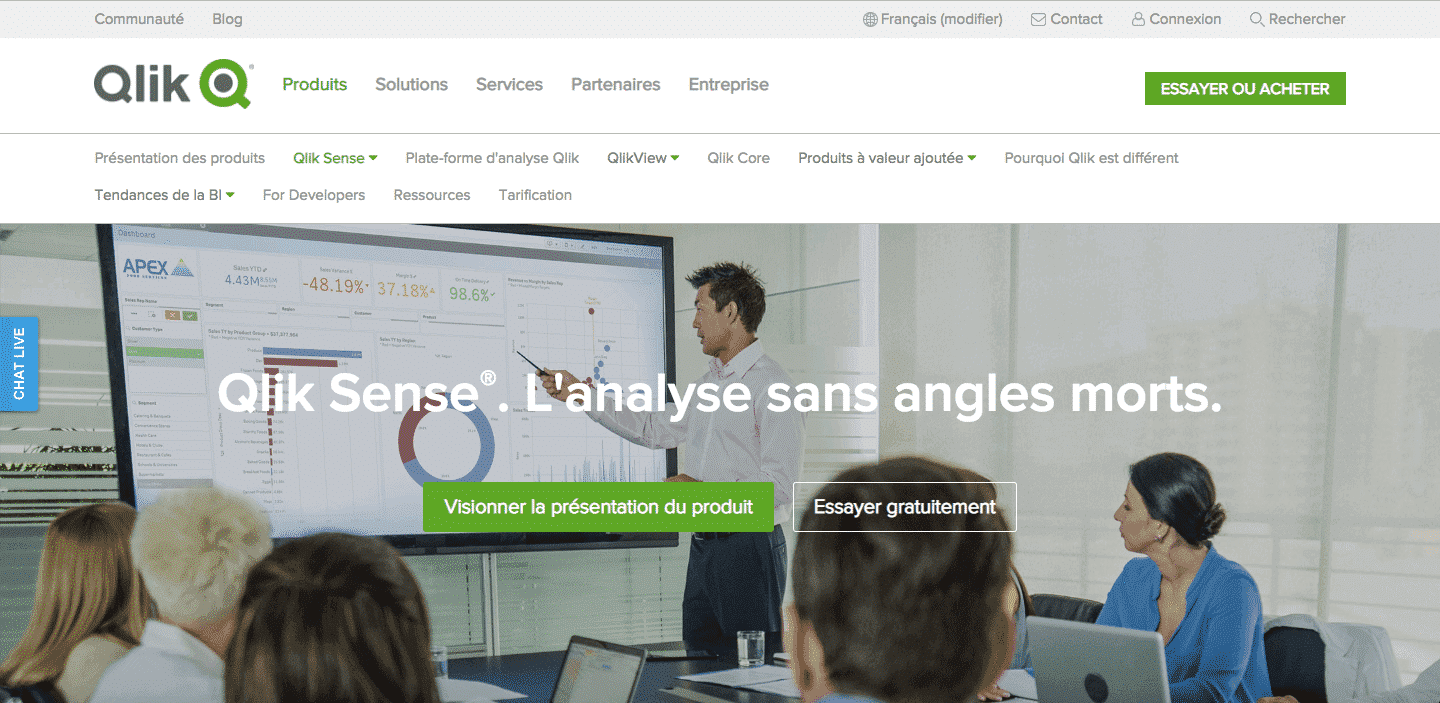
Qlik sense is a tool particularly well suited to non-specialists. The interface is very visual, and analysis is made easier by automatic suggestions. Its playful side makes information accessible to every department in the company. You can watch a 60-second demo in this video.
Strengths:
- Usable by every department in the company
- Simple, playful interface
Price:
- A free basic version
- Custom pricing for more features
8. WinPure
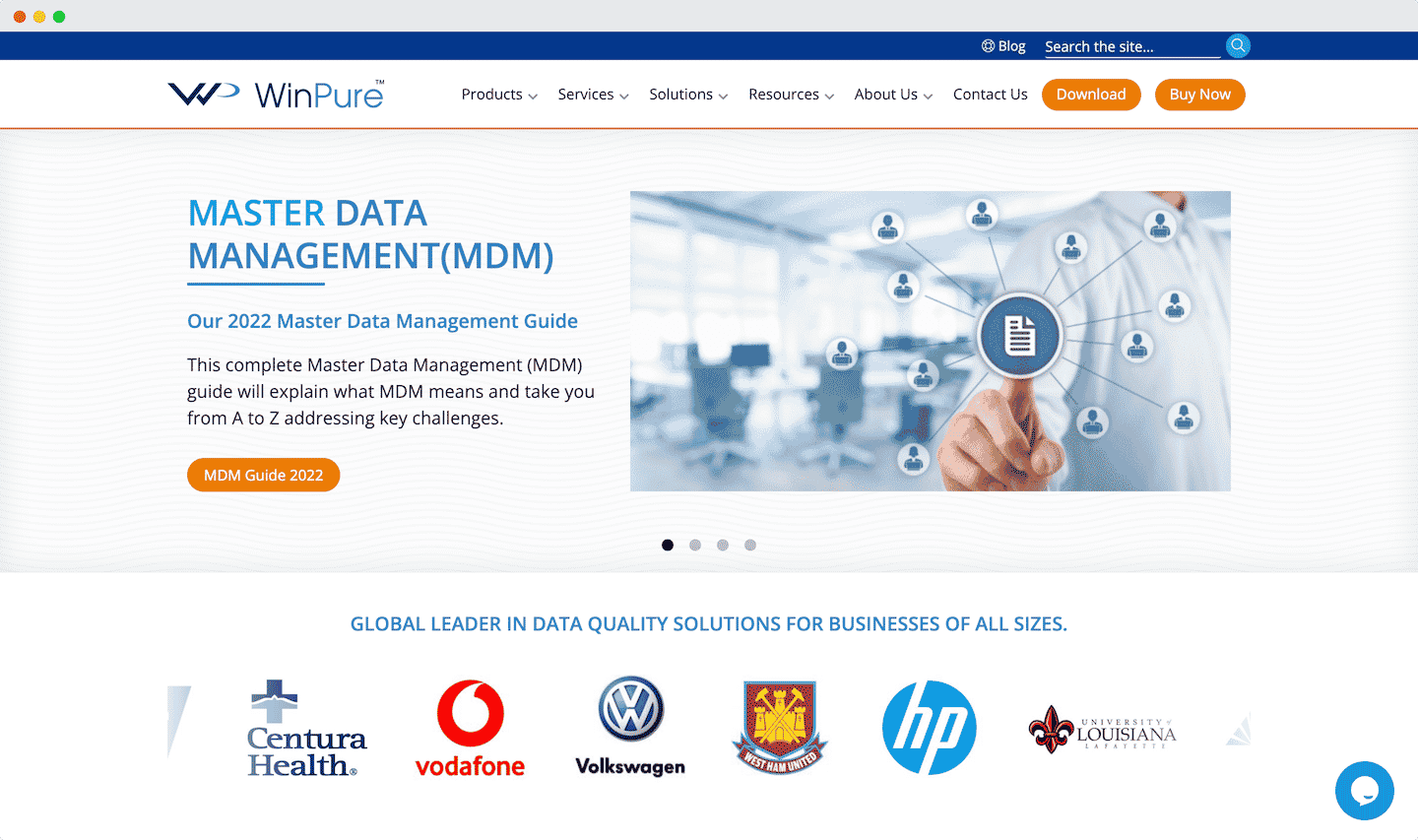
WinPure is a no-code, accessible suite of data quality tools that has been on the market since 2002. They offer a very complete range of services to address the data quality issues of customers of all sizes and industries.
They also offer a Master Data Management solution that lets their customers set up, test and deploy MDM initiatives before investing more significantly in infrastructure and hiring talent.
Strengths:
- Very complete data cleansing, matching and preparation solution
- Address verification
- Master Data Management
Price:
- From $185 per month per user, billed annually
3. Contact data verification
Contact data verification consists of taking all types of data on individuals and legal entities, then analyzing them and standardizing them into a correct, single format. It is linked to data preparation since it shares the same goal of obtaining reliable data that can be processed without errors.
9. DataValidation
DataValidation, acquired in 2021 by Emailable, to which its website now redirects, is one of the best-performing email cleaning solutions on the market. It lets you spot invalid email addresses so that you are not considered a spammer during your emailing campaigns.
Strengths:
- Easy to use
- Accurate results
Price:
- $60 for 10,000 verified emails, $420 for 100,000 emails (Emailable pricing, credits never expire)
10. 76310
The 76310 solution specializes in checking and correcting postal addresses. It complies with the French RNVP standard for the automated processing of addresses to postal standards and is approved by La Poste SNA (national address service).
Strengths:
- Interface available for RNVP processing
- RNVP processing, change of address and deduplication software
- SNA approved
Price:
- For 10,000 addresses (SaaS use) – €200
- For 100,000 addresses (SaaS use) – €400
- On-premise software provision – from €16,000 excl. VAT / year to €30,000 excl. VAT / year
11. Egon
Egon is one of the leading references among the software packages on the international market for standardizing all kinds of personal data (name, date of birth, titles, phone numbers, email, tax code, VAT number, bank details, postal data, postcode, foreign names, identity documents)
Strengths:
- Wide choice of data to standardize
- Complete data validation solution
Price:
- On request
Data quality audit
If data is the fuel of your company, in particular of your marketing & sales departments, that data still needs to be of good quality. Working on poor quality data generates all sorts of costs and can lead to bad strategic decisions.
How do you set up a system for steering Data Quality? Which criteria should you use to qualify data quality? What are some examples of data quality metrics that are easy to set up? What are the main causes of Data Quality problems?
We will address all these questions one after the other. We hope this guide will help you build or improve your organization’s data quality audit approach.
Not auditing can have damaging consequences for your company
The consequences of poor data quality control
Poor control of your data quality can have very damaging consequences for your organization, at every level: the cost of your marketing campaigns and their performance, your understanding of your customers’ needs and expectations, the efficiency of your sales processes (the process of turning leads into customers), the relevance of your strategic decisions, etc. RingLead published a very interesting infographic on this subject. In it, the software vendor shows the costs associated with poor quality data. Here is a short excerpt from the infographic:
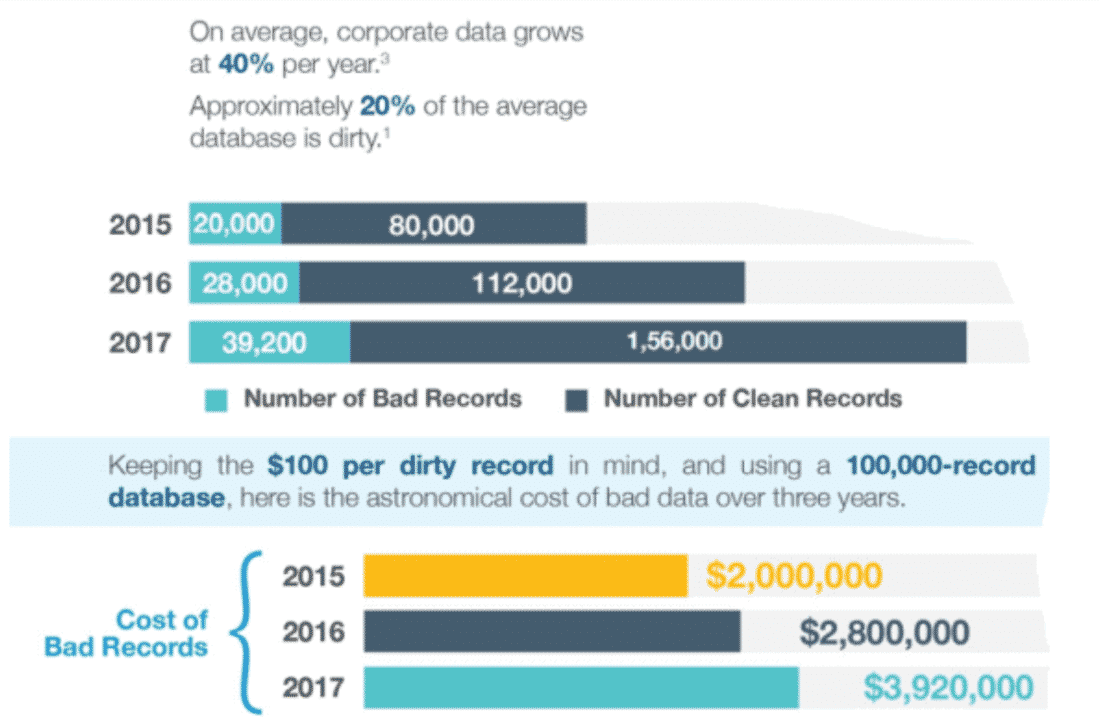
RingLead first highlights the dizzying growth in the volume of data available to companies. Every year, the volume of data grows by 40%. But 20% of data is bad data. We will come back later to the criteria used to qualify data quality.
The costs of using poor quality data rise year after year. Another study, by the well-known firm Gartner, tells us that the lack of data quality control costs the companies surveyed an average of 14 million dollars a year!
The intangible costs of poor data quality control
Not controlling the quality of your data is very expensive from a material and financial point of view. That much is obvious. But alongside these “tangible” costs, you also need to take into account all the intangible costs, by definition hard to measure but fairly easy to imagine.
Let’s imagine your company is trying to spread a “data-driven” culture. You make every necessary effort and develop a pilot program designed to show the ROI benefit of data-driven decision-making, based on business intelligence and analytics.
But here is the problem: if your data is not of good quality, you will have a very hard time demonstrating the benefits of Business Intelligence to your colleagues and superiors. If you question the quality of the data used after the fact, it is too late, it will sound like an excuse.
You are better off fixing the Data Quality problems and demonstrating upstream how crucial it is to have high quality data to generate ROI from data.
The main intangible cost: bad decision-making
Perhaps this example does not apply to you. Perhaps you don’t need to prove to others how important it is to integrate data analysis into the decision-making process. Perhaps your company already does analytics, but without paying much attention to Data Quality control.
Well, in that case, you and your organization risk facing an even more serious problem: making decisions based on incorrect data. In a sense, it is better not to be data-driven at all and to use your intuition than to be data-driven without controlling the quality of the data you use.
In the latter case, the impact of the bad decisions made can be catastrophic. For example, let’s say your incorrect data shows that your cash position is in the green. You are encouraged to launch new initiatives and increase your investments.
Except that after a few months, you finally realize that you have serious cash flow problems. Except that it is a bit late, you are unable to pay your suppliers, or even your employees. Controlling the quality of your data protects you from these difficulties.
A virtuous cycle to guarantee the quality of your data
Managing and controlling data quality is a continuous process that can be illustrated as a cycle:
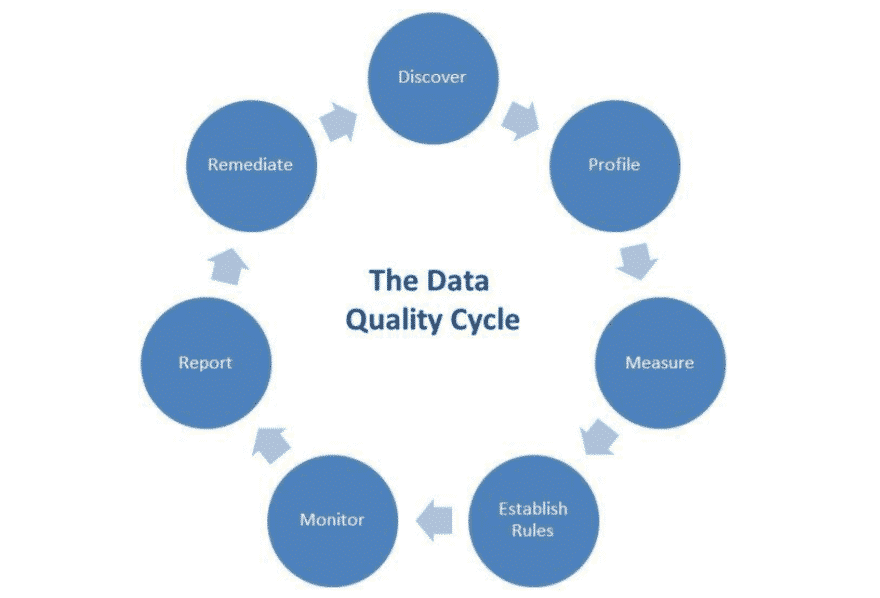
Here are the different steps summed up in a few words:
- Data discovery => Methods that make raw data easier to interpret for non-technical users (marketers…). Data Visualization is an integral part of this step.
- Data Profiling => A process that consists of analyzing data in detail, comparing data with its metadata, calculating statistics and assessing data quality and how it evolves.
- Data Quality Rules => Based on business needs, the process of defining the rules that data must meet to qualify as good quality data.
- Monitoring => The process of continuously steering Data Quality on the basis of the quality rules defined upstream. This includes, for example, setting up notification systems that alert you when a piece of data drops below the quality threshold.
- Reporting => The activity of creating dashboards and implementing KPIs to track how data quality evolves over time.
- Remediation => The process of correcting errors and problems as they are reported in the dashboards.
This cycle alone would deserve a long discussion. Here we will focus in particular on 5 dimensions of Data Quality that you will need to take into account in your audit approach.
Read alsoDiscover 10 major trends in the world of B2B CRM software.
5 key dimensions for setting up your audit system
To measure the quality of your data, you obviously need quality criteria. You must define them clearly upstream. These dimensions cover different aspects of quality. For the audit, we keep 5 of them, close to the DAMA grid presented above: accuracy, consistency, completeness, integrity and timeliness.
Accuracy
The first criterion is the most obvious: does your data reflect reality? Is it correct, valid? Does it accurately describe what it claims to represent? Changes in user / customer status or transactions constantly change the data and must be integrated into your data set in real time.
Data accuracy can be measured against documentary sources (your order management software, for example) or with confirmation techniques. The point is to assess whether or not your data contains errors.
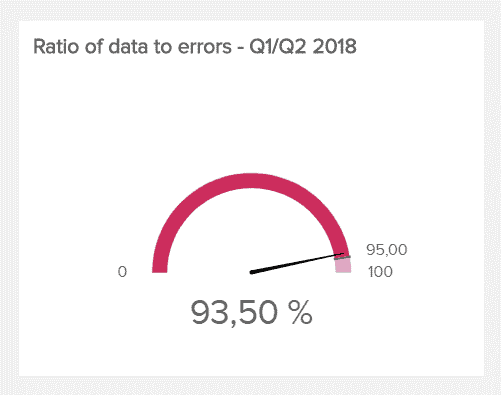
A metric commonly used to measure data accuracy is the data accuracy rate, that is, the percentage of correct data. The higher this ratio, the better, obviously. There is no average ratio or target ratio.
It all depends on your company, its size, and the volume and type of data processed. In most cases, a ratio above 85% is considered very good.
Consistency
Strictly speaking, the consistency dimension specifies whether or not two pieces of data located in two different databases conflict with each other. The point is to know whether the data scattered across your different databases is consistent, whether, for example, the information on the same individual recorded in several databases is the same.
More broadly, however, consistency does not necessarily imply accuracy. Take the example of setting up a rule that would automatically check that the sum of employees in each department does not exceed the total number of employees in the organization.
Completeness
Do you have all the data you need to draw the right conclusions? Are all your fields and attributes correctly filled in? Are there empty fields? Do you have missing data?
These are the things this criterion is meant to measure. Incomplete data can skew the results of your analyses. So this dimension is essential to take into account. An example of a data quality metric you can use to assess this criterion: the number of empty fields in a given data set.
Integrity
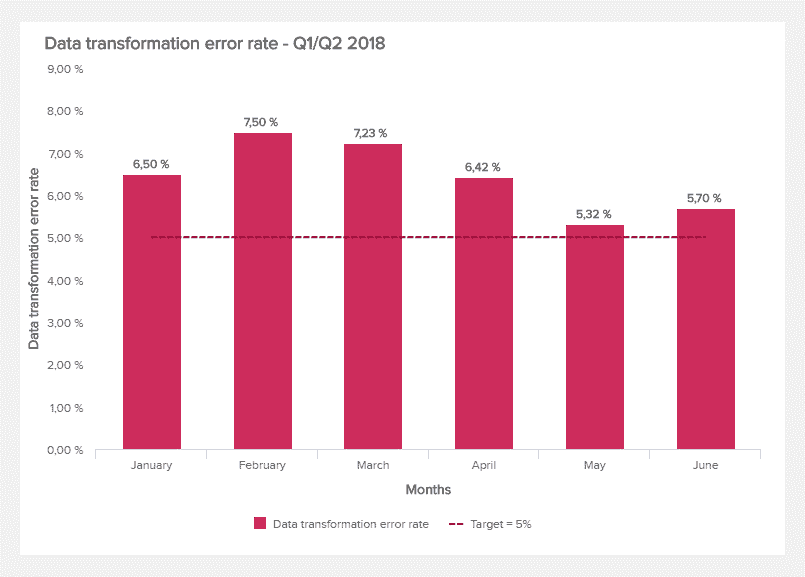
Also known as Data Validation, integrity refers to the tests and procedures designed to get rid of all the errors and anomalies found. The point is to make sure that the data is readable and correctly formatted (for example, that all dates use the DD/MM/YYYY format).
You can use the Data transformation error rate to measure the proportion of errors that occur in data transformation operations (converting from one format to another). You can track how this ratio evolves over time.
Timeliness (or freshness)
With this last dimension, the point is to make sure data is available and accessible at all times. This criterion measures the time between the moment data is requested and the moment it is actually available for use. You can use data time-to-value to measure this dimension. The goal is to reduce this time as much as possible, aiming for an ideal of immediacy.
Whatever method you use to improve the quality of your data, you will always need to measure the effectiveness of your efforts. These examples of data quality metrics let you track and assess your work. The more you measure and assess, the easier it will be to improve Data Quality.
Examples of data quality metrics you can set up
The dimensions we presented above let you measure your Data Quality and your efforts from a quantitative point of view. The data quality metrics we are now going to present will let you take a more qualitative approach in parallel. Here are a few examples:
- Satisfaction indicators, obtained through polls or surveys, which measure how satisfied your company’s employees are with the data available to them.
- Productivity indicators, such as the change in the percentage of times the data governance department detects and eliminates redundant projects or initiatives.
- Measuring risks and opportunities. For example, the profits generated thanks to data quality or the risks that materialized from using problematic data.
- Progress in competitive analysis linked to better data availability or to improvements in data quality.
3 sources of poor data quality problems
Cleaning your data, fixing the errors found, filling in missing data and checking its accuracy are all very important. But, as everywhere, prevention is better than cure, by identifying problems at their root. Fixing problems at their source will keep poor quality data from coming back up. Never forget that maintaining data quality is not a one-shot job. It is a continuous, never-ending process.
Source 1: Mergers and acquisitions
When two companies come together, whether through a merger (one entity absorbing the other) or an acquisition (one taking control of the other), the data follows the same movement and is brought into contact, or even merged. As when two people who have children from a previous relationship get together, complications can arise.
For example, it is possible, even likely, that the two companies use completely different data systems and different data collection methods. It is even possible that one of the entities has a database full of errors.
It is advisable to set up a winner-loser matrix to decide, for each data entry, which one should be considered “true”. As you might expect, this kind of matrix can turn out to be very complex and incomprehensible.
If you are facing this situation, if a merger or acquisition is about to happen, get the IT department around the table to anticipate the difficulties ahead and draw up an action plan upstream – even before signing.
Source 2: Migrating from one information system to another
For a non-technical user, it can be hard to understand the difficulties inherent in changing IT systems. Yet it is a very complex operation. The transition from one system to another can be very tricky.
Some companies have used the same database management systems for decades. For these companies, migration is often a very painful time. This is due to the technical characteristics of information systems. An IT system has three parts:
- A database (= the data).
- The rules set up and used to interpret the data
- The user interface, which determines how the data is presented to those who handle it (the users).
Each of these three aspects can create difficulties when migrating from one IT system to another. People generally focus on the structure of the data. They make sure this structure is preserved.
That is the wrong approach, because from one IT system to another, the operating rules are often very different. The result: after the migration, the data is incorrect in the eyes of users even though it may remain correct from a strictly technical point of view.
Our advice: in a migration, it is not enough for your transition team to be expert in one system or the other. They need to know both systems very well for the transition to go smoothly.
Read alsoDiscover our comparison of B2B databases.
Source 3: User errors
This is a problem we will probably never fully solve, since there will always be humans entering data and to err is human. Everyone makes typos regularly. You have to accept it and take it into account.
Even the experts in charge of data cleaning make typos! Short of turning people into infallible robots, our simplest advice is to create forms that are easy to fill in. That way, you can significantly reduce typing errors.
At a time when the volume of data used by companies is exploding, in the age of Big Data and of ever more touchpoints between the company and its customers/users, setting up a mechanism for steering data quality is a must-do project.
We hope this guide has shed light on some points and answered some of the questions you had.