Multichannel lets you increase sales pressure while staying below your targets’ tolerance threshold. Make sure, though, that you have a well-defined ICP and sales message. Otherwise, making your prospecting processes more complex will only muddy the waters.
In this article, we present 4 concrete examples of multichannel prospecting sequences to help you put it into practice. Most of the examples here lean heavily on email & phone, and fairly little on the newer, somewhat “trendy” channels. It is up to you to adapt them to your personas to take advantage of new ways of communicating & the new features that come out regularly (e.g. LinkedIn voice messages, even if they are already a bit out of fashion).
Find the right providerNeed to outsource your prospecting? Find the provider that matches your actual needs.
Find a provider
Also worth readingHow to find anyone’s (mobile) phone number?
1. Max Altschuler’s cadence (Saleshacker.com)
Cadence in multichannel prospecting is a much-debated topic, and there is no right or wrong choice. Run tests to identify the most promising results.
According to Max Altschuler, CEO of Saleshacker.com (one of the go-to references for B2B sales in the United States in 2021), here is the “ideal” cadence:
- Day 1: Email/InMail,
- Day 3: Email in the morning, phone call in the afternoon,
- Day 5: Phone call in the morning, phone call with a voicemail in the afternoon,
- Day 7: Email in the morning, phone call with a voicemail in the afternoon,
- Day 10: Email and phone call in the morning.
The number of touchpoints in your sequence is the subject of endless debate. HubSpot uses seven, and says that after nine, you hit diminishing returns.
They can even end up in spam. If you get no reply, try taking a break of three to six months before trying again.
2. close.com’s ultra-aggressive cadence
Here, the crucial step in this sequence is leaving a voicemail on the very first day. That way, on the second call, the recipient will know who you are and will be less inclined to decline the call.
- Day 1: Phone call (with voicemail) + an email,
- Day 3: Phone call,
- Day 5: LinkedIn InMail,
- Day 7: Phone call (with voicemail) + an email,
- Day 10: Email with SMS (if you have permission),
- Day 11: Phone call,
- Day 14: Phone call (with voicemail) + LinkedIn connection request with a message,
- Day 16: Email,
- Day 18: Phone call (with voicemail) + breakup email.
Also worth reading5 examples of phone call plans: the CROC method
3. g2Crowd’s cadence
g2Crowd is a software review site that has grown remarkably fast in recent years. Bear in mind that sales cycles are much longer than 14 days; the sequence below shows an interesting and fairly healthy approach to prospecting: 14 days of (very) high pressure to get a contact. Otherwise, lost.
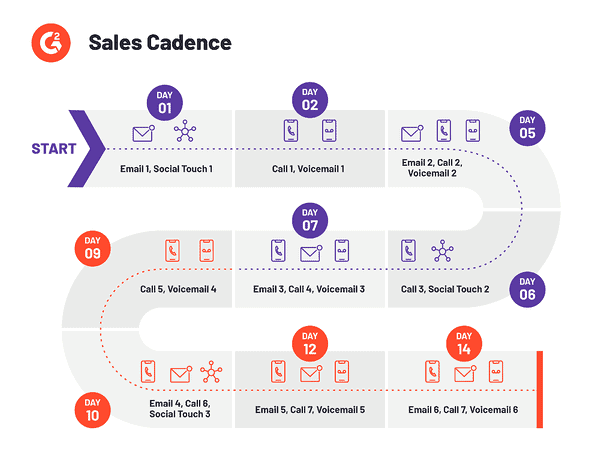
Source: G2
4. Steli Efti’s sequence (CEO @ Close.io)
When you follow up, start by doing it very frequently, then taper off over time. Here is a general schedule for planning your follow-ups:
- Day 1: 1st follow-up,
- Day 3: 2nd follow-up,
- Day 7: 3rd follow-up,
- Day 14: 4th follow-up,
- Day 28: 5th follow-up,
- Day 58: 6th follow-up,
- After day 58: once a month.
This is the follow-up email schedule Steli Efti uses.
Follow up by email or by phone?
That is THE big question when the time comes to follow up with your prospect. Is it better to do it by email, by phone or through another channel?
- By email: email is the best way to get a positive answer, because you can follow up forever without being (too) invasive!
- By phone: if you want a quick answer, the phone is the most effective way. On the other hand, it is much more intrusive, and the risk of getting an answer like “maybe” instead of “no” is much higher.
- In person: this is the “double or nothing” method. Think carefully before showing up at your prospect’s workplace. But doing it once, saying “I was in the area, so I took the opportunity to…”, can sometimes be valuable.
- By SMS: if you want a higher reply rate, SMS can be the answer. Like a phone call, SMS is fairly intrusive, so use this tactic sparingly.
- On social media: this method is still not very widespread. Retweeting, commenting, sending a LinkedIn invitation, etc. are all actions you can take to stay on your prospect’s mind.
The Salesdorado tipSometimes you might think that contacting someone who doesn’t reply in public will “force” them to answer. By commenting on a LinkedIn post, for example, or by tweeting publicly. In reality, you are taking a considerable risk, and you have extremely little chance of it working when you do that:
- A considerable risk, because someone with slightly bad intentions can humiliate you (you and your company) in public. Unless you are 1000% sure of your targeting and your hook, it will be very easy to show why your message is not relevant. And that is quite likely the reason you still haven’t had a reply.
- Extremely little chance of it working, because you are trying to make your prospect feel ashamed. Steli Efti talks about it better, but always avoid negative emotions in your communications as much as possible. They never drive action. Nobody does anything out of shame; people decide not to act instead. When you want to push a lead to take action, only positive emotions will help you.