
In business, we often think our offer perfectly matches our customer’s needs.
That’s an illusion: 8% of companies lived up to the expectations of the customers surveyed in a study by Bain – while 80% of the 362 companies that answered the survey believed they offered their customers a superior experience.
Two explanations:
The first is that in trying to grow, a company often hurts its core of loyal, profitable customers. For example, a company that raises its transaction fees to increase revenue per customer.
The second is that it is extremely hard to understand what customers really want and to keep up with their constantly changing needs. Worse, initiatives to get to know your customers better can backfire: by collecting too much data, your customers become numbers and segments rather than individuals.
In this article, we give you a few keys to building good customer relationships.
Read alsoCRM: the complete guide
What makes the customer relationship different in B2B
A B2B purchase serves to meet the needs and goals of an organization and its teams – not the individual needs of one person.
1. Many people involved in the business relationship
A B2B buying process involves several stakeholders – on the customer side as well as the vendor side.
On the supplier side, a lot of people are in contact with a customer: sales, support / CSM / Account manager, Marketing advocacy, Product research, etc.
A common piece of advice is to contact your customers to understand them well – which is a bit ironic when you know that a purchase does not involve just one person, but many different players.
2. The length of the buying process
The organizational structure of the customer company can have a big impact on the length of the process: the more stakeholders there are, the longer the process is likely to be.
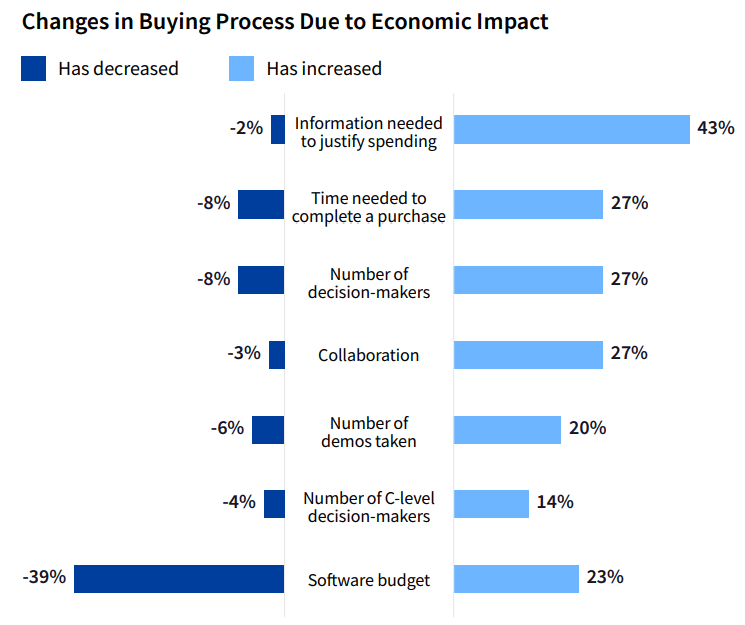
Source: TrustRadius
27% of buyers say they involve more people in the decision-making process because of the current economic climate. 14% of them say C-level decision-makers were more involved.
The customer relationship starts much earlier, as early as the evaluation phase.
3. The products and services sold are more complex
In B2B, the products sold are more complex. Customer requests are more complex, and at the same time customers know a lot more.
On the vendor side, this means the company has to be able to handle that complexity.
Context matters all the more: you cannot waste the customer’s time with standard questionnaires. Ideally, you should take on a coaching stance: the support staff presumably knows the software or service better, but knows the subject less well than the person contacting them.
The 9 best practices for your B2B customer relationships
1. Identify your best customers
Where are your most profitable customers, and how can you deepen your relationship with them? Where are your problem customers? The chart shows customers’ level of advocacy, measured by Net Promoter Score (NPS), on the horizontal axis, and customer profitability on the vertical axis.
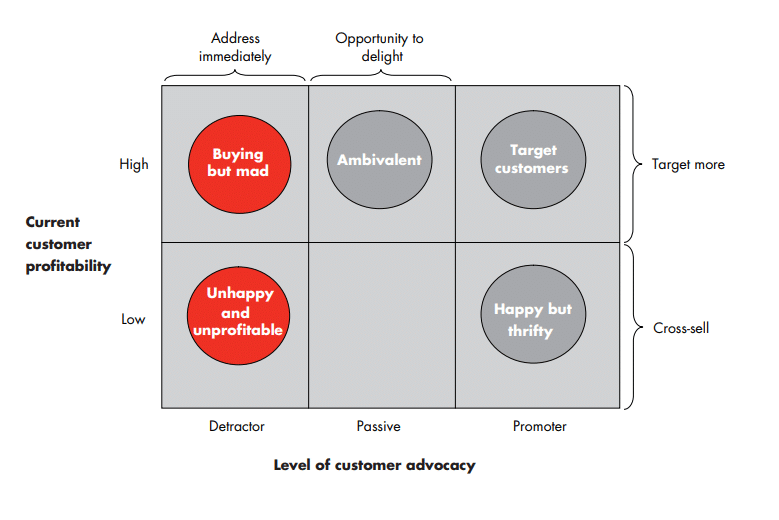
Source: Bain
- Top right, the company’s core target: you want to keep them, find more like them and explore the additional products or services they need. They are your main source of innovation, so listen to them.
- Top left are the “false profits”, the customers who are “buying but mad”: they are profitable right now but in fact only stay because they have no other choice. You need to deal with this group quickly, for example by steering them toward the right product range – otherwise, they can turn the market against you.
- Bottom left, the “unhappy and unprofitable”, meaning the buyers who are not satisfied anyway. It makes sense to help them migrate to other providers.
To identify at-risk customers, a customer success tool can be a big help.
2. Value all customer feedback
To deliver an effective service, two practices:
The first is a matter of attitude: take every interaction into account. While data mining and CRM tools can help you gauge what customers think, you need to pay particular attention to their recommendations, meaning what they say about you to others.
The second practice is organizational. The best companies deliver targeted value propositions throughout the customer experience. The idea behind it is that customers don’t really care which function of a company meets their needs or how cost-effective it is – they just want the promises to be kept.
Read alsoTop 10 customer loyalty tools
3. Listen to unhappy customers too
Even if complaints take more time and effort to resolve, you need to listen to them as much as to the opinions of satisfied customers. Handling a complaint brilliantly is also a chance to win the customer’s loyalty – even more than if they had never complained.
For a company, it is an opportunity to build a more competitive brand with a more compelling customer experience.
Except that complaint handling has to be perfect, which is not always easy because a customer who complains already has a negative opinion of the company. The challenge is big, and so is the reward.
The problem is that plenty of unhappy customers choose not to complain. Over the last three decades, the American Customer Satisfaction Index (ACSI) shows that 12.8% of customers formally complained to companies, but that in reality 30% of customers complained more informally on social media and then chose substitute products.
Conclusion: it is often better for customers to complain than not to complain (and simply leave), if the company can handle the complaint satisfactorily without draining its resources.

For example, EarthLink has a team of specialized representatives who step in when needed with customers on its self-service website. They can start a chat with a customer who has spent more than 90 seconds in the knowledge center or who has clicked on the “Contact us” link. This program cut calls by 8%.
4. Master your customer communications
The idea is that every customer communication should be adapted to the customer’s stage in the sales journey. This notably means creating cross-functional teams to deliver a compelling experience:
- You need to identify your important customers so you can offer them an experience suited to their needs and develop feedback loops.
- At a more macro level, you need to align your goals, your metrics, your systems and your organizational structure to become a customer-centric organization.
It sounds simple, but striking a balance between customer satisfaction and operational efficiency is sometimes complex. To solve this problem, there is a trend called the “1/3-1/3-1/3” rule:
- About a third of companies’ operational effectiveness measures have no consequences for customers and can even lead to revenue opportunities.
- The second third, on the contrary, leads to actions that harm the customer experience and therefore to a drop in revenue.
- The last third requires debate between the different functions to know whether these measures can be applied without tipping the balance between costs and customers.
5. Listen, and show it
Customers want to be able to buy the product they need when and where it suits them. Faced with these increasingly complex demands, where the buying experience is part of the journey, companies have to listen to their customers and be agile.
A company that can create a competitive mix of speed, quality, cost and flexibility can thrive in its marketing ecosystem and align more effectively with its customers’ goals. And so deliver an exceptional customer experience.
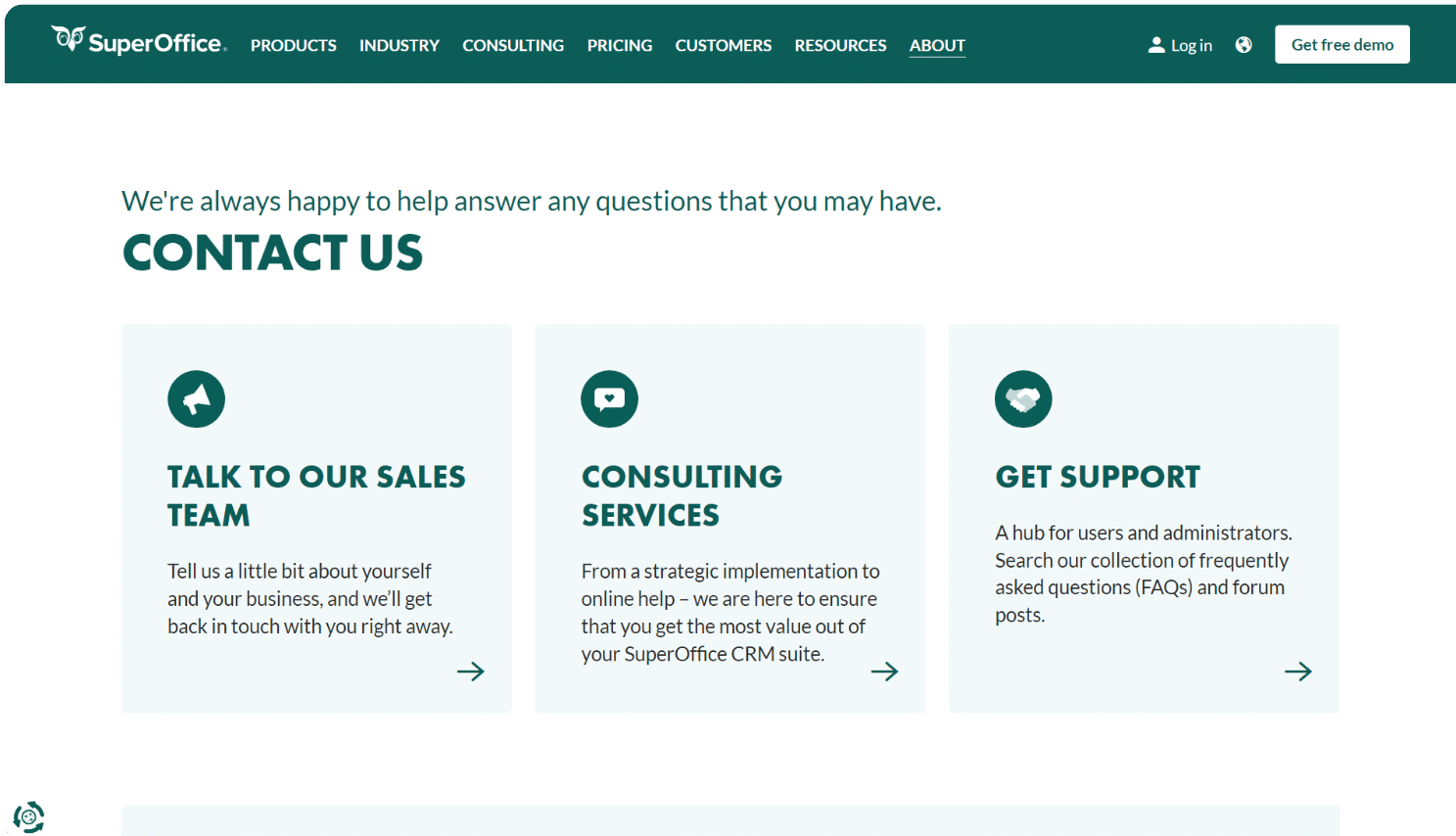
From a more micro point of view, the best companies offer customer service that is exceptional too. For example, the CRM SuperOffice offers full customer service that it highlights on its site, with an email address clearly visible on the home page of its website, which makes getting in touch very easy. It also adds an element of trust, because the company shows it is not afraid to listen to its customers.
Read alsoGlossary of sales techniques
6. Institutionalize a customer-first culture
High-performing companies recognize that understanding what their customers really want and delivering it to them is not a marginal exercise but a fundamental part of their business strategy.
On top of designing and delivering the right propositions, they also have to develop the capabilities to do it on a lasting basis. To do that, they invest heavily in setting up processes aimed at keeping a real dialogue with their most important customers.
It is not about collecting masses of data, but rather about getting real customer insight and timely feedback – by putting formal procedures in place to stay on top of changes in customer needs.
For example, have your customers vote on improvements to your products. Train your teams on the complaints that need particular attention.
For this, NPS is your ally: it is a simple number that rallies your teams around a shared goal.
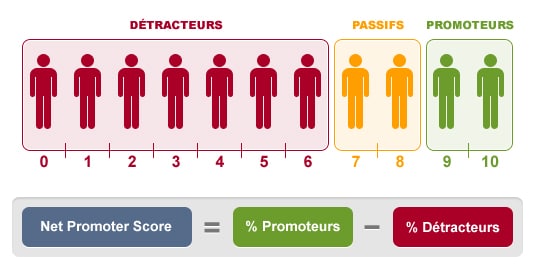
Creating repeatable processes is not easy and often requires significant investment in information technology, training and change management programs, as well as a thorough review of the company’s mission, vision and values. Above all, it takes committed leaders who focus on keeping the promises the company makes.
7. Start building the customer relationship early
You need to include all stakeholders from the decision and evaluation phase onward.
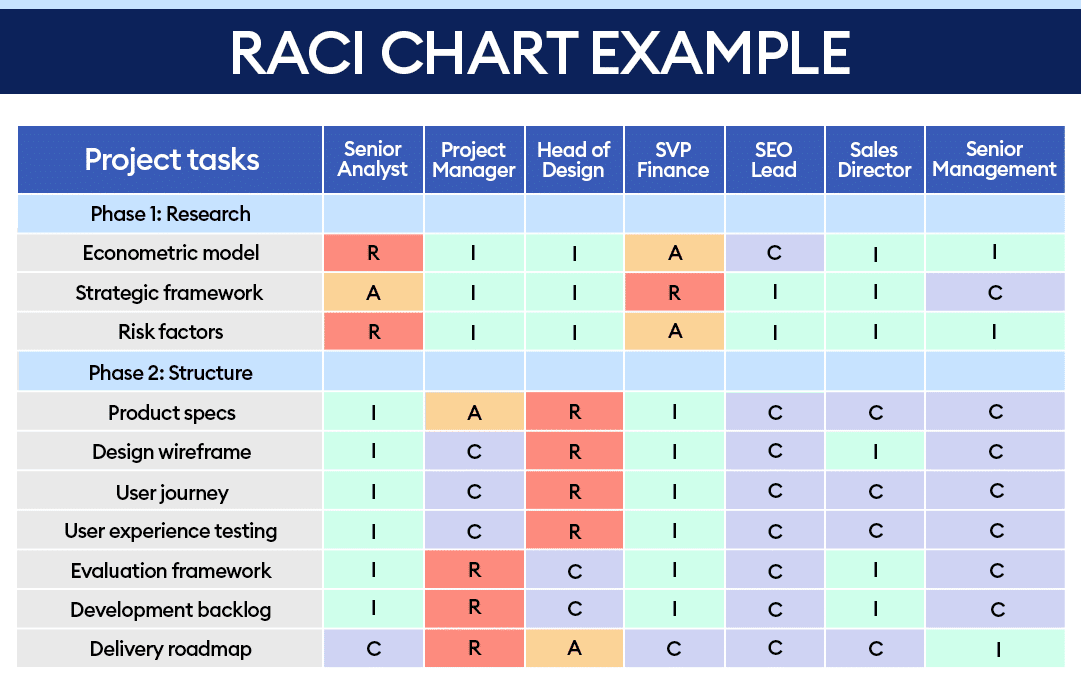
To do this, you need to map the different personas (decision-maker, influencer, user and detractor). For example, with the RACI matrix, which defines everyone’s role:
- Responsible – takes care of getting the project done properly
- Accountable (Approver) – checks that tasks are completed
- Consulted – advises throughout the project
- Informed – is kept informed of how the project is going
This matrix makes it very clear who all the stakeholders in the buying process are, as well as the different stages of that process.
Source: Forbes
For an enterprise sale, you need to identify and involve three very specific types of contacts in your sales cycle:
- The decision-makers – the ones who give the final go-ahead for signing the deal
- The managers, including the project owners – mandated by the decision-makers to find a solution to a specific problem. They are your main contacts.
- The operational staff who will be the end users – they witness the problem to be solved. They can give you the weapons and arguments to convince the project owners.
You may interact with other types of profiles, such as support functions, who are consulted for decision-making: for example, the purchasing department or the legal department.
8. Train the teams in contact with customers
As we said, the B2B buying process is increasingly complex. Hence the value of training your teams well.
They need to take on a coaching stance toward customers, assuming they know more about their product than the customer, but know the subject less well than a potential customer who has done a lot of research.
You also need to train them to take customers’ emotions into account: for example, the customer does not trust the representative enough, does not like the answer given, or feels the rep is hiding behind general company policy. In those cases, the customer will call back and waste your teams’ time.
Train your representatives to listen for clues about the customer’s personality type and to assess them so they can adapt their answers accordingly.
Study your call transcripts to spot the words that tend to trigger negative reactions: for example, try to replace all negative phrasing (“I must not”, “you can’t”, etc.). Instead of saying “We don’t have that item in stock”, a representative can explain “We will have stock available for that item in two weeks”.
Beyond assessing the profile, train your representatives to use all the information they can get about a customer.
9. Don’t overdo it
It feels as if your customers will be more loyal if you manage to go beyond their expectations. But in the end, this effect is only very marginal.
This belief comes from the fact that customer service is almost always assessed in light of customer satisfaction. Yet while customer service efforts to exceed customer expectations are often costly and time-consuming, they do not directly lead to higher loyalty.
Worse, while good customer service cannot really increase loyalty, bad customer service can destroy it completely. Customers are more likely to be disloyal than loyal.
To illustrate, picture two pies, one representing the things that drive loyalty and the other disloyalty. The loyalty pie is made up of slices such as product quality and brand – the service slice is fairly small. On the other hand, service makes up most of the disloyalty pie.
Conclusion: people buy from a company because it offers quality products, excellent value for money or a compelling brand. They leave it when it does not offer good customer service. Invest in quality customer service that meets your customers’ expectations, without overdoing it, because the loyalty gains are only marginal.