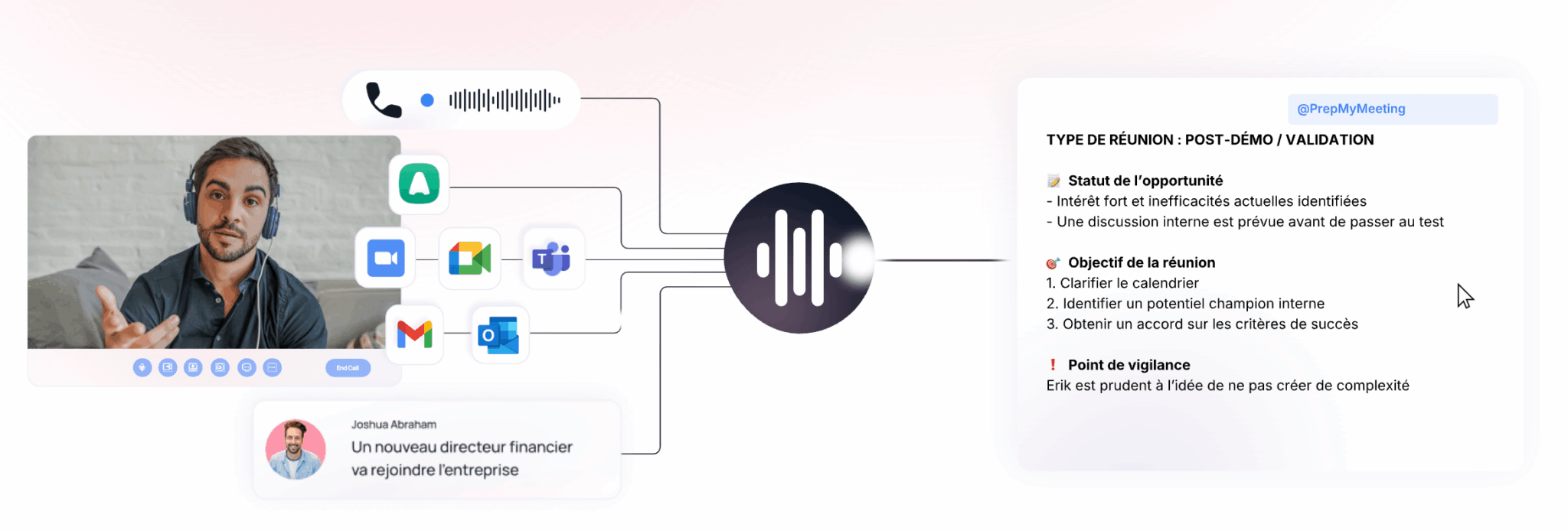
Modjo listens to all your sales conversations (calls, video meetings, emails) and takes care of everything that comes after the meeting: filling in the CRM for you, summarizing the exchange, surfacing the buying or risk signals your reps let slip.
It is a platform that has established itself as a European benchmark in this niche, with customers such as Qonto, Doctolib, Pennylane and Bouygues Telecom.
Call transcription, now commonplace, is only the raw material. The real value lies in what the AI agents do with it next. On pricing, however, the tool plays in a completely different league from the €20-a-month notetakers.
What exactly is Modjo? (and what it is not)
In its early years, Modjo built itself as the French answer to Gong: a conversation intelligence platform that records, transcribes and analyzes sales calls to draw lessons from them. Founded in 2020 by Paul Berloty and Matthieu de la Fournière, the company quickly made its mark in the French SaaS ecosystem.
But the Modjo of 2026 no longer sells itself that way. The market has changed: transcription and meeting summaries have become commodities, available everywhere for a few euros. So Modjo moved one notch up and repositioned as an AI agent platform for sales teams, with a promise summed up in its official mission: “restore the art of selling” by removing the administrative friction that keeps reps from selling.
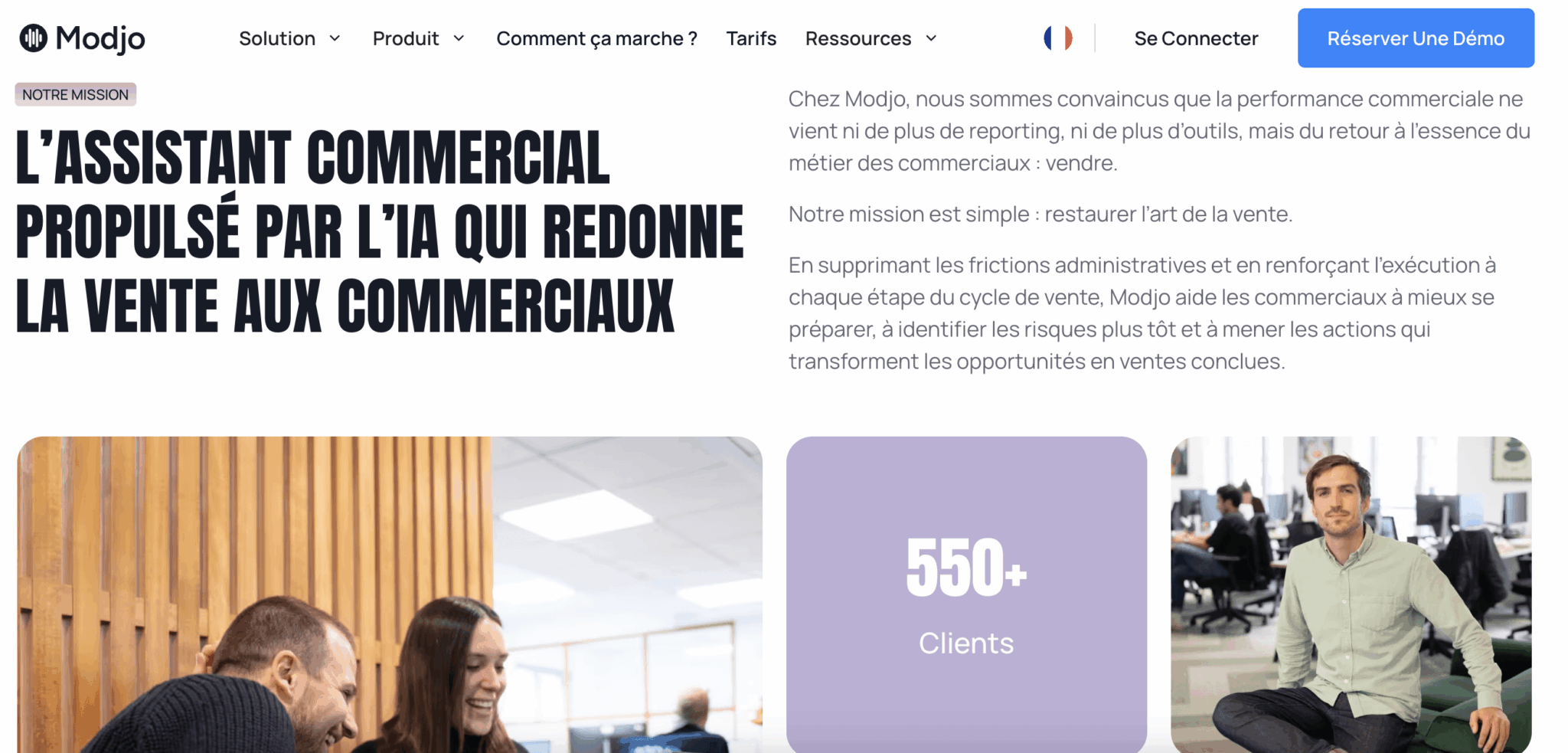
The platform captures all your sales interactions (calls, video meetings, emails), analyzes them, then acts: it fills in the CRM, prepares meetings, drafts follow-ups and surfaces the signals that matter. All of this is claimed by 600 customer companies and 22,000 sales reps, with a who’s who of French tech on the trophy wall: Qonto, Doctolib, Pennylane, Payfit and Spendesk.
What Modjo is notModjo is not a souped-up notetaker, nor a CRM, nor a tool for freelancers. The vendor itself positions its solution as optimal from 3 sales reps upward. If all you need is transcription and meeting notes, a tool like Fathom will cost you 5 to 10 times less.
Modjo’s key features
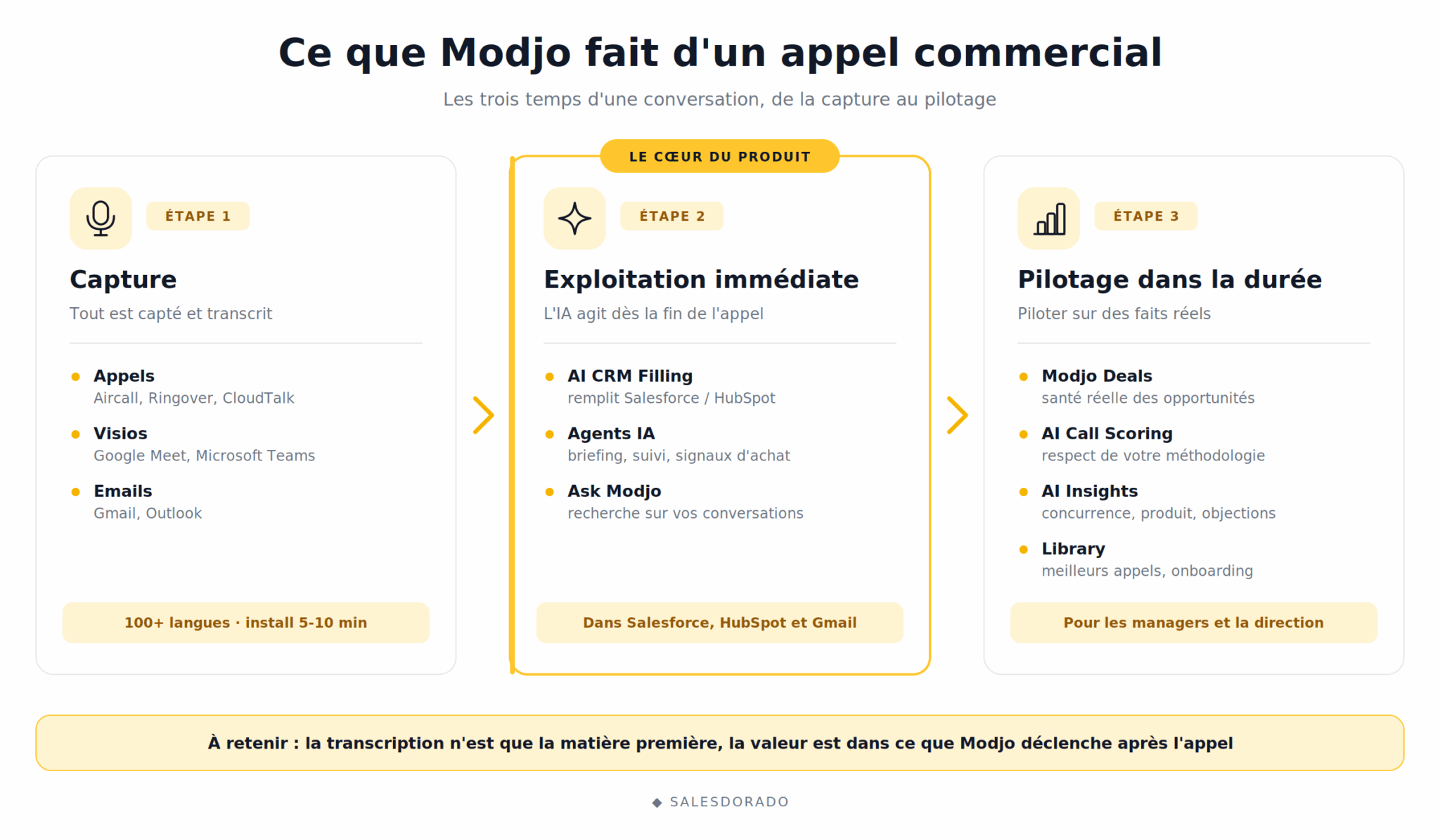
Rather than run through the marketing catalog, we organized the analysis around the life cycle of a sales conversation: capture, then immediate use, and finally long-term management.
Capture: calls, video meetings and emails
It all starts with collection. Modjo plugs into your telephony (Aircall, Ringover, CloudTalk, Diabolocom and a few others) and sends a recording bot, the Modjo Recorder, into your Google Meet, Microsoft Teams and Zoom meetings. The bot shows up as a visible participant, which incidentally settles the question of the other parties’ consent. Emails come in via Gmail or Outlook.
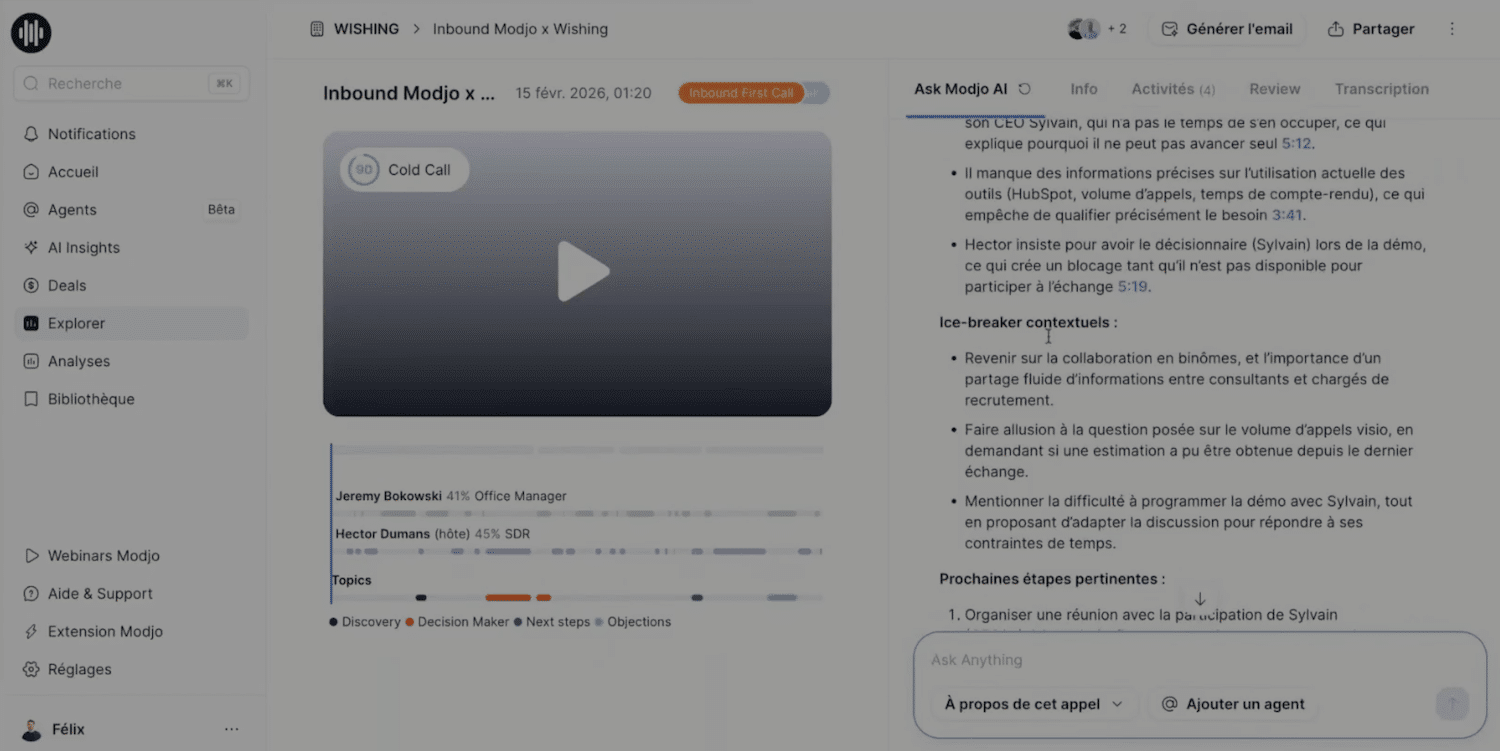
Transcription covers more than 100 languages, with a claimed accuracy of 95% in French. In practice, it is very good on clean calls but somewhat shakier with strong accents, fast speakers or poor-quality lines. Nothing that rules it out, but don’t expect a perfect verbatim on every call.
If you already use Aircall or an equivalent, setup on the rep’s side takes 5 to 10 minutes. It is one of the fastest deployments in the category.
AI CRM Filling: the real reason to buy Modjo
We’ll say it plainly: this is the feature that justifies the budget.
The principle: after each call, the AI extracts the key information from the conversation and feeds it straight into the fields of your CRM. Not just a summary pasted into a note, but structured filling of any field, standard or custom, on any object (account, contact, opportunity, custom objects).
Configuration relies on templates: for each field, the manager or admin writes a prompt (“extract the budget mentioned and its constraints”, “identify the economic buyer”), tests it on real calls, then chooses whether the data goes into the CRM automatically or goes through a validation by the rep. A library of pre-tested prompts speeds up the rollout.
The results at customers who have structured the approach are spectacular:
- PlayPlay automatically fills 90% of the fields on its Salesforce qualification record, and the rep only has to check it in 2 minutes.
- Payplug, for its part, gained 10 points of conversion rate (from 24% to 34%) by combining automatic HubSpot filling, opportunity scoring and standardized deal reviews.
Warning: Salesforce and HubSpot onlyAI CRM Filling only works with Salesforce and HubSpot. Modjo does integrate with Microsoft Dynamics or Pipedrive to sync calls, but without automatic field filling. If you are on another CRM, the tool’s most differentiating feature is out of your reach: factor this in very early in your thinking.
AI agents and Ask Modjo
This is the most recent layer of the platform. Modjo offers ready-to-use agents that run in one click to carry out a range of tasks: a full deal briefing before a meeting, a plan for next steps, a follow-up email drafted from the conversation, detection of churn signals or cross-sell opportunities. You can also create your own agents, test them on real accounts before rolling them out and even enrich them with web search.
Alongside the agents, Ask Modjo works like a ChatGPT plugged into the full history of your sales conversations: “where does the Silverline deal stand?”, “which objections keep coming up on this account?”, “what did the customer say about our competitor?”. Queries work on a single deal or across the whole portfolio.
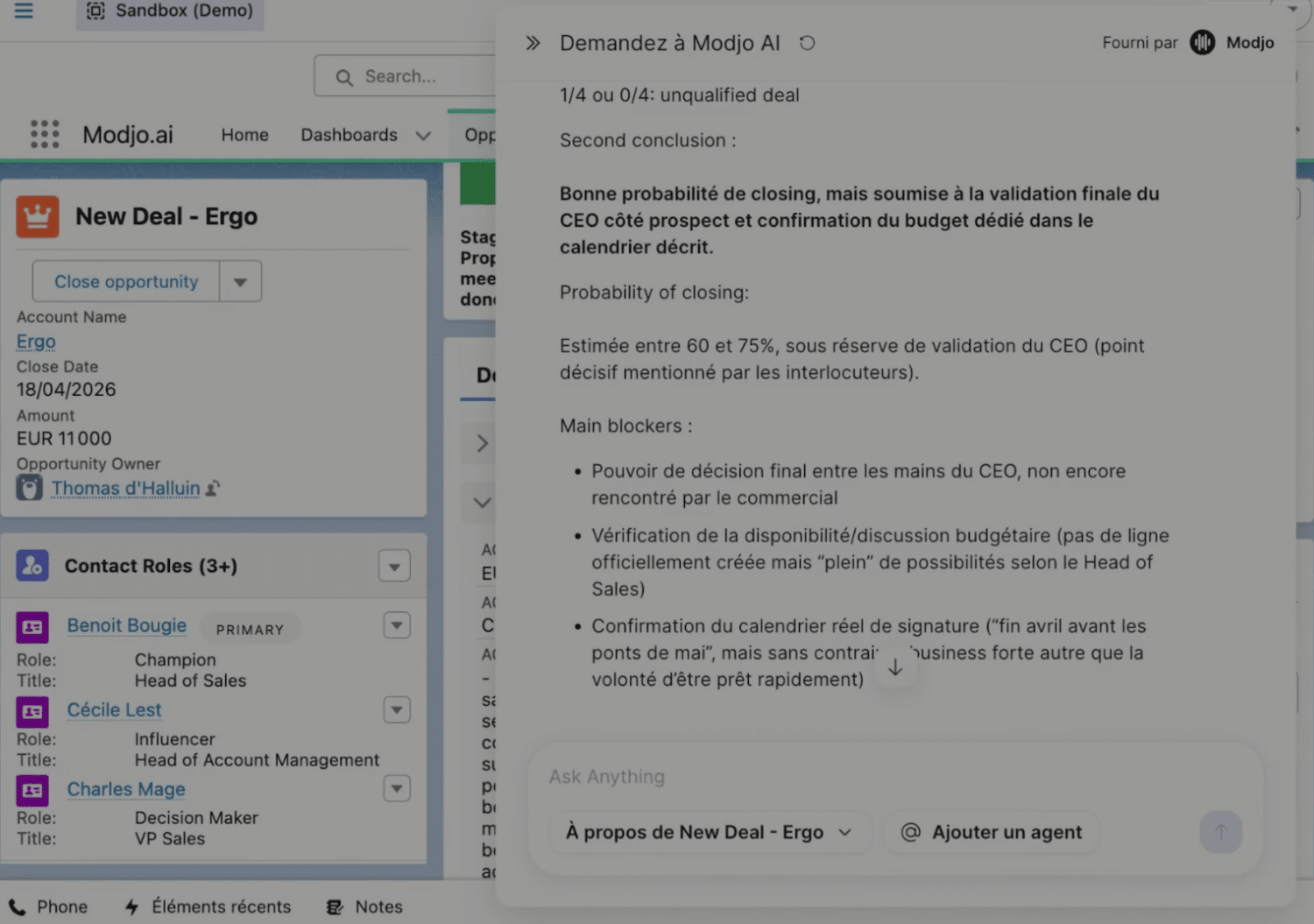
These capabilities are available directly in Salesforce, HubSpot and Gmail, without switching tabs. For Ops teams, a full API and an MCP server let you go further and plug Modjo data into your own workflows. We detail this kind of architecture in our article on AI use cases in B2B sales.
Management: Modjo Deals, Call Scoring and AI Insights
The third layer is aimed at managers and sales leadership:
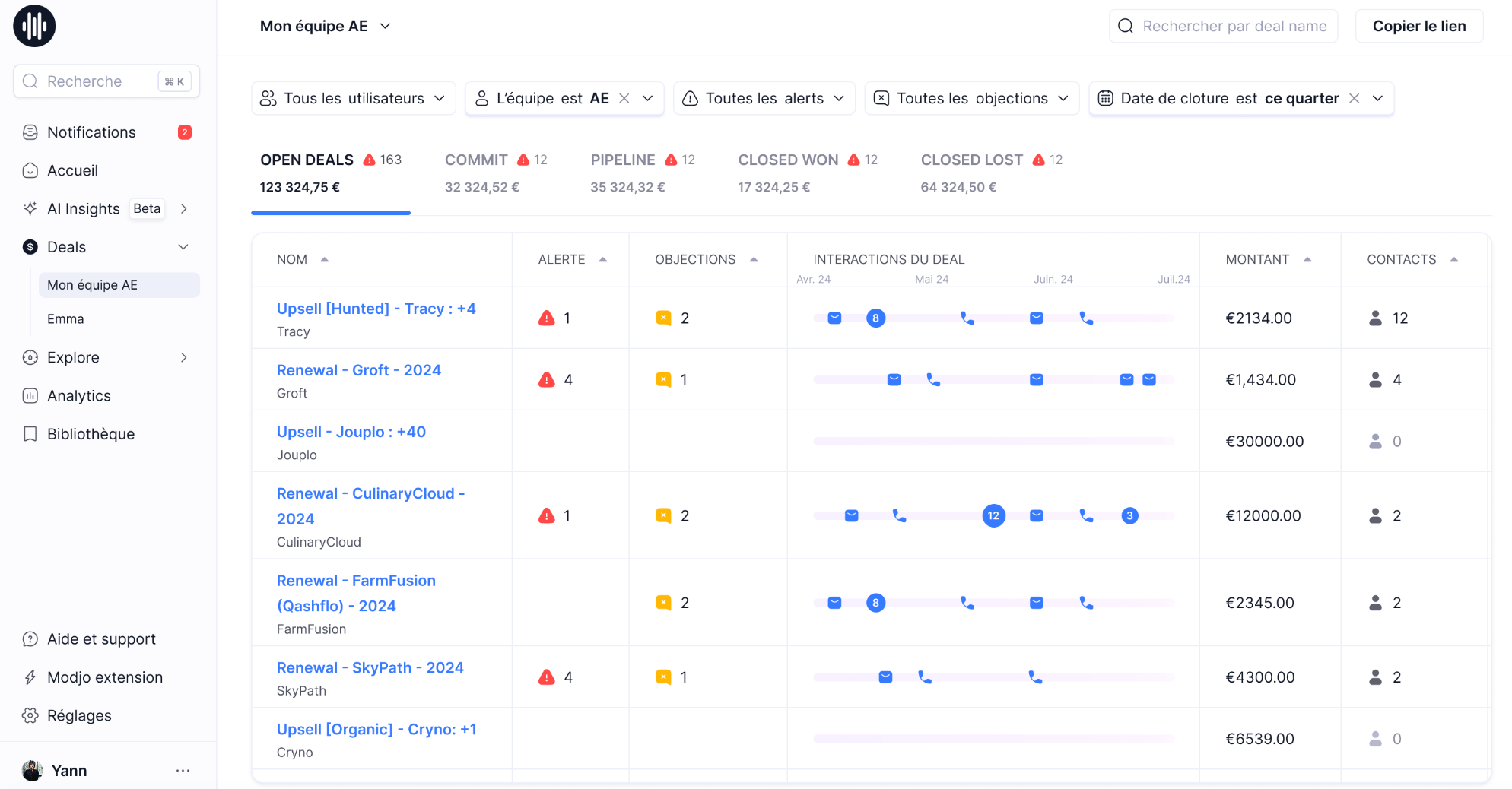
- Modjo Deals analyzes all interactions to give a view of the real health of each opportunity: positive signals, risks, next steps. It is a valuable complement to the self-reported CRM pipeline and a good lever to make your sales forecasts more reliable.
- AI Call Scoring automatically checks whether your reps apply your sales methodology on their calls and highlights coaching areas. Reps can also self-assess right after each call.
- AI Insights aggregates every month what your customers really say across three dimensions: the competition, your product and the objections raised. It is a gold mine for product and marketing teams, who finally get access to the unfiltered voice of the customer.
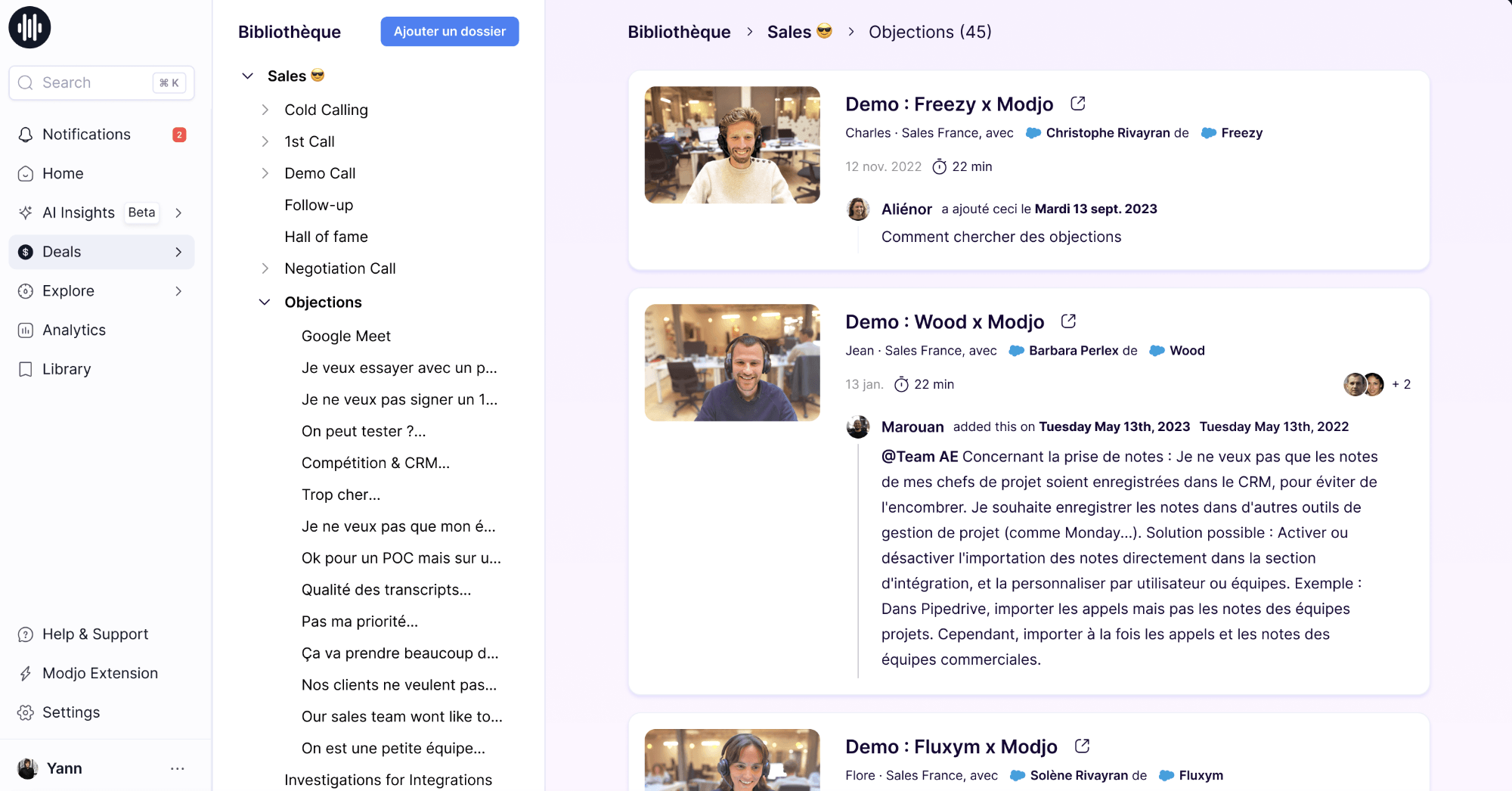
- The Library centralizes the team’s best calls. It is the tool that transforms onboarding of new sales reps: at Doctolib, ramp-up time was cut in half and new hires sign 22% more in their first two months.
Salesdorado’s takeModjo’s depth comes from configuration. Everything requires a manager or a Sales Ops to take serious ownership of the tool during the first weeks. Without that work, you will pay for a sales execution platform and use it as a tape recorder. That is the leading cause of disappointment with this type of tool, well ahead of the limits of the product itself. Our sales enablement guide will help you structure the approach.
Modjo pricing: how much does it really cost?
This is the main friction: Modjo publishes no prices. Pricing is quote-based, after a form and a demo. It is frustrating, but the cost model is actually fairly simple to understand, and rather well designed.
| What you need to know | The Modjo model |
|---|---|
| Paid licenses | Only recording licenses, meaning the users whose calls are captured and analyzed (your sales reps, your CSMs). |
| Listening licenses | Unlimited and free. Managers, leadership, product or marketing teams access the platform at no extra cost. |
| What’s included | All features (no modules to stack), a structured 30-day onboarding and a dedicated account manager. |
| Commitment | Annual contract. No monthly plan without commitment. |
| Free trial | No. Personalized demo only. |
| Ballpark | Prices observed on the market are around a hundred euros per recording license per month, with volume discounts. Expect 20 to 30% less than Gong for a comparable scope. |
Let’s run the numbers on a typical case: a team of 5 sales reps, 2 managers and 1 executive. Only the 5 reps need a recording license, the other 3 get free listening licenses. Based on the feedback we have gathered on the subject, the budget is around 6,000 euros per year, onboarding and all features included.
Set against the claimed time savings (2 to 4 hours per rep per week, a figure consistent with feedback from customers such as Pennylane or PlayPlay), the equation largely holds up, provided your reps actually spend their days in meetings. With 3 calls a week, the investment will never pay for itself.
Salesdorado’s adviceCome to the demo with your numbers: number of users to record, monthly call volume, CRM and telephony in use. Ask two awkward questions: does the price change if we add licenses during the year? What happens to our data if we leave? Modjo contractually commits to deleting data within 30 days after the end of the contract, so get it confirmed in writing.
Modjo vs Gong vs notetakers: how to decide?
The head-to-head Modjo versus Gong comparison misses the real point. In 2026, the choice plays out on three levels, and the first decision is to identify yours:
- Level 1: meeting notes. Your need stops at transcription, summaries and a few shared clips? A notetaker such as Fathom, tl;dv or your CRM’s built-in one is enough, for 0 to 30 euros per user. Buying Modjo for this use is like paying a team of consultants to file your invoices.
- Level 2: sales execution. This is Modjo’s turf. You want a reliable CRM without manual data entry, signals detected across the whole portfolio and structured coaching. If your team has anywhere from 3 to over 100 reps, works on HubSpot or Salesforce and sells in Europe, Modjo is probably the best choice on the market. The sovereignty argument carries a lot of weight, with data hosted in Paris, native GDPR compliance and a contract in French with a French vendor. For regulated sectors or buying committees sensitive to the US Cloud Act, it is often the criterion that tips the decision, exactly like Yousign versus DocuSign in e-signature.
- Level 3: enterprise revenue intelligence. Gong stays ahead on advanced forecasting, multichannel engagement (Gong Engage) and analytical depth for very large international organizations. On the other hand, the entry ticket is much higher, the implementation heavier and the support American-style.
Our reading: Modjo’s relevance zone covers the vast majority of French sales teams asking the question. Gong is justified in less than 1% of cases, notetakers in the rest, provided you accept to keep filling in your CRM by hand.