Salesforce Marketing Cloud is the all-in-one, omnichannel marketing platform developed by Salesforce, the global leader of the CRM market. No doubt about it, it is one of the most sophisticated solutions on the market. Salesforce Marketing Cloud is built around two functional pillars: the campaign manager (Email Studio, Mobile Studio…) and the Journey Builder, designed to create personalized customer journeys (marketing automation).
Given its pricing, Salesforce Marketing Cloud is aimed mostly at large companies, even though Salesforce has thought about SMBs and developed a €25 per user per month offer that theoretically gives access to Marketing Cloud features (it will hardly be discussed in this article).
Marketing Cloud comes in two main versions: the B2C version, “Engagement”, and the B2B version, called “Account Engagement”, which is none other than Pardot.
In this article, discover the key things to know about Salesforce Marketing Cloud and our detailed review of the platform.
Discover Salesforce Marketing CloudAccess the official Salesforce Marketing Cloud demo and explore the main features of Salesforce’s all-in-one marketing platform.
Overview of Salesforce Marketing Cloud
Salesforce has a fairly dense product lineup that is hard for a newcomer to understand. To place Salesforce Marketing Cloud properly, remember that Salesforce’s core product is Sales Cloud, a B2B CRM that manages prospect interactions and the sales cycle. Salesforce has gradually expanded its offering, developing in particular:
- Customer service software: Service Cloud.
- Online sales management software: Commerce Cloud.
- Business Intelligence software: Tableau (bought by Salesforce for 15 billion dollars in 2019)
- A collaboration tool: Slack (bought by Salesforce in 2020 for the modest sum of 27 billion dollars).
- A customer data management platform (Customer Data Platform): Data Cloud, renamed Data 360 in 2025.
- An omnichannel marketing platform: Marketing Cloud.
The list is long, and yet it does not sum up Salesforce’s offering, which includes other products not worth mentioning here. Salesforce is not a piece of software, it is an ecosystem, a complete and integrated suite that covers many needs. The different products connect with each other very well.
Marketing Cloud is therefore the platform Salesforce offers to manage relationship and promotional marketing across every channel: email, SMS, push notifications, social networks, website, display advertising, internet of things, etc. It is an omnichannel, all-in-one marketing platform (campaign management, marketing automation and reporting).
But things would be too simple if we stopped there. Marketing Cloud is actually made up of three distinct products:
- Marketing Cloud Engagement (formerly ExactTarget), the B2C marketing platform used to orchestrate marketing campaigns and scenarios across the entire customer journey.
- Marketing Cloud Account Engagement (formerly Pardot), Salesforce’s B2B marketing platform, designed to run lead generation and nurturing campaigns and scenarios.
- Marketing Cloud Personalization (formerly “Interaction Studio”), the most complete and also the most expensive product, with advanced features for product recommendations and real-time web personalization. Marketing Cloud Personalization lets you tap the full potential of customer data and AI.
Watch outWhen people say “Marketing Cloud” without further detail, they usually mean Marketing Cloud Engagement. To refer to the B2B version, many professionals still say “Pardot”.
Here is a summary diagram from Salesforceben, an excellent blog dedicated to Salesforce:
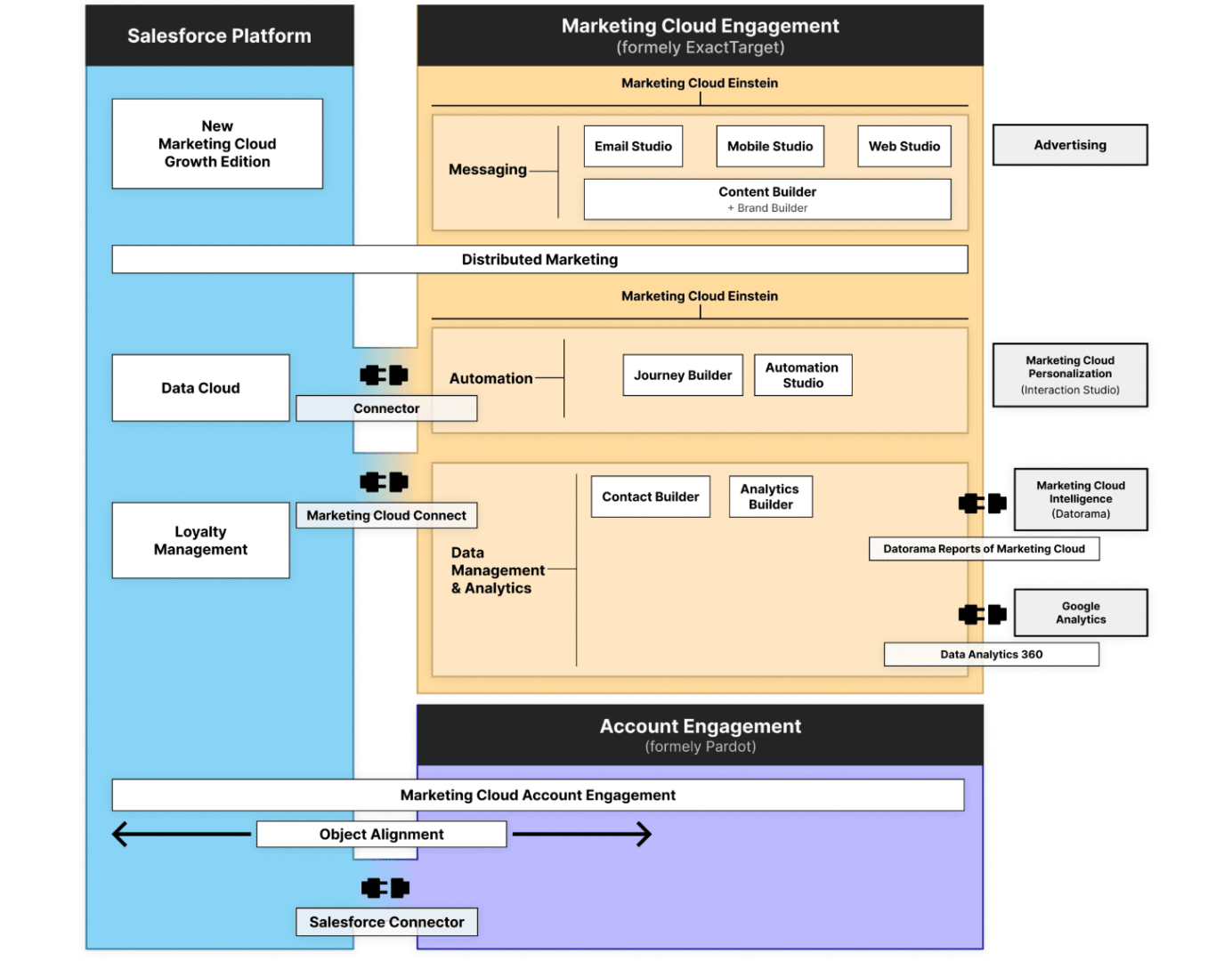
If you struggle to understand the subtleties of this diagram, that is normal. It is less Salesforceben’s fault than Salesforce’s. Their offering is objectively hard to decipher. Complex offering, complex diagram. Here are the key points to remember:
- Salesforce Marketing Cloud Engagement, the B2C marketing platform, includes three main functional building blocks:
- A campaign manager to edit your marketing campaigns on every digital channel: email, SMS, push, web, etc.
- A Journey Builder to create marketing automation scenarios. For example: orchestrating a sequence of actions and messages to follow up on abandoned carts.
- A customer data analysis and management tool to manage your contact lists and customer segments, and to analyze the performance of your campaigns and marketing automation scenarios.
- Below this diagram sits Salesforce Account Engagement, the platform to manage and automate B2B marketing: lead generation, lead nurturing, sales follow-ups, etc. The diagram clearly shows that Marketing Cloud Engagement and Account Engagement are two fundamentally distinct products.
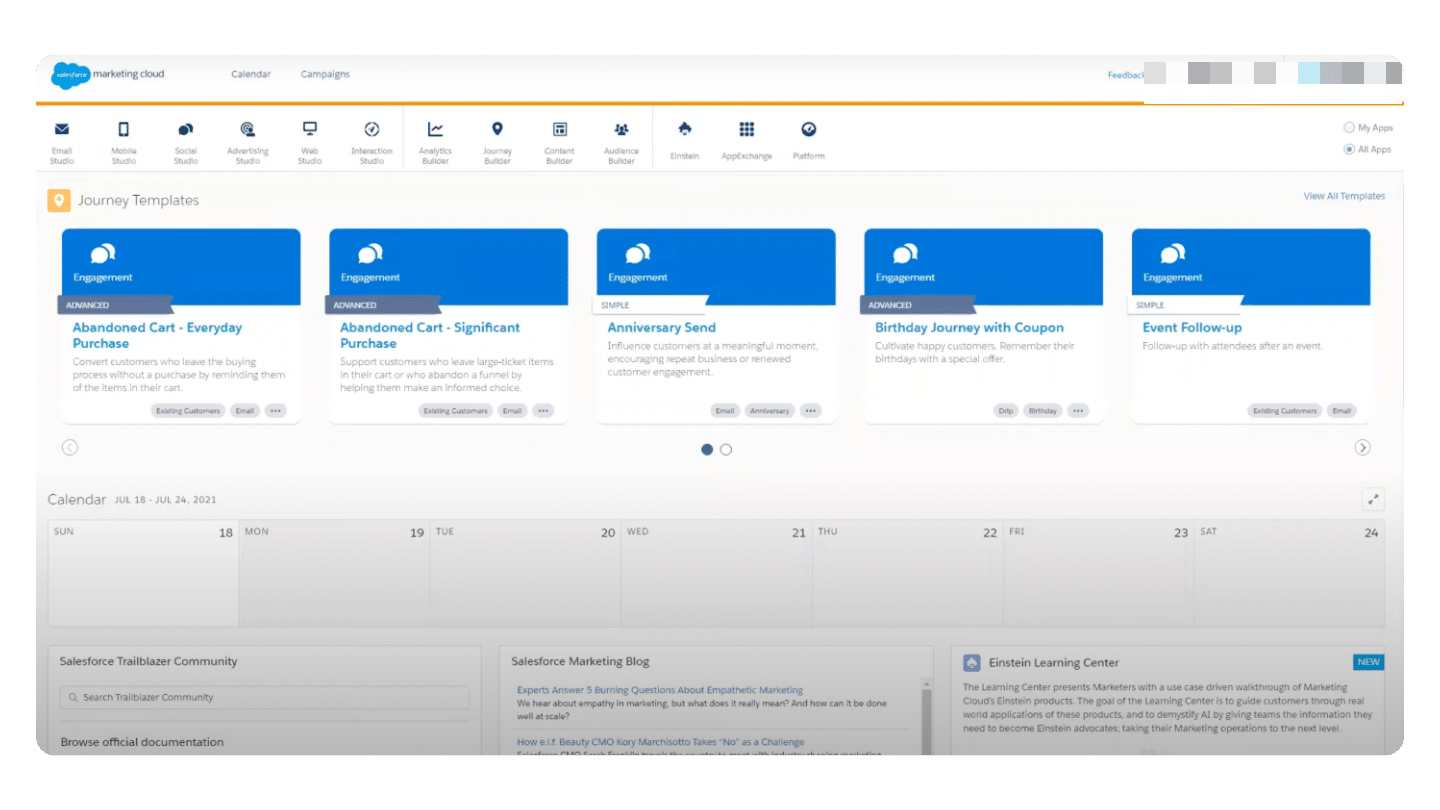
Salesforce Marketing Cloud Engagement can plug into other products of the Salesforce suite, notably Data Cloud (Salesforce’s CDP) and Loyalty Management, which manages loyalty programs.
This article is mostly about Salesforce Marketing Cloud Engagement. But it is impossible not to talk about Salesforce Account Engagement, which will certainly interest Salesdorado readers.
Contact management in Salesforce Marketing Cloud
Salesforce Marketing Cloud offers advanced contact and list management features. Salesforce uses a “relational” data model: all the data on your customers (at least, the data integrated into the platform) is attached to contacts and organized in a set of linked tables that store contact information, attributes and events. That is the technical explanation. As a user, you have access to the list of all contacts, which you can filter and query.
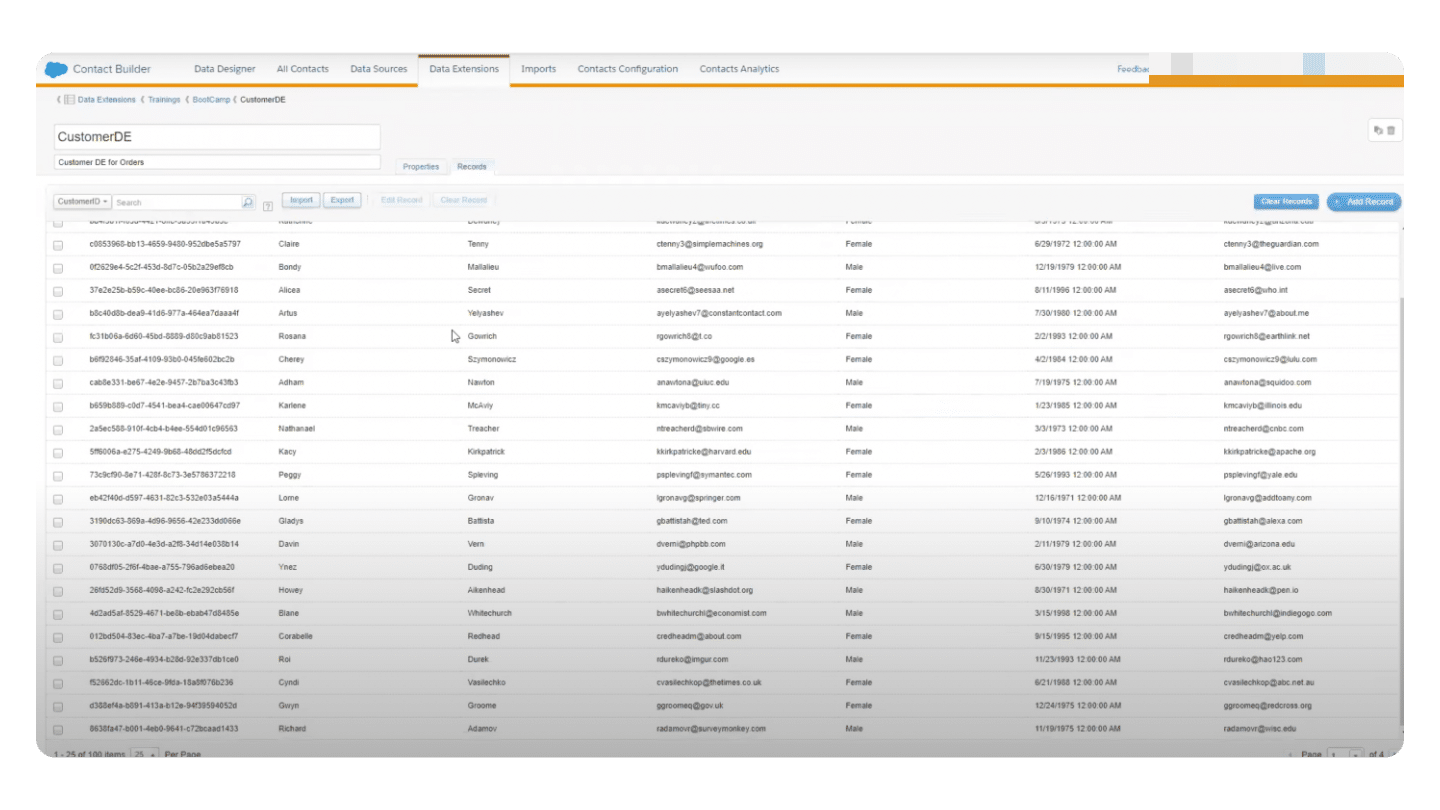
It is from this master table that you build your lists, segments and audiences to target marketing campaigns and scenarios. You can indeed create groups of contacts based on criteria that can be socio-demographic, behavioral, transactional… Beyond static contact lists, you can create dynamic segments updated in real time based on customer behavior or customer lifecycle stages (for example: by making a given purchase, a customer can move from one segment to another automatically).
Salesforce Marketing Cloud lets you import your contacts manually (file import) or dynamically (by setting up data flows between your data sources and Marketing Cloud).
In Salesforce Marketing Cloud, managing contacts, lists and segments is both (relatively) simple and complete.
Marketing campaign management (emails, mobile…)
Salesforce Marketing Cloud lets you design, edit and schedule your marketing campaigns. The basic Salesforce Marketing Cloud plan only gives access to the email campaign manager. To run campaigns on other channels such as SMS, push or WhatsApp, you need to subscribe to the higher plan (more on pricing at the end of the article).
No big surprise, the Email Studio is very good. It gives access to loads of customizable email templates. If you prefer, you can also import your own email templates or build them from scratch in Marketing Cloud. Salesforce Marketing Cloud offers a 100% no-code visual editor based on drag & drop: you can add any element with a simple drag and drop from the options in the left-hand menu.
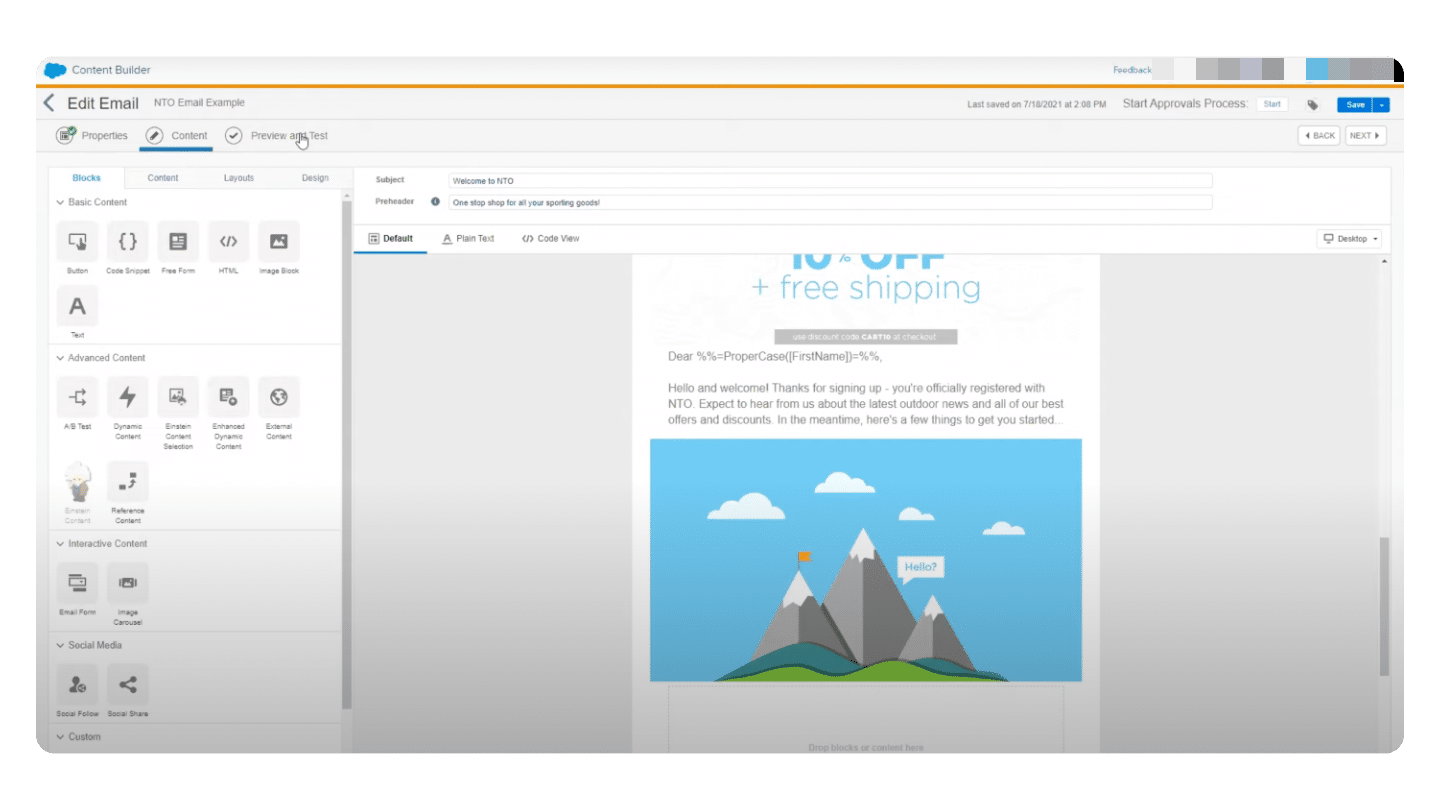
If you have already used a marketing campaign manager, you will feel right at home. You can add just about any personalization variable, starting with the classic Last name / First name.
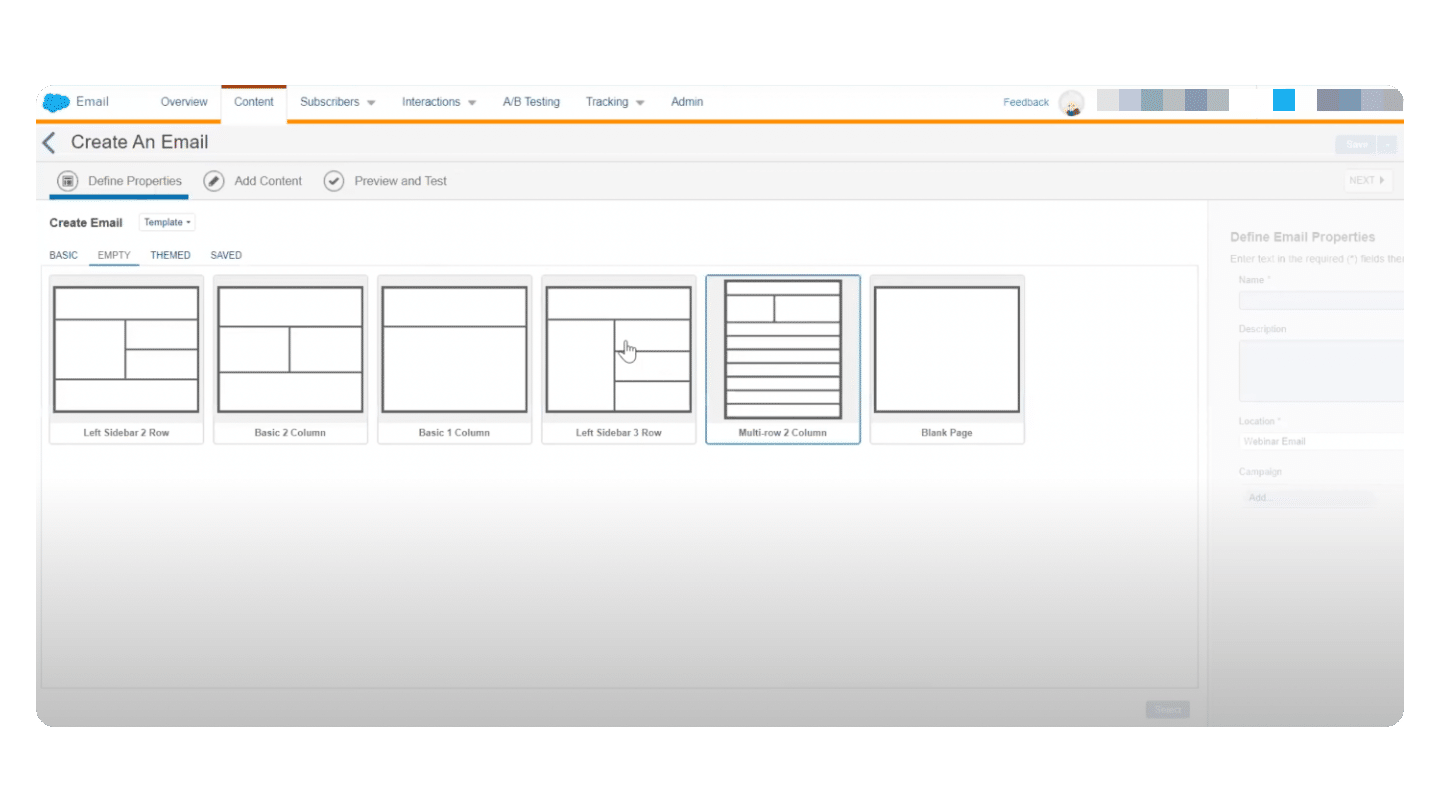
The Mobile Studio gives access to a visual editor built on the same logic as the email editor. It lets you edit the content of your SMS, WhatsApp and push campaigns. Dozens of customizable templates are also available.
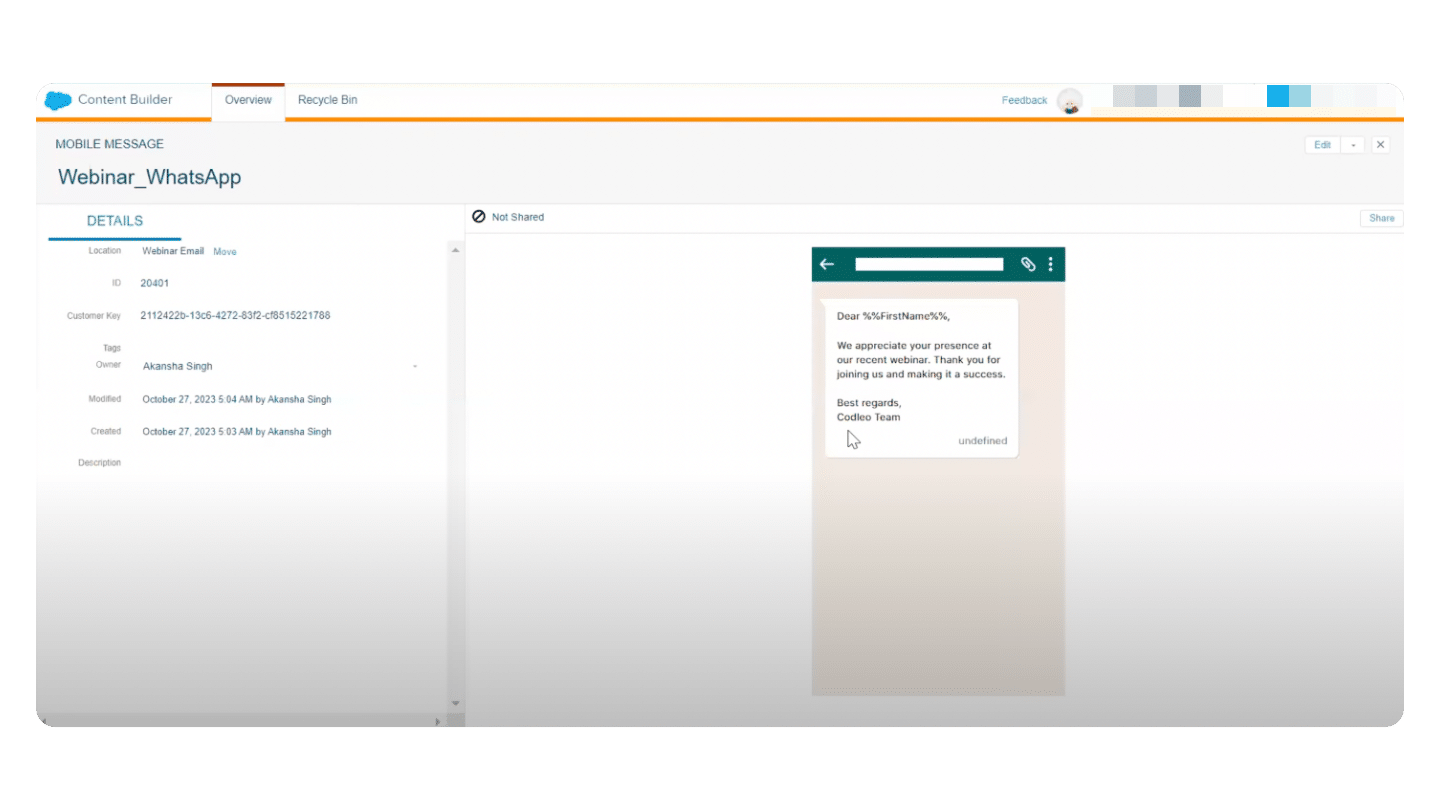
All the advanced features associated with marketing campaign managers are available in Salesforce Marketing Cloud, such as A/B testing, dynamic personalization and detailed performance analysis. Salesforce has found a good balance between functional depth and ease of use.
Marketing automation management: the Journey Builder
The Journey Builder, only available from the “Corporate+” plan at €5,500 per month, is the heart of Salesforce Marketing Cloud. It lets you create personalized customer journeys (marketing automation scenarios) in a fairly intuitive way. It works quite simply. You start by defining the entry point into the scenario, for example a customer action (an abandoned cart) or a change in customer status. Then you build the sequence of actions to trigger on the contacts who entered the scenario. The Journey Builder is 100% visual and therefore fairly intuitive, as the screenshot below shows:
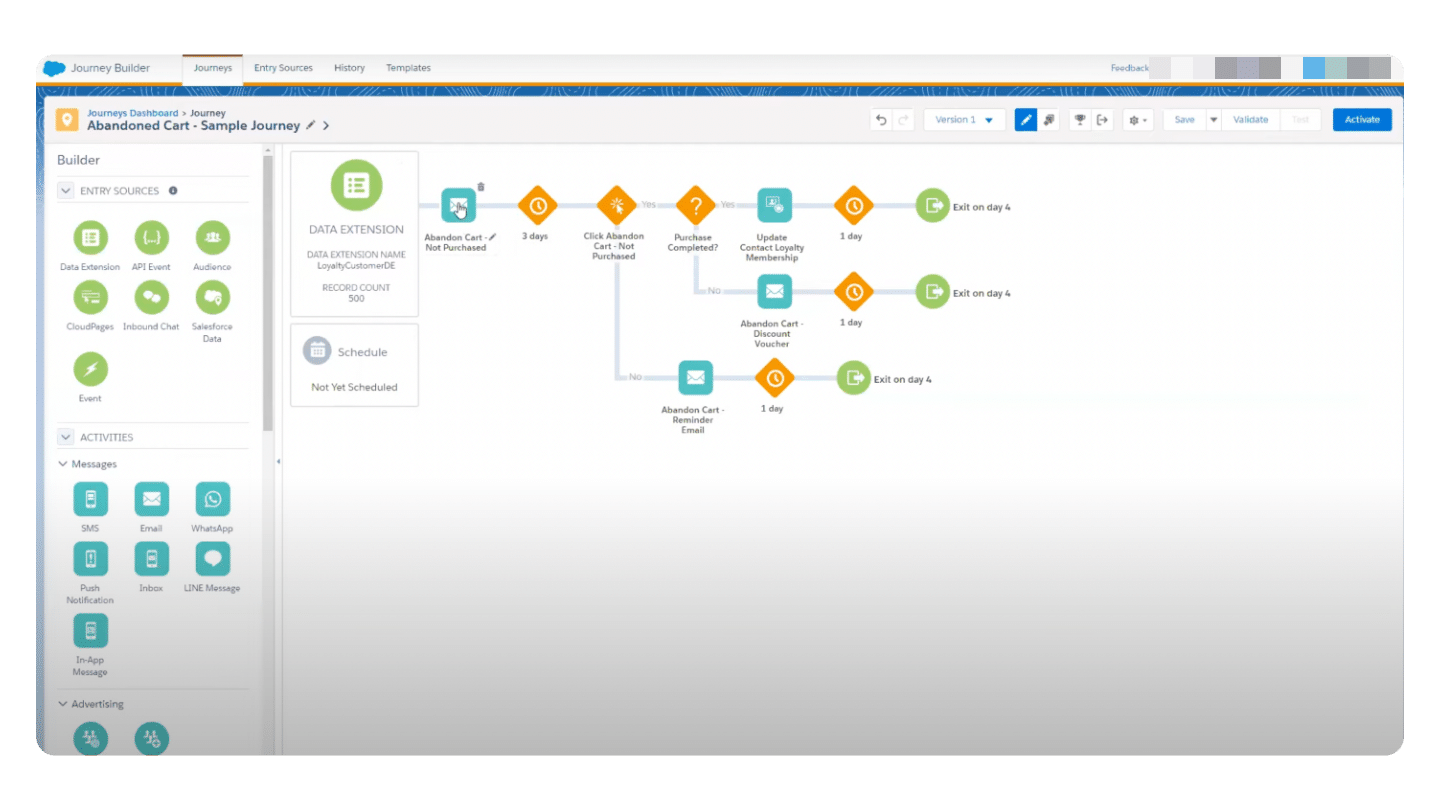
Of course, you can create cross-channel scenarios, including email, SMS, push and even in-app messages. You can also run A/B tests to keep improving the performance of your customer journeys.
Watch outCompared to the Email Studio, you will probably need some time to get familiar with the Journey Builder, but it is clearly a very complete and intuitive tool once you master it.
The other features of Salesforce Marketing Cloud
Detailing every feature built into Salesforce Marketing Cloud would be both long and tedious. The campaign manager and the Journey Builder are the two main functional modules, the heart of the platform. Beyond that, and depending on the plan you chose, you can also access:
- The “Advertising” module (formerly Advertising Studio), which builds lookalike audiences from your CRM data for your display campaigns. You can even manage your Google, Facebook or YouTube campaigns directly in Salesforce.
- The Web Studio, to build landing pages, forms and even small websites to grow your contact base.
- The Analytics Builder, to create custom reports analyzing the performance of your campaigns and customer journeys, your customers’ behavior, etc.
- Einstein, the name covering all of Salesforce’s AI features. In Marketing Cloud, Einstein can be used to generate the content of your messages or to optimize the send timing of your campaigns (among other things).
The Social Studio, which let you schedule and manage your social media posts from Marketing Cloud, was retired by Salesforce on November 18, 2024.
A few words on Account Engagement (Pardot), the B2B version of Marketing Cloud
Salesforce offers a B2B version of its marketing platform, called Account Engagement, which is none other than Pardot. Account Engagement gives access to a campaign manager and a Journey Builder very close to those of the B2C version, except that the goals here are different: the point is to build campaigns and automated action sequences (scenarios) to generate more leads, engage your leads with personalized messages (Lead Nurturing) and grow your customers’ engagement throughout their lifecycle.
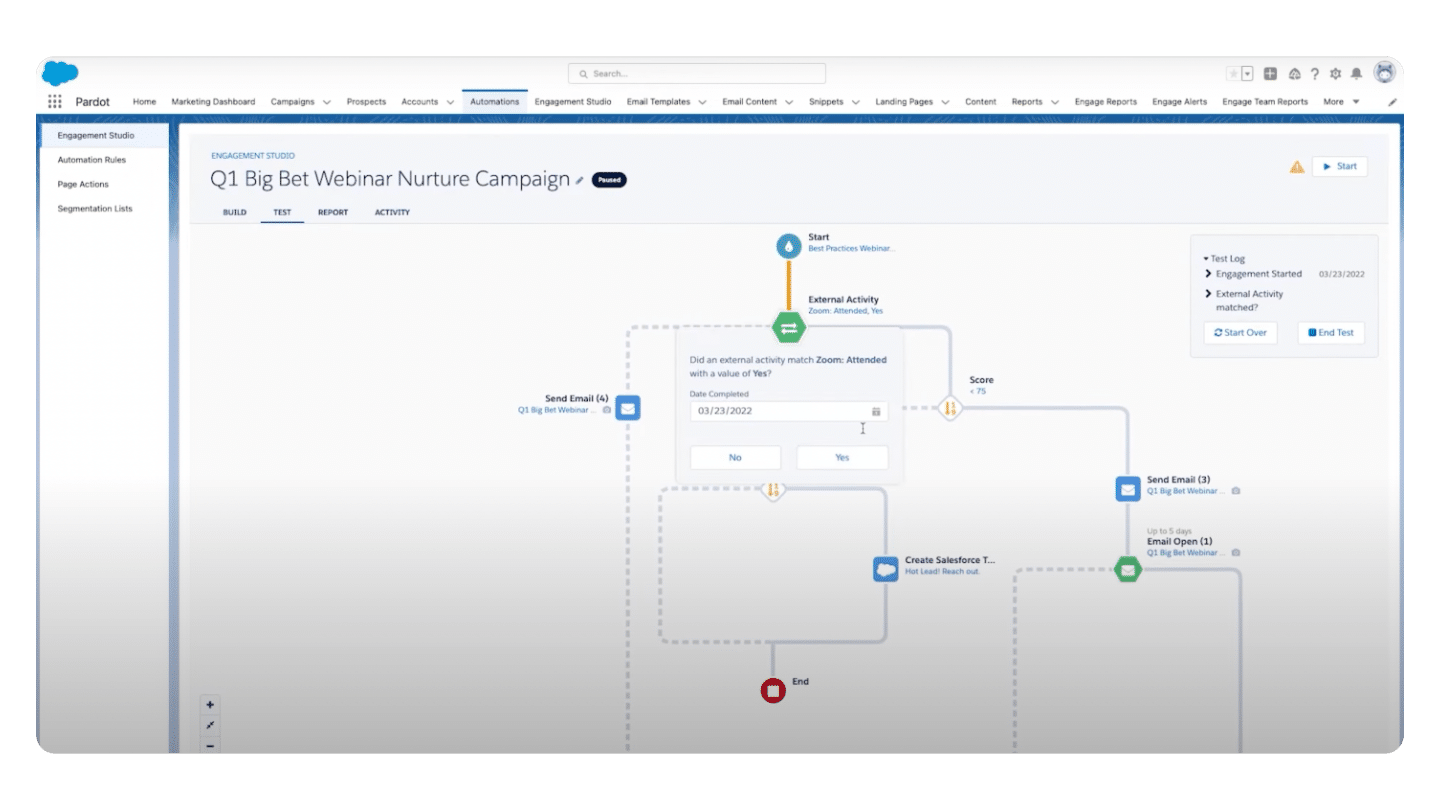
Going furtherWebinars, birthdays, re-engagement, lead scoring, upselling, NPS: discover 11 B2B marketing automation examples.
Pardot (Account Engagement) also gives access to very complete prospect/customer records that aggregate all customer information, as well as relationship history, billing data, engagement level, etc. These customer records contain all the information needed to personalize the conversation and build ultra-targeted campaigns/scenarios.
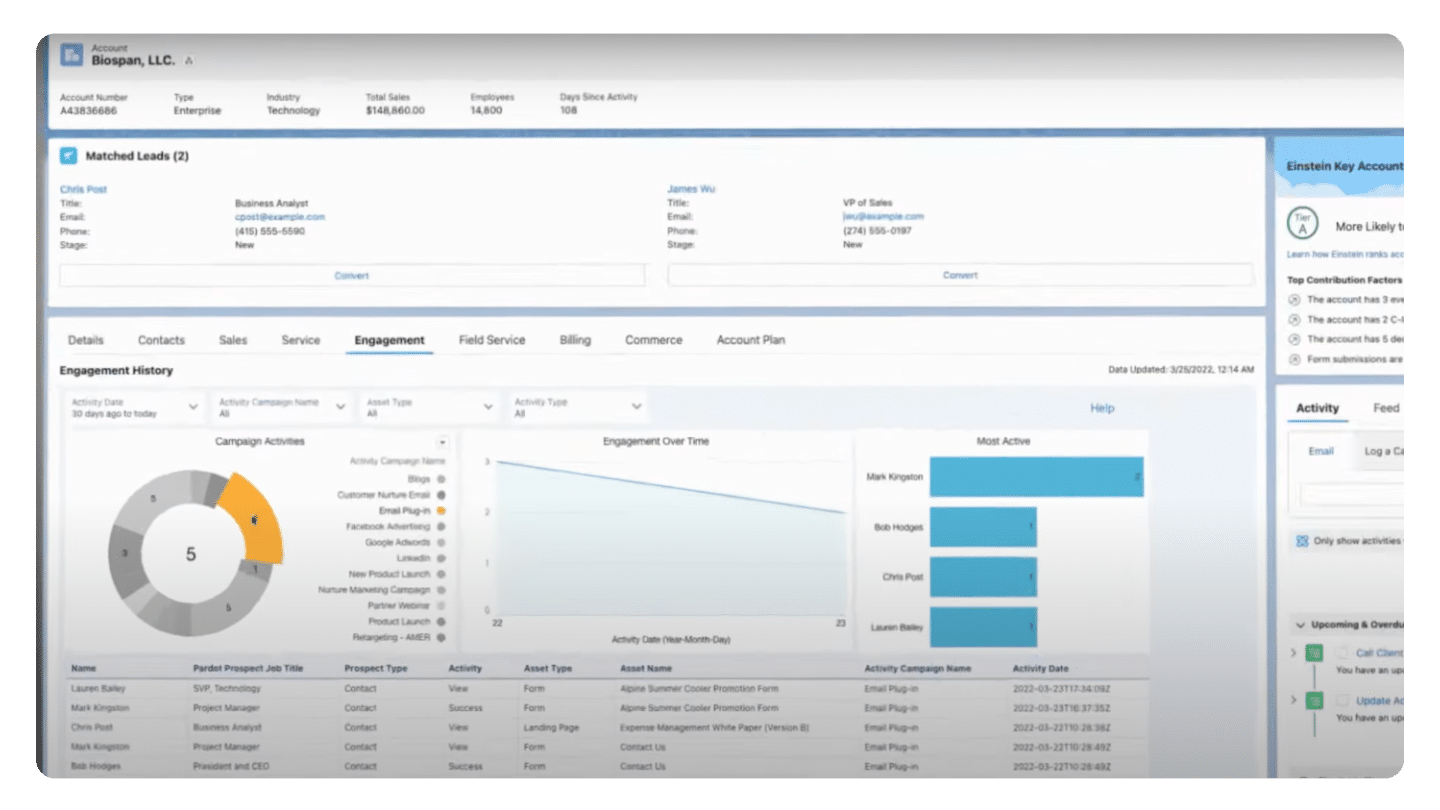
To boost lead generation, Account Engagement includes a landing page and form editor, research tools and LinkedIn connectors. Needless to say, Account Engagement integrates very well with Sales Cloud, Salesforce’s B2B CRM and flagship product. The two tools are meant to work hand in hand.
Salesforce Marketing Cloud customer support
Salesforce users have access to a phenomenal amount of free online resources, whether tutorials or video courses, via Trailhead, Salesforce’s training platform. The video courses and modules dedicated to Marketing Cloud are divided into chapters. Each chapter, lasting between 10 and 40 minutes, explores a specific aspect of the platform. Courses end with quizzes that let you test your knowledge and earn points that then give access to certifications. Trailhead is a real gold mine, which also brings together a very active community of users where everyone can ask specific questions or share their expertise on the platform.
Going furtherSalesforce is no exception to the CRM rule: to get the most out of it, you had better be well trained so you can use all its features. But CRM training can quickly get expensive, and there are dozens on the market. Discover the 10 best Salesforce training courses.
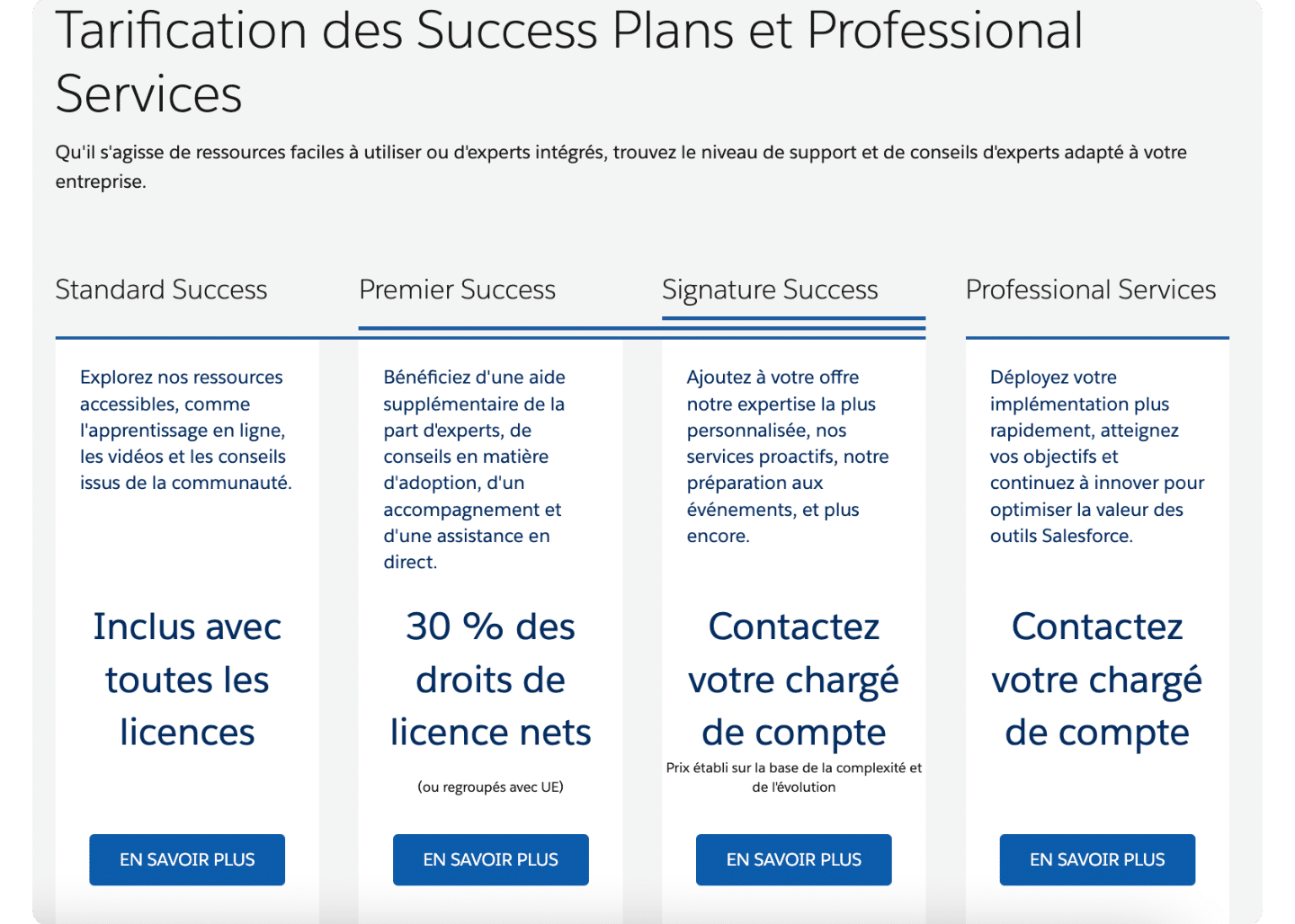
Salesforce also offers 24/7 support in French, by chat or phone, but this “human” support is paid and costs at least 30% of the license price. Support is known to be very responsive. At that price, you would expect nothing less.
Salesforce Marketing Cloud plans and pricing
Salesforce Marketing Cloud comes as 3 products.
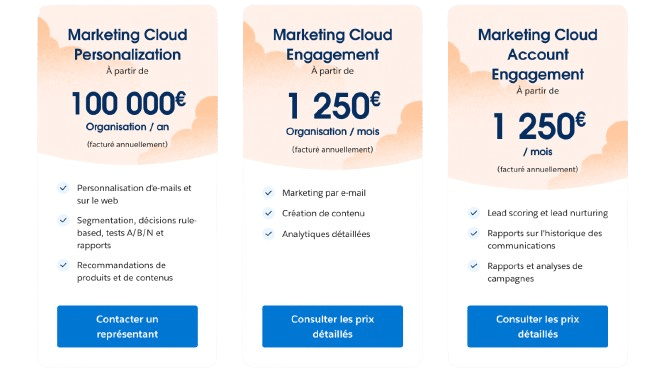
Here are a few details on these 3 products and their pricing:
- Marketing Cloud Engagement starts at €2,000 per month (Pro+ plan, 15,000 contacts). At that price, you only get the email campaign manager and the integration with Sales Cloud (the B2B CRM). To use the Journey Builder (marketing automation), run mobile campaigns (push and SMS) and access Einstein (that is, the AI features), count on €5,500 per month (Corporate+ plan). Finally, Salesforce offers an Enterprise+ plan, starting at €30,000 per month, for complex, multi-entity and multinational organizations.
- Marketing Cloud Account Engagement starts at €1,250 per month. At that price, you get the lead generation and management features (landing pages, forms, lead research tools) as well as the email campaign manager. To access marketing automation tools and advanced reporting, you will have to pay €2,750 per month. The plan that gives access to AI features is sold at €4,400 per month. Good to know: these three plans are limited to 10,000 contacts.
- Marketing Cloud Personalization, which goes well beyond what classic marketing platforms offer, is sold from €8,000 per month. This plan lets you personalize the customer experience in real time and across every channel, including the website and connected devices.
So, clearly, Salesforce Marketing Cloud is not within everyone’s reach. It is one of the most expensive solutions on the market.
Watch outSalesforce prices are shown for reference only. In practice, prices are often negotiated. So you will not necessarily pay what the Salesforce website shows.
Salesforce Marketing Cloud can be extended with other Salesforce products, in particular:
- Data Cloud for Marketing (Data Cloud has been called Data 360 since 2025), Salesforce’s CDP, which unifies customer data from all of the company’s data sources to run ultra-targeted, 100% data-driven marketing. Its price no longer appears on Salesforce Marketing Cloud’s public price list.
- Marketing Cloud Intelligence, a sophisticated Business Intelligence reporting tool to analyze customer behavior and the performance of campaigns and scenarios. Marketing Cloud Intelligence goes further than the dashboards and reports built into Marketing Cloud. The product, renamed Marketing Intelligence, starts at €10,000 per month.
- Loyalty Management, which manages loyalty programs, starts at €20,000 per month.
Whatever product and plan you choose, customer support is not included. Granted, you get free access to very complete online resources and training (Trailhead), but if you want human assistance, you need to subscribe to the Premier Success Plan or the Signature Success Plan. The Premier Success Plan is billed at 30% of net license fees. The Signature Success Plan is priced on a custom basis.
Discover Salesforce Marketing CloudAccess the official Salesforce Marketing Cloud demo and explore the main features of Salesforce’s all-in-one marketing platform.