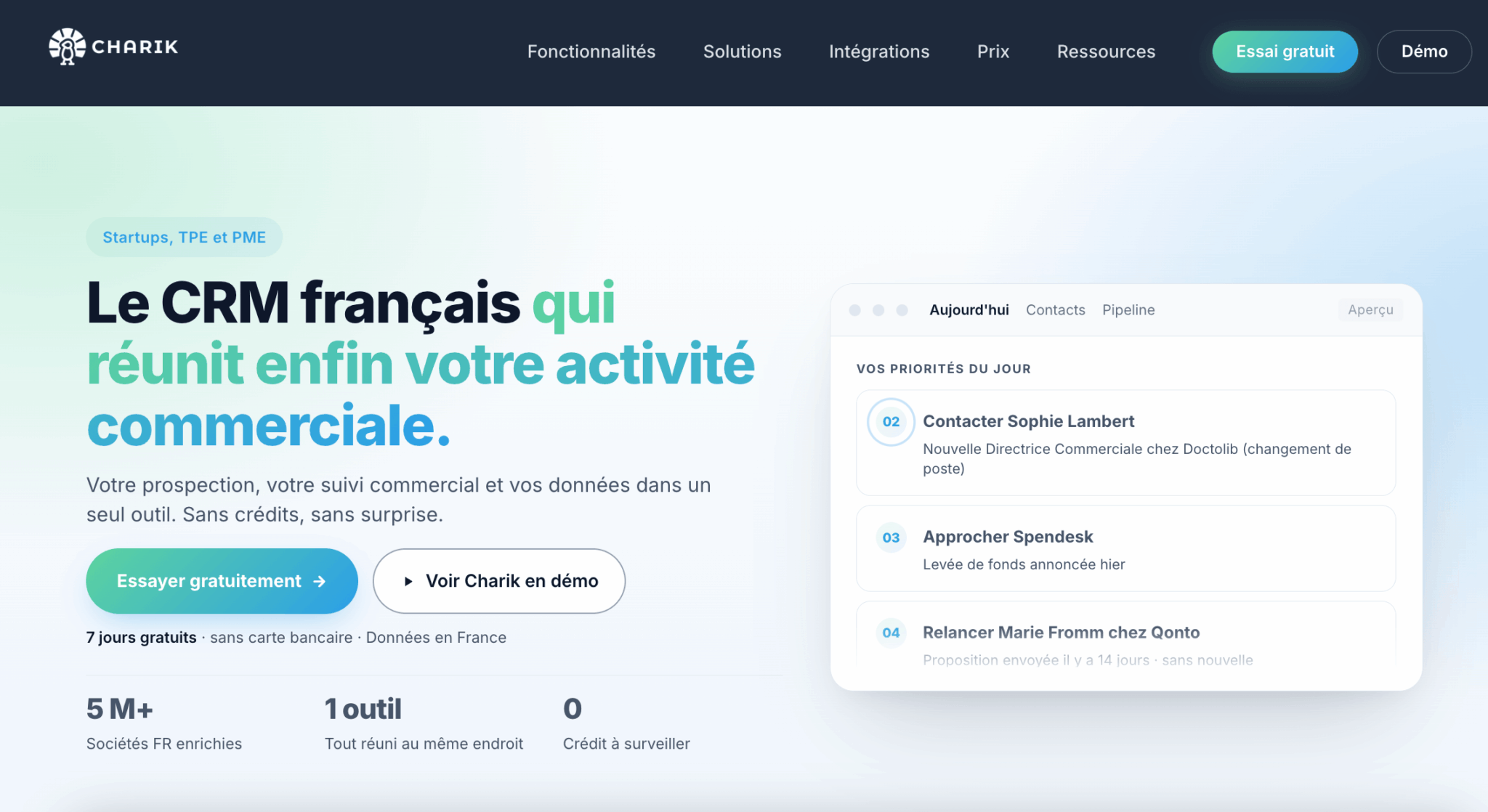
What exactly is Charik ?
Charik is a French sales CRM created in 2023 by Jimmy Hoareau, carried by developers steered by salespeople who lived through the frustrations of classic CRMs. A stated stance, bootstrapped rather than fundraising at all costs, summed up by their own formula: innovate to free up time, not to raise money. The product is recent, but the database that feeds it already claims more than 5 million enriched French companies.
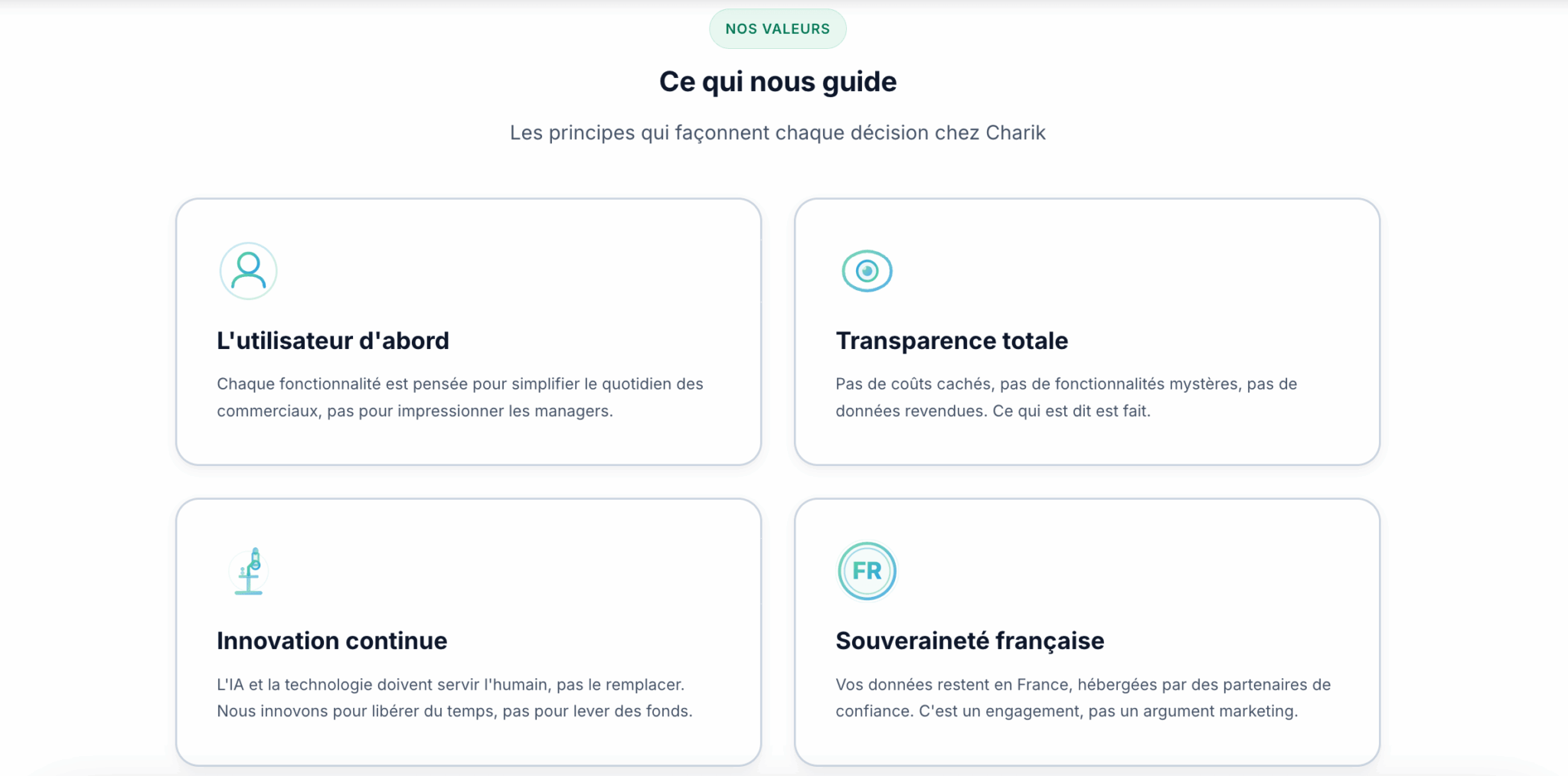
The starting observation is fair and anyone can check it at home. A sales team in France easily stacks six to eight tools: a CRM, a prospecting tool, an enrichment database, a signal detector, an email sequencing tool, and so on. Each has its subscription, its credits, its interface, its password, and two hours a day go into copy-pasting between tabs. Charik puts that typical stack at 250 € and up per user per month. Its answer fits on one line: bring it all back into a single application at 58 € excluding tax, unlimited enrichment included.
A point often misunderstood: Charik does not bundle the same thing as the other French all-in-ones. An Axonaut or a Sellsy bring together CRM and management, that is, invoicing and accounting. Charik brings together CRM and prospecting: the data, the enrichment and the business signals. It is not the same bet and it does not answer the same pain. If your problem is administrative, look at Axonaut. If your problem is the scattering of your acquisition tools, Charik may be of interest.
Here is what the tool concretely brings together and what each block is worth.
| What Charik brings together | The specialised equivalent | Our verdict |
|---|---|---|
| The CRM: pipeline, contacts, companies, deals, activities | HubSpot, Pipedrive | Enough for an SME, less suited to bespoke work |
| Record enrichment, backed by a base of 5 M+ French companies | Pharow, Societeinfo | The strong point, excellent for the price, France only |
| The signals: hiring, fundraising, job changes | Pharow | Solid, a pure player pushes the fineness further |
| Email sequences through Gmail and Outlook | Lemlist | Perfect for following up, without aiming at advanced emailing |
| The product catalogue and the quotes | Axonaut, Sellsy | Clean native quotes, invoicing through Pennylane |
The principle of an all-in-one is to be good everywhere without being the reference anywhere. That is owned and coherent for an SME that would rather have a decent tool across the whole chain than five excellent tools to make talk to each other.
Getting started with Charik: a simple CRM, not a poor one
We expected one more tool. We found an interface of surprising maturity for a three-year-old product.
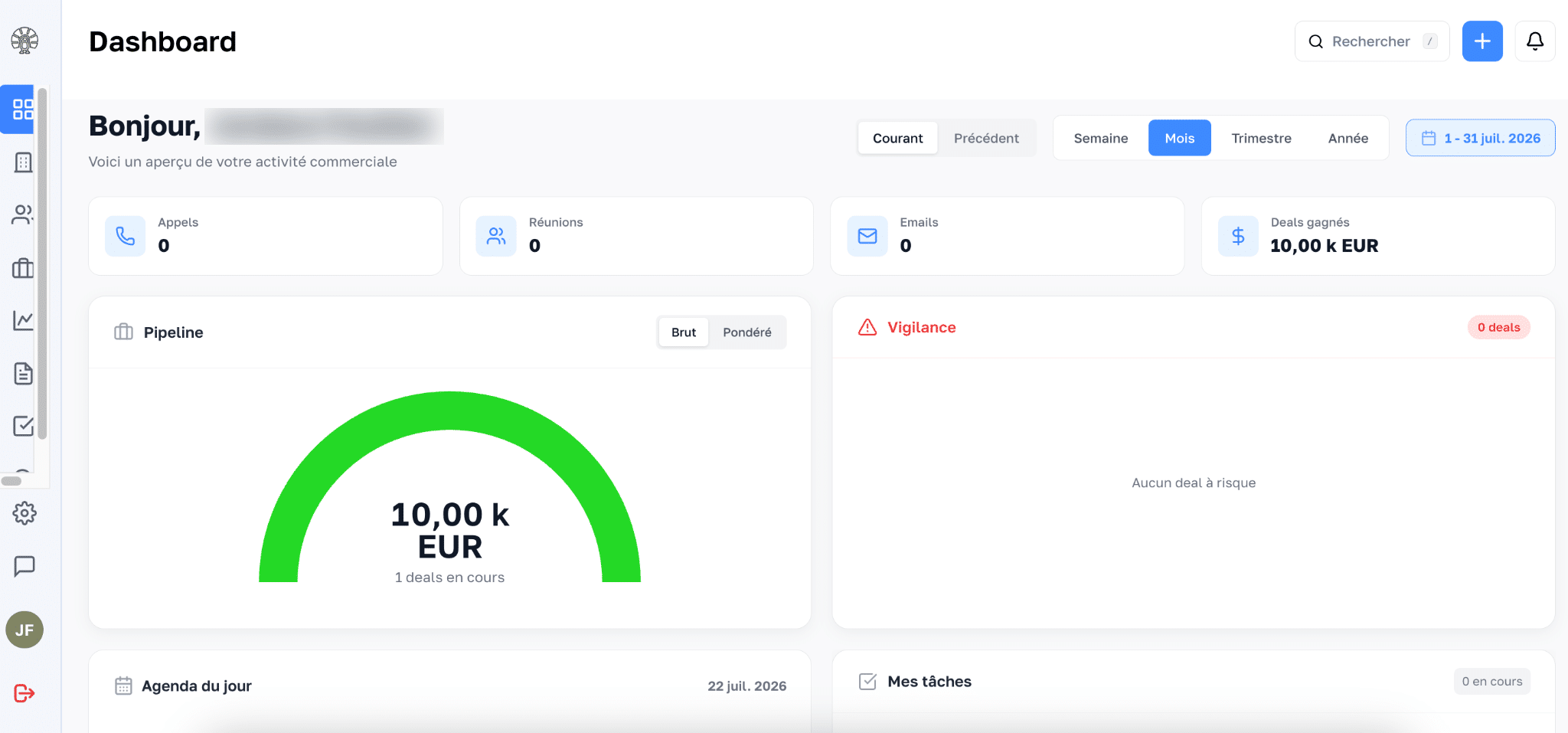
The first login sets the tone. A restrained dashboard shows the essentials: your calls, meetings and emails for the month, deals won, a pipeline gauge in gross or weighted value, your agenda for the day, your tasks. To which is added a “Watch list” block that isolates the deals at risk. Nothing spectacular, everything readable. You know where you stand in five seconds, which is exactly the job of a sales dashboard.
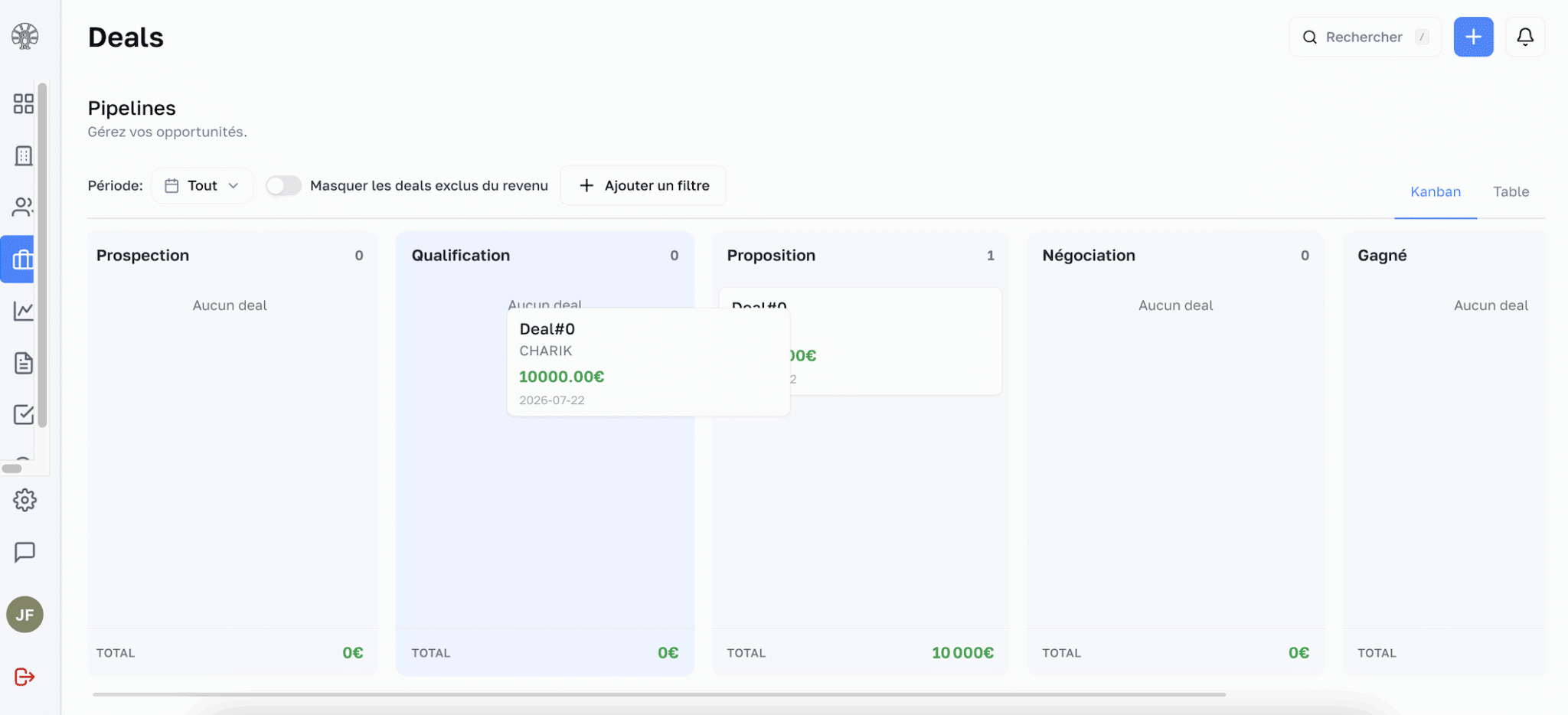
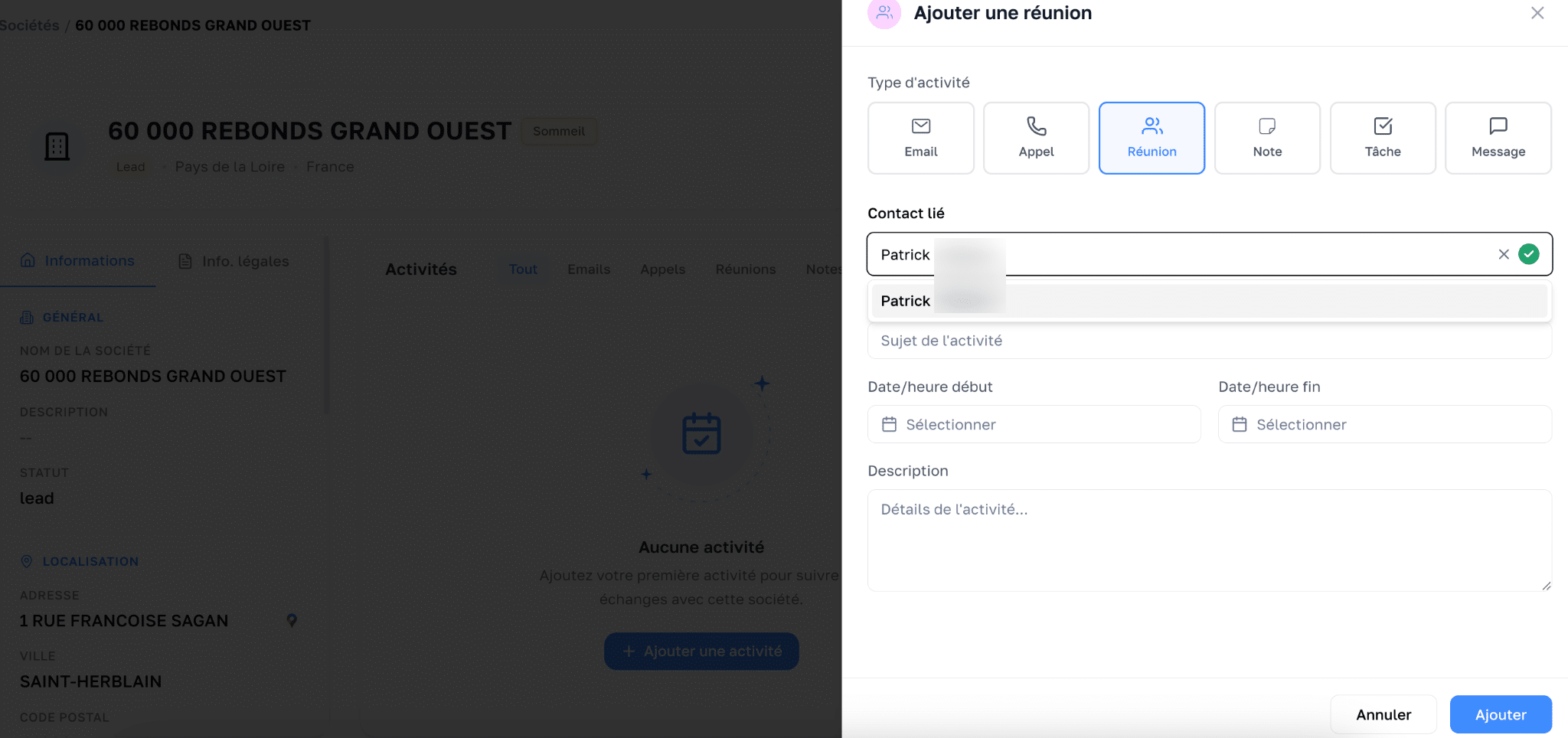
The sales pipeline is handled in kanban, with drag and drop of deals between stages, totals per column and a switch to a table view. Activity logging covers six types, email, call, meeting, note, task or message, linked to a contact in two clicks. It is fluid, with no latency and no extra screen.
That leaves customisation, on which a received idea needs correcting, ours included. We expected a rigid CRM in the name of simplicity. The reality is more nuanced:
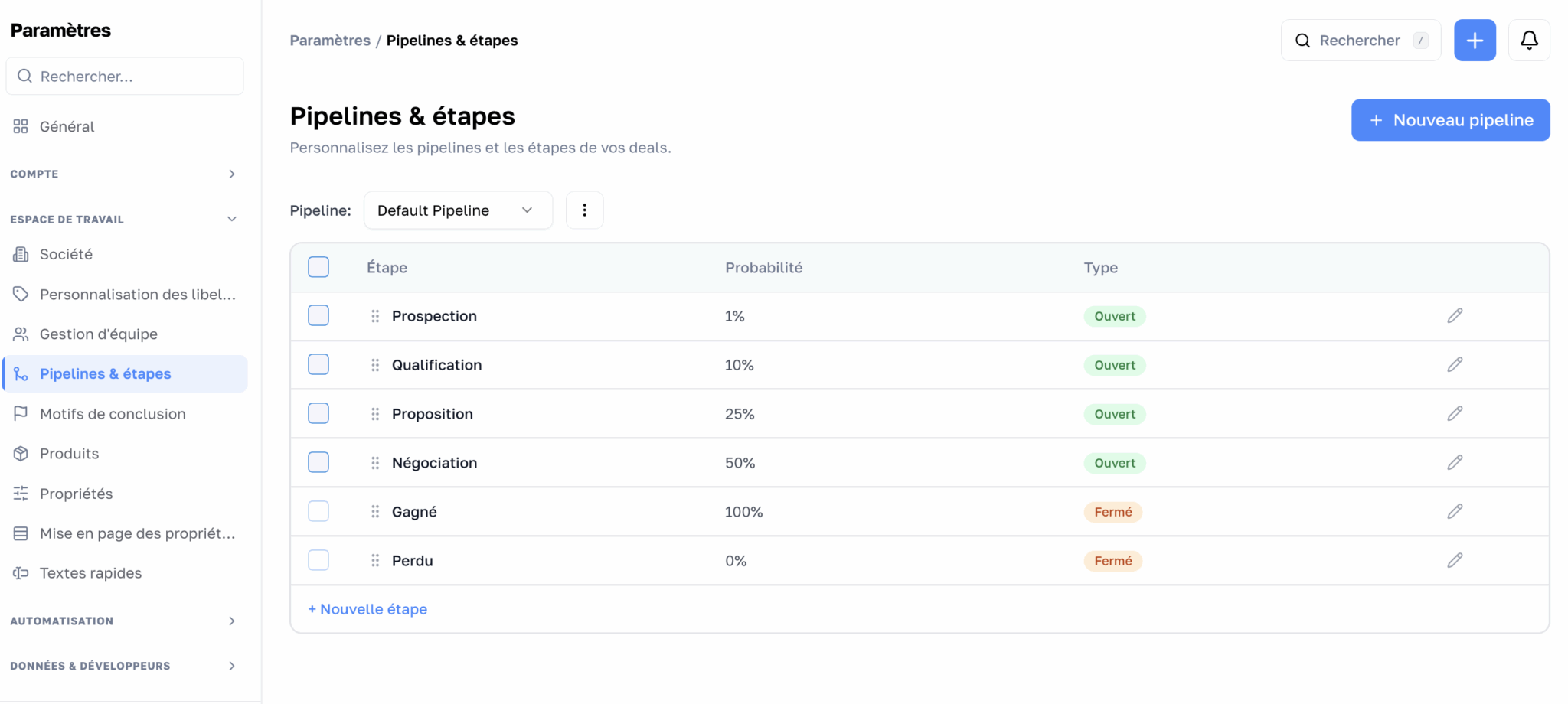
- Several pipelines, with stages carrying a configurable probability (1 % in prospecting, 50 % in negotiation, your call)
- Custom properties on the records, with adjustable layouts
- Renameable labels to match your internal vocabulary
- Closing reasons to qualify lost and won deals
- Quick texts, handy for standardising the team’s replies
For an SME, that is the level of tuning you need. What is missing sits one notch above: no bespoke objects Salesforce-style, no complex workflow engine, no infinitely configurable scoring. Charik draws its boundary there and owns it. Setup takes minutes, not weeks of consulting.
French data enrichment, Charik’s real asset
If there is one reason to look at Charik closely, this is it. The test confirmed it. It is also the reason the tool only makes sense if you prospect in France.
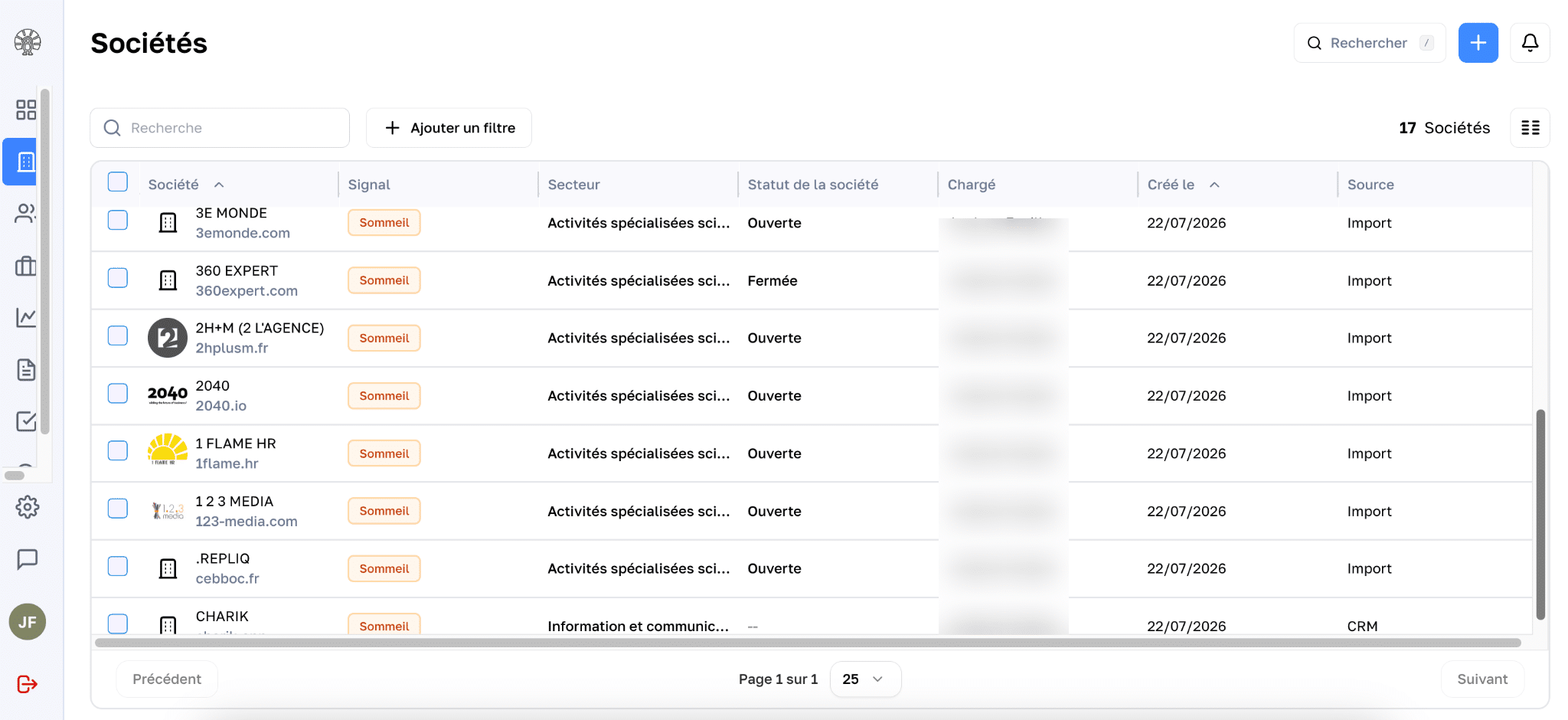
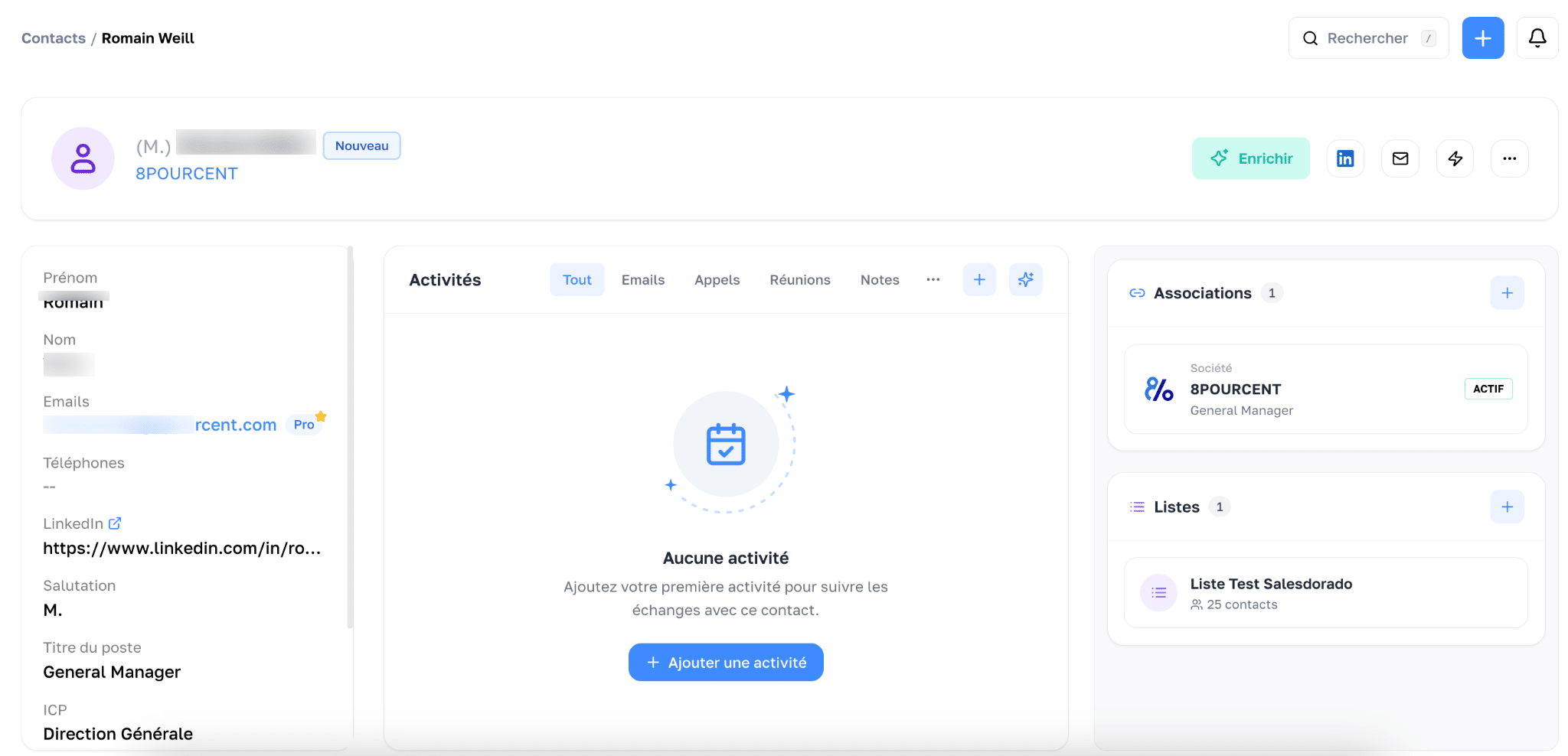
The foundation is a base of more than 5 million French companies that Charik builds from public data, the business register first among them. Your CRM benefits from it first through record enrichment: when you create or import a company, the tool recognises it in that base and fills in everything else, SIREN, NAF industry code, headcount, legal form, directors, address. A “Re-enrich” button refreshes that information on demand, with no credit counted. Every company carries a legal information tab and, a precious detail, its administrative status: open or closed. That sounds anecdotal, until the day you realise you have spent a week prospecting struck-off companies.
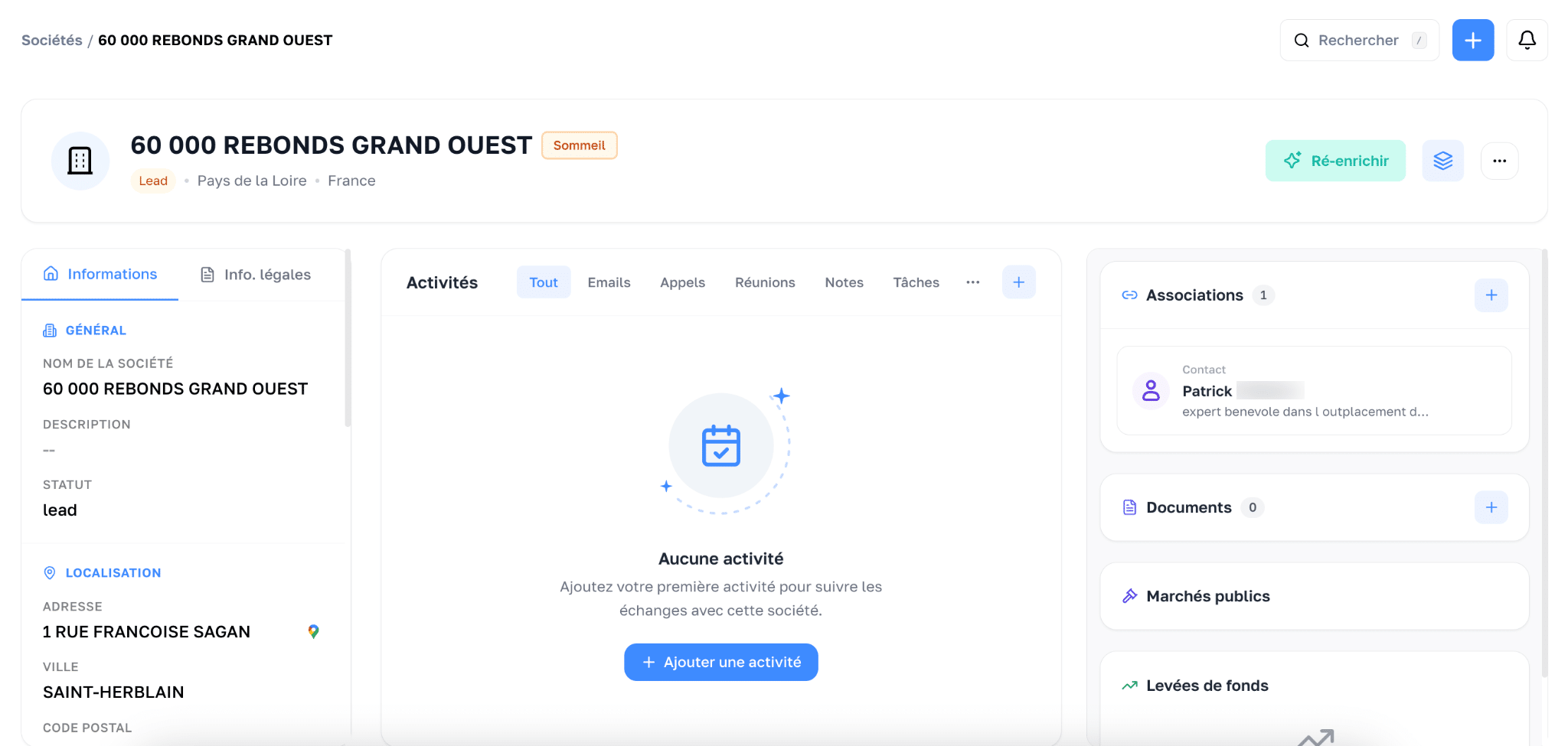
The record also aggregates two flows you do not find in a classic CRM: public contracts won or in progress and fundraising rounds. Your rep no longer has to go looking for that information, it comes to them.
ICP search: from the database to the prospecting list
ICP search attacks the same base from the other end: instead of completing your records, it hands you new ones. You filter by industry, with volumes counted in tens or even hundreds of thousands of companies per segment, by headcount or by geographic area. In return you get qualified contacts: job title, ICP category deduced automatically (general management, operations, advisory), seniority level, LinkedIn link and email where they exist. Searches can be saved, results load as usable lists.
For an SME that has never had a structured prospecting base, that is an immediate change of scale.
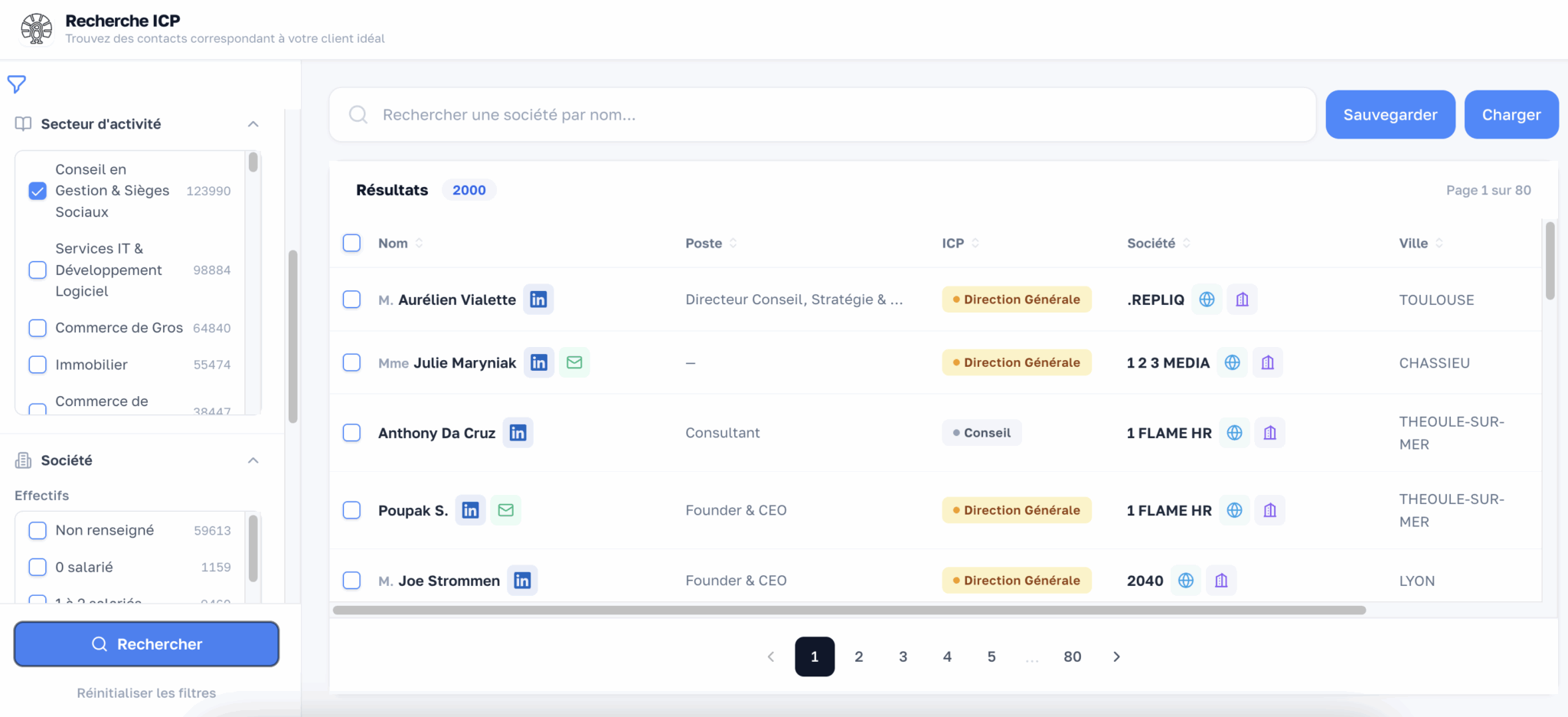
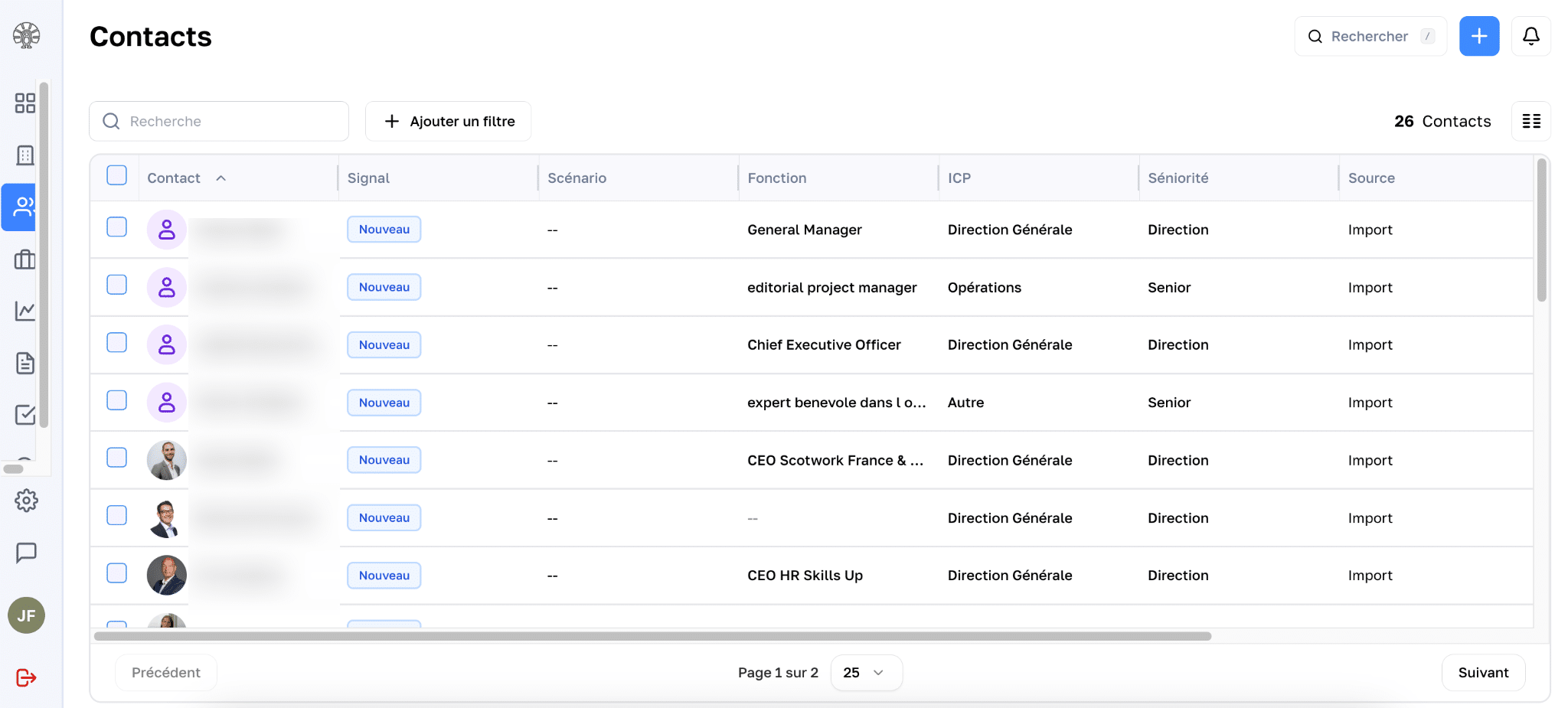
Let us be fair on the level, though. That enrichment is very good for its price, since it is included and unlimited. A dedicated specialist such as Pharow, whose only trade this is, pushes the depth and the fineness of the signals further. The right way to see it: Charik saves you buying a separate enrichment tool in the vast majority of cases. That is already huge, on the condition, again, that your targets are French companies.
Salesdorado’s takeIf French data enrichment and business signals are your number one need, compare Charik seriously against a pure player before deciding. If it is one need among others, having it included in the CRM with no counter is worth gold. Our overview of B2B data enrichment tools will help you place the right level of expectation.
Charik’s business signals: from data to the day’s priorities
Data is only worth something if it triggers an action. This is the second stage of the Charik rocket and probably its most appealing promise.
The tool watches your accounts continuously and surfaces the events that deserve a call: a sales director who has just changed jobs at a target account, a fundraising round announced the day before, a proposal sent fourteen days ago and still unanswered, an account gone dormant for lack of recent activity. Every morning, those business signals turn into a numbered list of priorities: who to contact, who to approach, who to chase. The CRM stops being a register you fill in and becomes a to-do list that tells you where to strike.
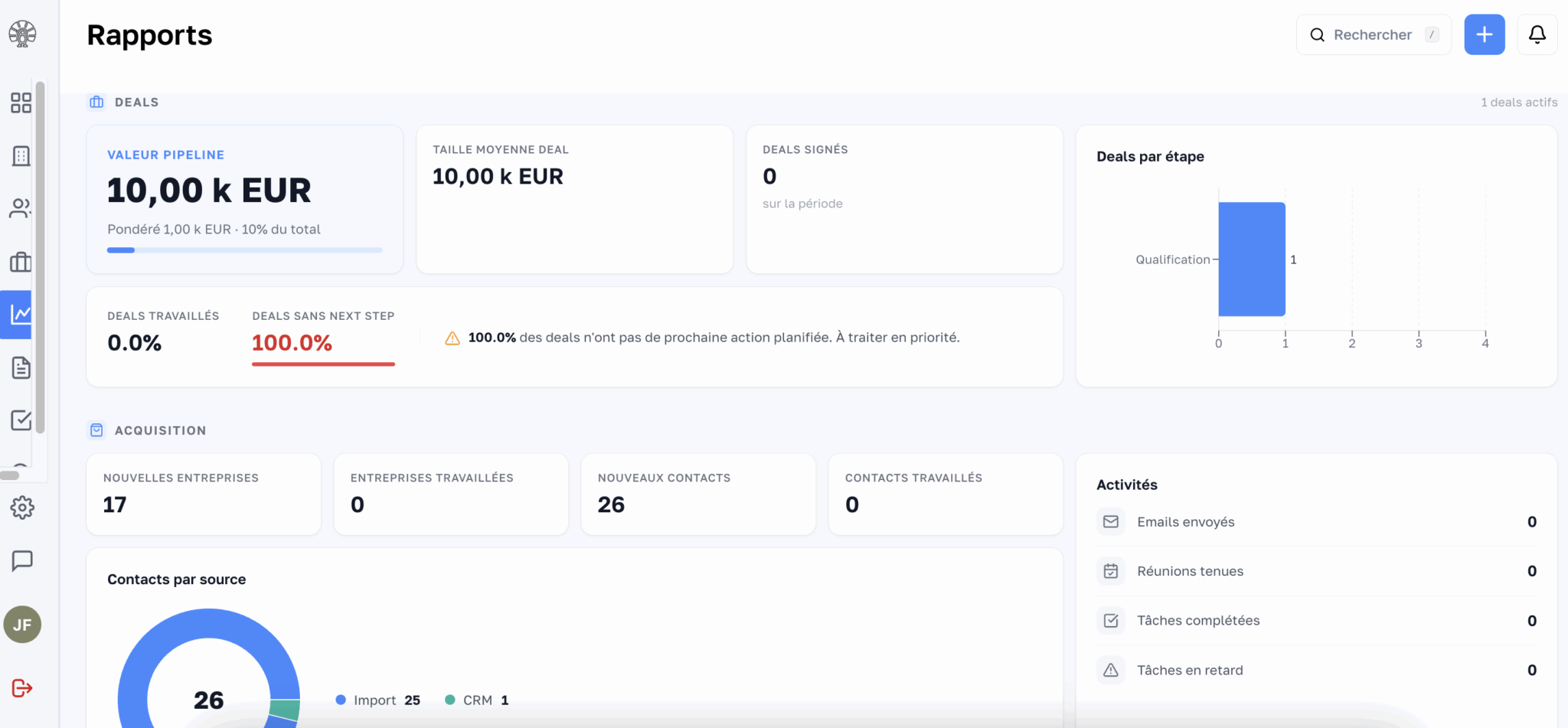
Reporting extends the same philosophy. Alongside the classics, pipeline value and split by stage, Charik shows discipline indicators: the percentage of deals with no next action planned, flagged in red with an explicit warning, accounts created but never worked, imported contacts left sleeping. This reporting does not flatter, it watches execution. You can feel a tool designed by people who have run sales teams: an SME’s problem is almost never a lack of leads, it is a lack of follow-up.
In exchange, do not look here for the granularity of a real BI tool. If you need to cross your sales data every which way, look instead at dedicated sales reporting tools.
Quotes and product catalogue: how far does Charik’s all-in-one go ?
Charik pushes the scope a notch beyond prospecting, as far as the quote. Here again, the execution is careful.
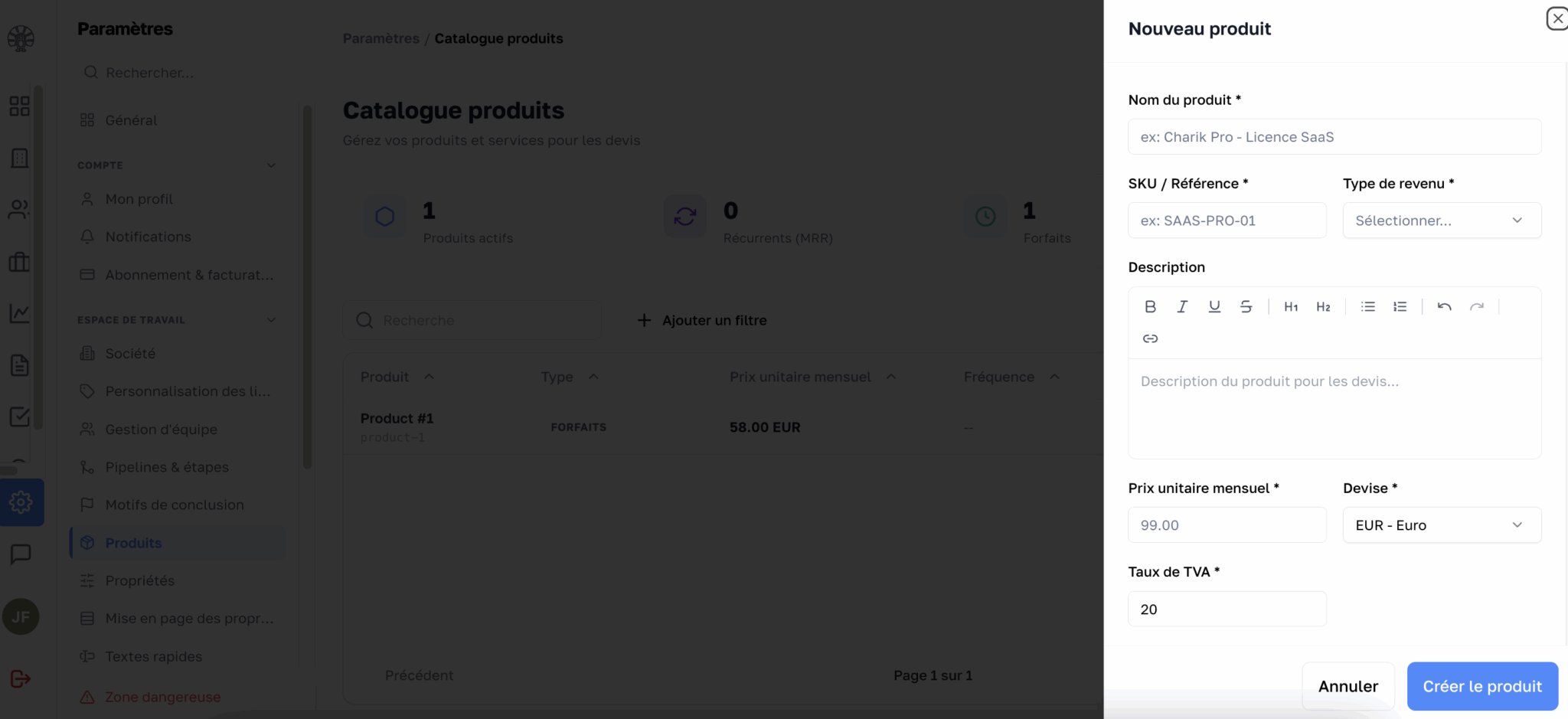
A product catalogue centralises your offers with reference, revenue type, monthly unit price and VAT rate, and even tracks your recurring revenue. That is a detail that speaks to software vendors and subscription service companies: the tool natively thinks in MRR.
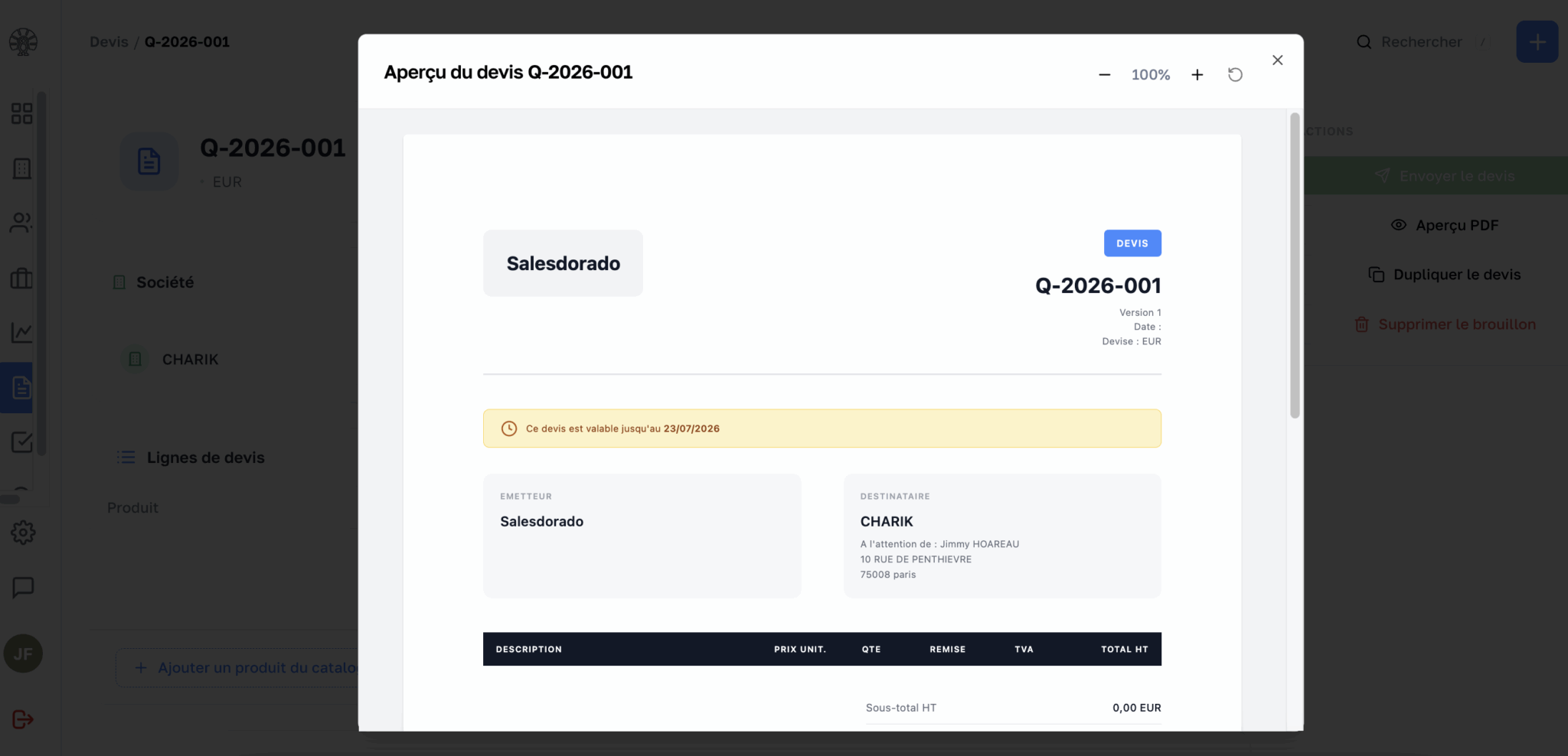
Quotes are then built by picking from that catalogue, with discounts and line-by-line VAT, a clean PDF preview in your company’s colours, sending and tracking straight from the tool, one-click duplication for variants and electronic signature to close.
The boundary is sharp, on the other hand: Charik stops at the signed quote. Invoicing goes through the Pennylane integration, not through a native module. If you are after the complete chain from quote to accounting in a single tool, that is Axonaut and Sellsy territory. Our comparison of quoting software can help you place the right level of tooling.
Charik’s integrations: Gmail, Outlook, Brevo, Lemlist, HubSpot and Pennylane
The basic connections cover the essentials of daily work:
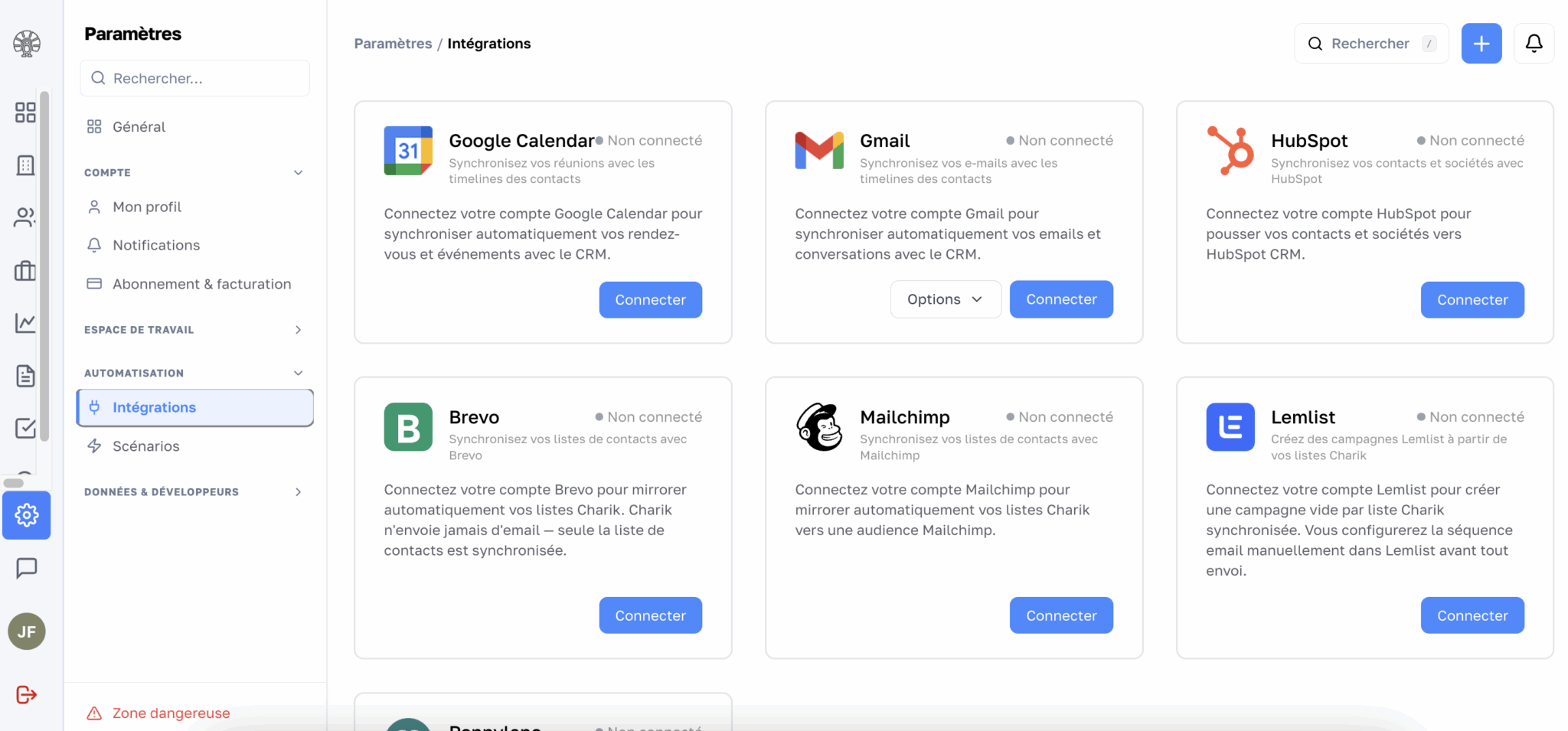
- Gmail and Outlook sync conversations into the contact timeline.
- Google Calendar does the same with meetings.
- On emailing, Charik syncs your lists to Brevo or Mailchimp but never sends a mass email itself.
- Charik can create a Lemlist campaign from a Charik list, the sequence still being configured in Lemlist.
In other words, the tool claims the data and the targeting, then delegates volume sending to the specialists.
The most unexpected integration remains the one to HubSpot: Charik can push your contacts and companies to HubSpot CRM. Charik also positions itself as the prospecting and French data layer upstream of a heavier CRM, rather than claiming to replace it everywhere.
One last block, invoicing: it is handed to Pennylane, which Charik connects to, rather than to an in-house accounting module. The logic is the same end to end: the tool keeps the sales data and delegates the administrative side to a specialist.
How much does Charik cost ? Pricing and the logic of “no credits”
“No credits” is Charik’s knockout argument. It deserves the maths, because it is not worth the same to everyone.
There is one single offer: 58 € excluding tax per user per month, on an annual commitment and with no monthly option, that is 696 € excluding tax a year for one rep and 3,480 € excluding tax for five. Everything is included, unlimited enrichment among it: complete CRM, prospect search, business signals, email sequences, catalogue and quotes. What remains to be paid elsewhere is invoicing, through Pennylane, and mass emailing, through Brevo, Mailchimp or Lemlist. The free trial lasts 7 days, with no credit card, up to 10 users and 100 records.
That leaves who the package really benefits:
- Do you prospect and enrich a lot, in France? The package is a bargain. Add up a CRM, an enrichment tool billed by credit and a sequencing tool, and you go past 58 € fast, without the comfort of an all-in-one.
- Do you mainly want a simple CRM, with little prospecting? Then 58 € fixed becomes expensive. An entry-level Pipedrive runs around 14 € per user, a noCRM stays on a light price and you do not pay for enrichment you do not use.
In other words, Charik is neither expensive nor cheap in absolute terms. It pays off handsomely for a profile that uses the whole chain, and is debatable for anyone who only switches on part of it.
Salesdorado’s tipBefore signing, add up what you really pay today: CRM, enrichment, prospecting and signals, credits included. If you are above 58 €, Charik saves you money on top of time. If you are below, it means you are not yet using the prospecting side, and a lighter CRM will do.
Hosting in France and durability: the questions to ask a recent CRM
Charik insists heavily on its Frenchness. Let us see what that is really worth.
The facts first: OVHcloud servers in France, no transfer outside the European Union, no US Cloud Act, documented and auditable GDPR compliance, data not resold, human support in French with no bot. That is not veneer, it is verifiable and more and more buyers are sensitive to it.
Should you pick Charik for that? For most SMEs, sovereignty separates two finalists, it does not on its own tip you towards a new tool. But for certain profiles, the public sector or activities handling very sensitive customer data, it can become a decisive criterion.
That leaves the question of how young the product is, perfectly legitimate. A CRM is not a tool you change lightly. It is your system of record, the memory of your whole sales activity. On that front, Charik puts the right guarantees forward: a supported inbound migration from HubSpot, Pipedrive or Sellsy, transfer of contacts, companies, opportunities and history, and data hosted in France that you remain free to take back. The team’s bootstrapped stance rather plays in its favour: it signals a product built for use and to last, not for a quick exit.
The right reflex before signingAs with any recent tool, check two points on the way in: how easy it is to export your data at any time, and how regular the updates are. On both counts, Charik ticks the right boxes, which makes it a reasonable bet.
Charik against the French CRMs: Axonaut, Sellsy, Pipedrive and HubSpot
| Solution | Its bet | Indicative price (excl. tax/user/month, annual billing) | Who for |
|---|---|---|---|
| Charik | CRM + prospecting + enrichment + signals | 58 € | French SMEs and startups drowning in prospecting tools |
| Axonaut | CRM + invoicing + accounting | 58.20 € on a 1-year commitment, 97 € with no commitment | A micro-business that wants sales and management together |
| Sellsy | CRM + invoicing, more complete | 29 to 79 € depending on the Sales licence | A services SME that invoices a lot |
| Pipedrive | Pure sales CRM, visual pipeline | 14 to 79 € depending on the plan | A team that wants a simple, effective pipeline |
| HubSpot | CRM + marketing, complete ecosystem | Free, then 7 € on Starter and 90 € on Pro | A startup that wants to grow inside an ecosystem |
First lesson, price separates nothing. On an equivalent annual commitment, Axonaut shows 58.20 € when Charik asks 58 €, and the mid-range of both Sellsy and Pipedrive sits around 49 to 59 €. This whole crowd fits in a handkerchief. The question is therefore not which is cheapest, but which replaces the most tools in your own stack.
The distinction is simple:
- If your pain is administrative, Axonaut or Sellsy bring sales and invoicing together.
- If you want the most readable pipeline, Pipedrive remains a reference and noCRM does the job for something very light.
- But if your pain is the stacking of prospecting and data tools upstream of the sale, and your targets are French companies, no French all-in-one brings prospecting and enrichment together the way Charik does. That is where, and only where, it is genuinely differentiating.
To widen the comparison, our overview of the best French CRM software and our selection of CRMs for micro-businesses and SMEs put each solution back in its context.