The tool speaks to structured micro-businesses as much as to SMEs and mid-caps that want to stop juggling a CRM, an invoicing package and an emailing platform. That broad scope is what makes its strength, and it is also what justifies pricing well above the average.
Our review of Sellsy’s main features
Opportunity management
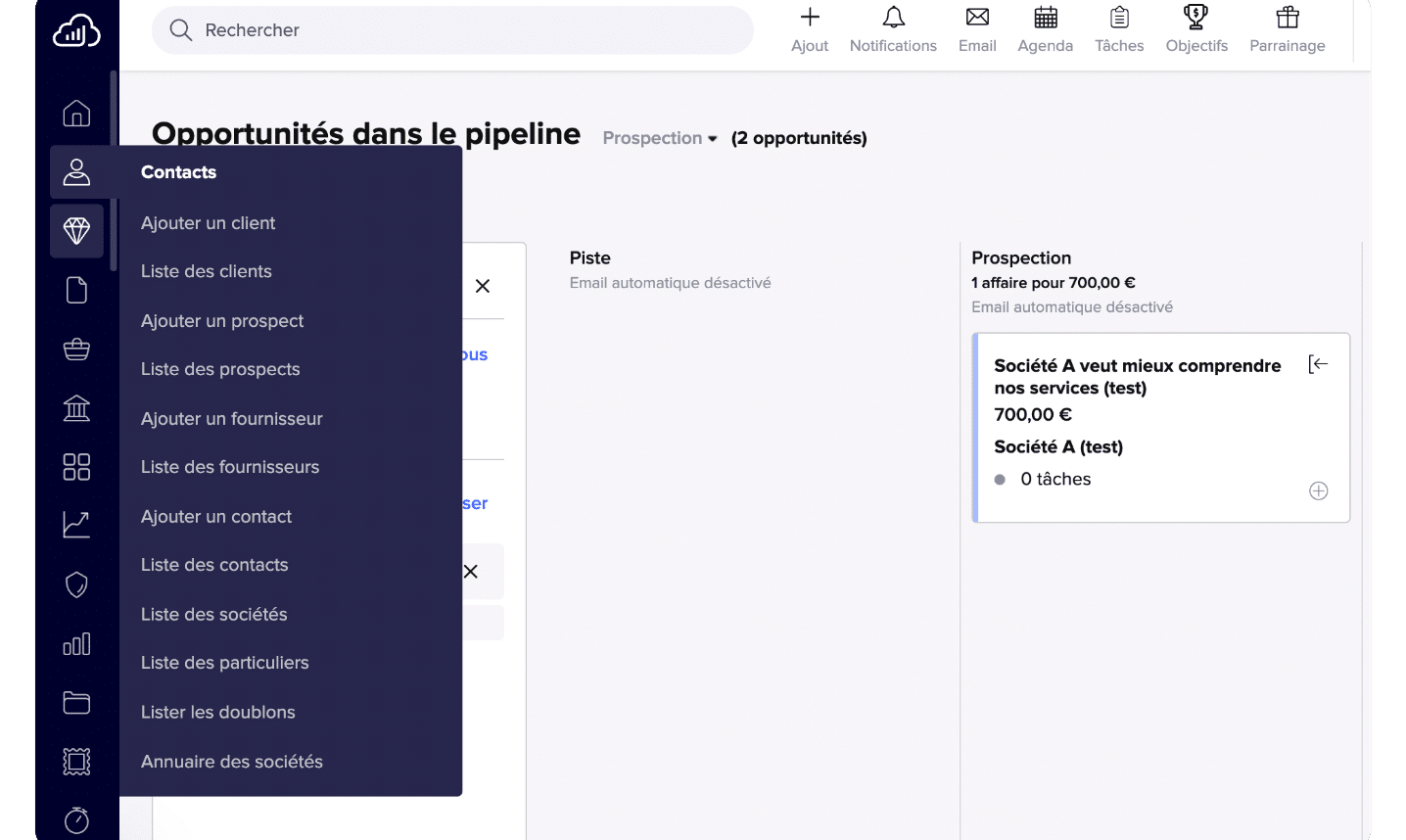
Sellsy lets you follow the customer cycle through its configurable pipeline. Every new opportunity is automatically attached to a stage of the sales pipeline. Read from left to right, it gives an overview of the deals in flight according to how mature they are.
By default, Sellsy’s sales pipeline is set up like this: lead, prospecting, phone contact, quote sent, negotiation. Those stages can be changed and adapted to your organisation.
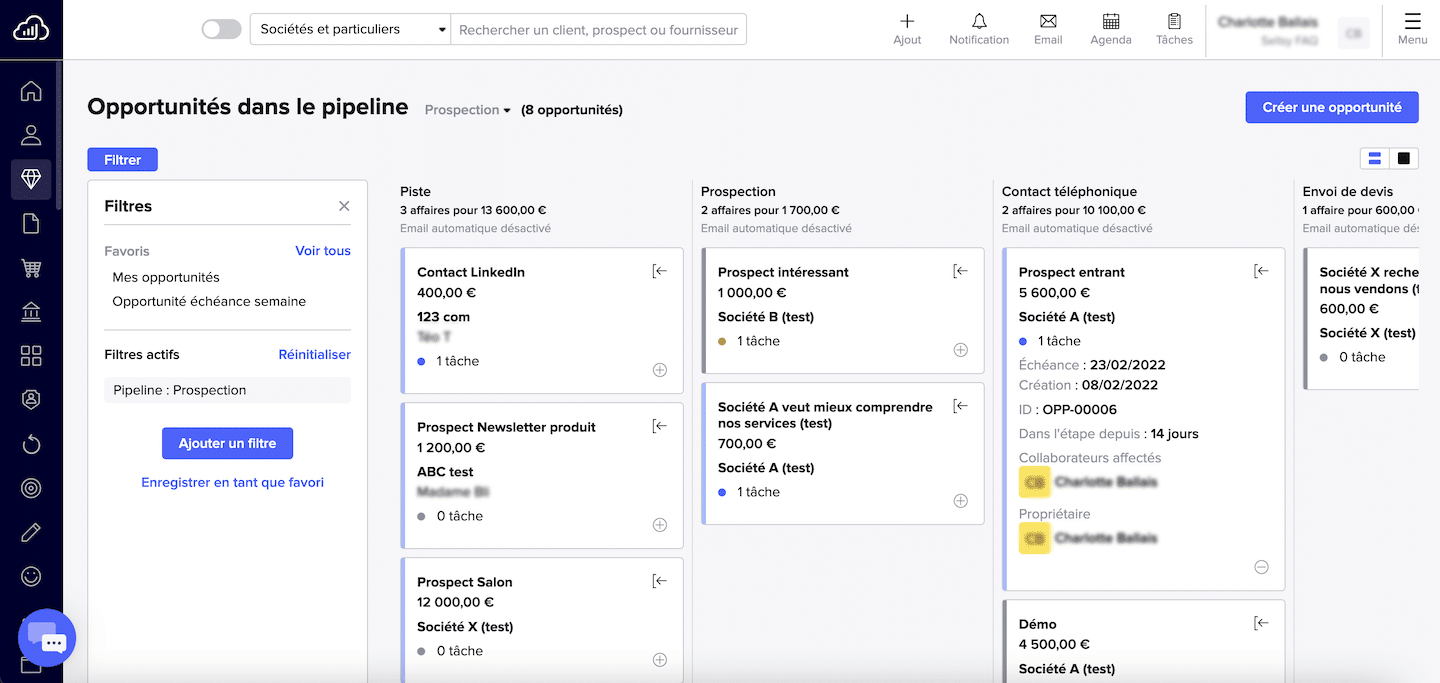
Another point of interest, Sellsy can trigger automatic emails to prospects and customers. At every change of stage, they can receive a message without any action on your part.
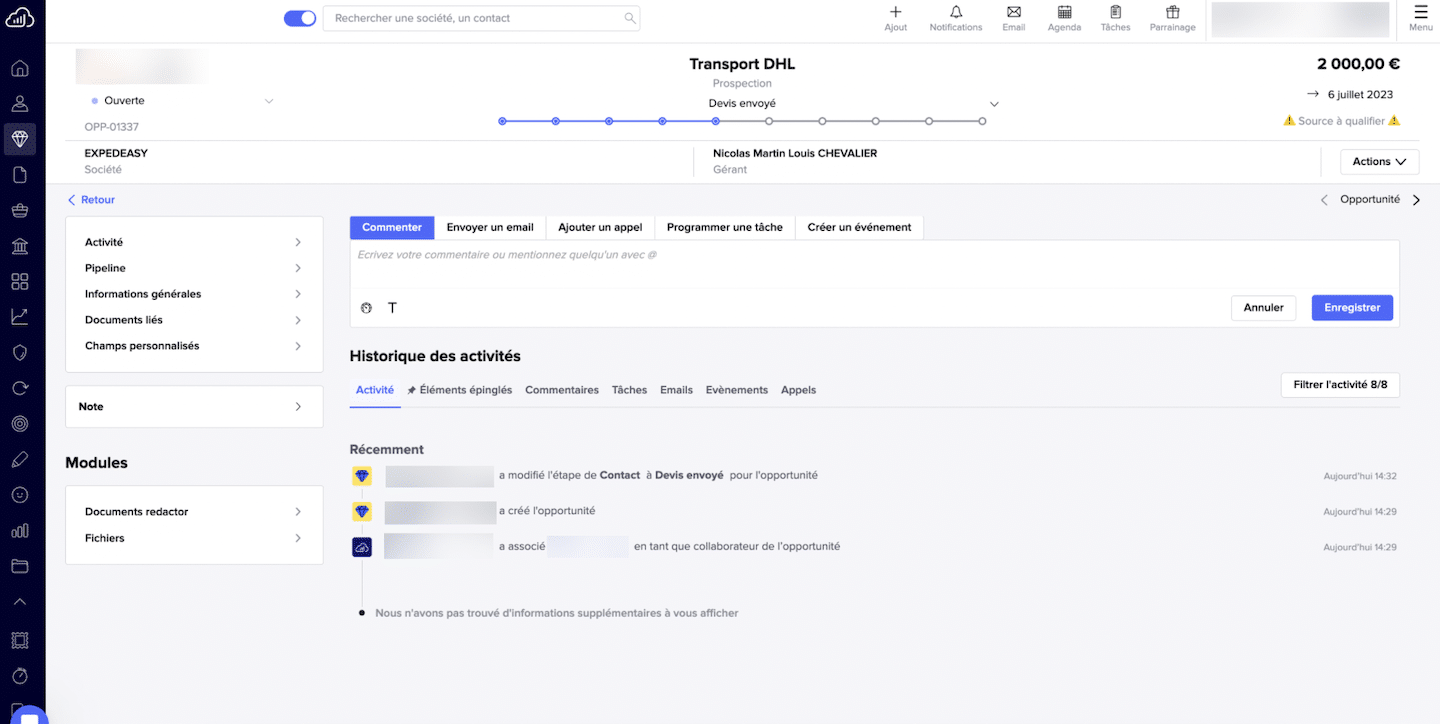
The information attached to a sales opportunity is filled in by hand. It can also flow up automatically if you have the whole Sellsy tool set, such as the WordPress widget. The data collected is recorded, stored and analysed, which lets you identify the marketing campaigns that genuinely feed the pipeline, and therefore the best-performing channel.
Contact management
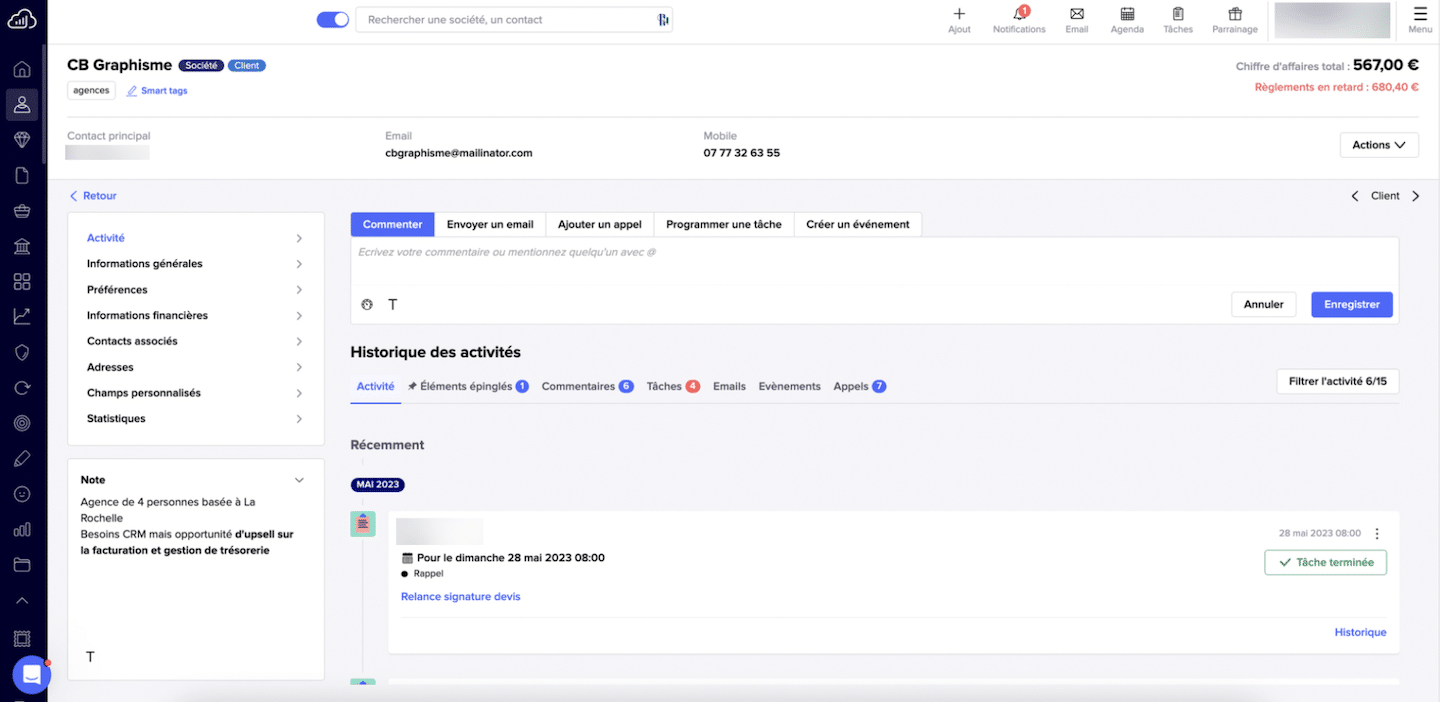
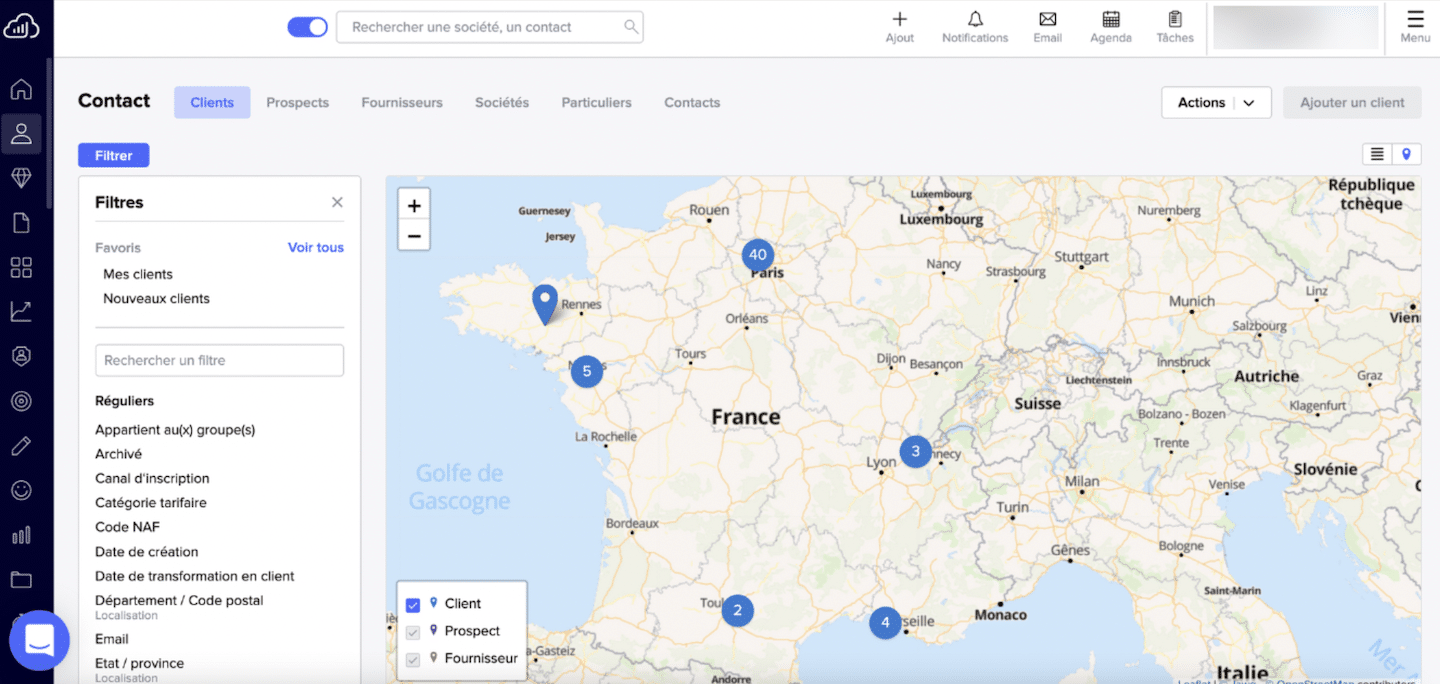
Sellsy lets you create contact records for prospects as much as for customers. Those records come with default fields (surname, first name) to which are added the usual details such as the phone number or the SIRET, the French company identifier, plus smart tags used to segment the base.
Once the contact is created, you can immediately generate a quote or an invoice. The customer record brings together the quotes and invoices, all the past interactions, but also the upcoming meetings and events. The customer list can be filtered, which lets you extract segments and pour part of them into your emailing campaigns.
Sellsy also embeds a directory of French companies you can query when creating a contact, by name or by SIRET. That directory is then enriched with your own company records: address, NAF industry code, VAT number. This data list, on the other hand, is neither editable nor configurable as you please.
Sales automation
Sellsy regularly gains new features. The vendor offers, for instance, tracking of your website visitors, switched on by embedding the Sellsy widget in your pages.
The point of that tracking is to follow a visitor from arrival to departure in order to feed a lead scoring strategy and qualify the opportunity according to their real interest in your brand. You then have access to their whole browsing history.
Not every visitor is worth the same, obviously: a blog reader does not weigh as much as a company that writes to you. So Sellsy assigns a value to the pages visited and the actions taken, which produces a final score and lets you identify the hottest leads.
Reporting
This is one of the platform’s strong points. Sellsy gives access to a large number of reports: sales report, forecast report, conversion rate and time for opportunities, split of opportunities by stage and by pipeline, conversion rate and time for accepted quotes, invoicing and management reports (revenue, margin rate, catalogue margin). Watch out though: most of those reports are only available from the Evolution plan onwards.
The results can be filtered on criteria of your choosing: date, product, rep.
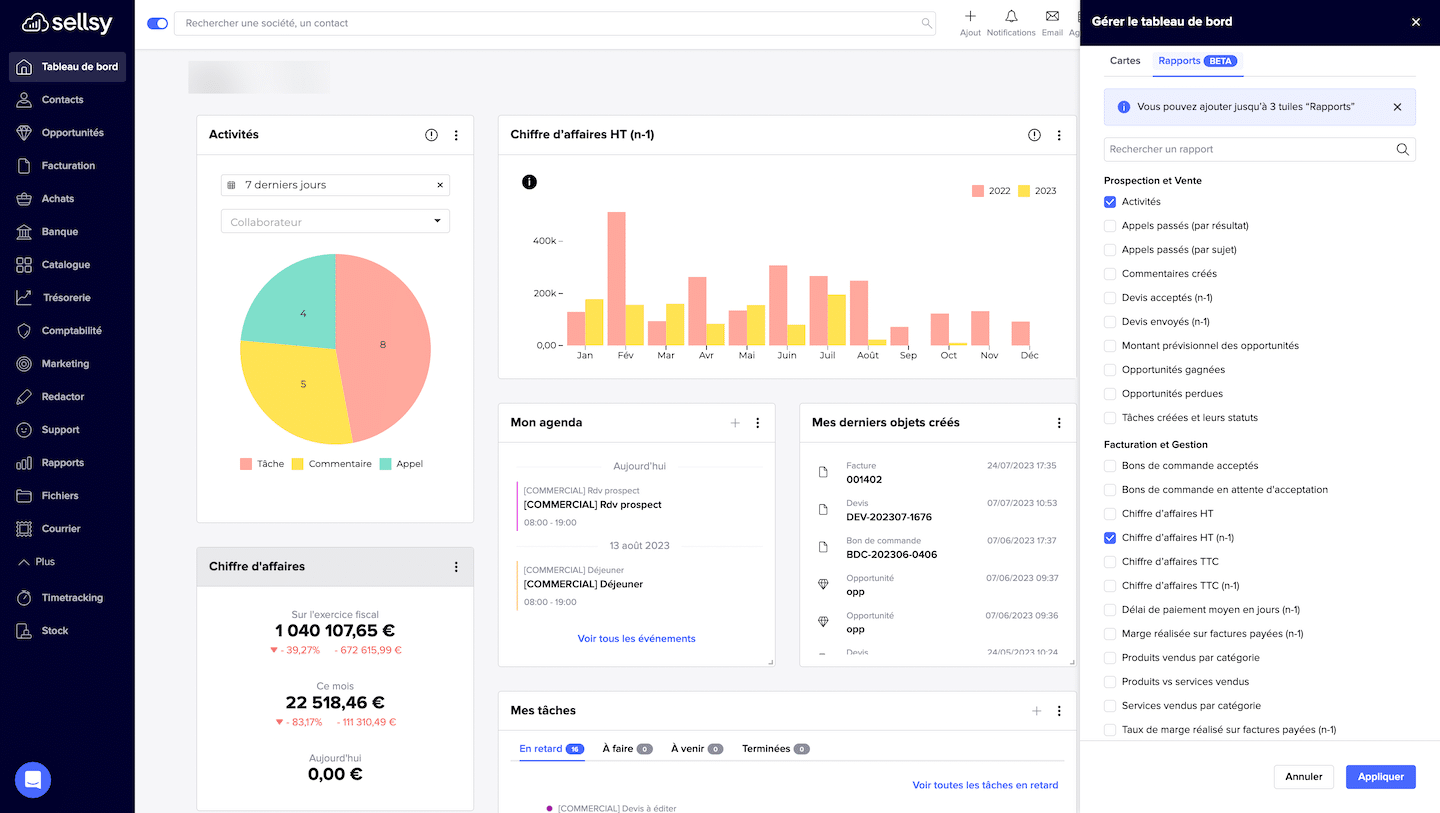
In detail, you get precise reports such as the prospecting report, which tells you about your reps’ activity and their performance: number of opportunities won, lost, in progress.
Sellsy also generates an activity report that gives an overall view: tasks in progress, completed and upcoming. Management therefore has a quick overview of where things stand, and a read on performance per pipeline that is useful when building a sales strategy with the marketing team.
Marketing campaigns
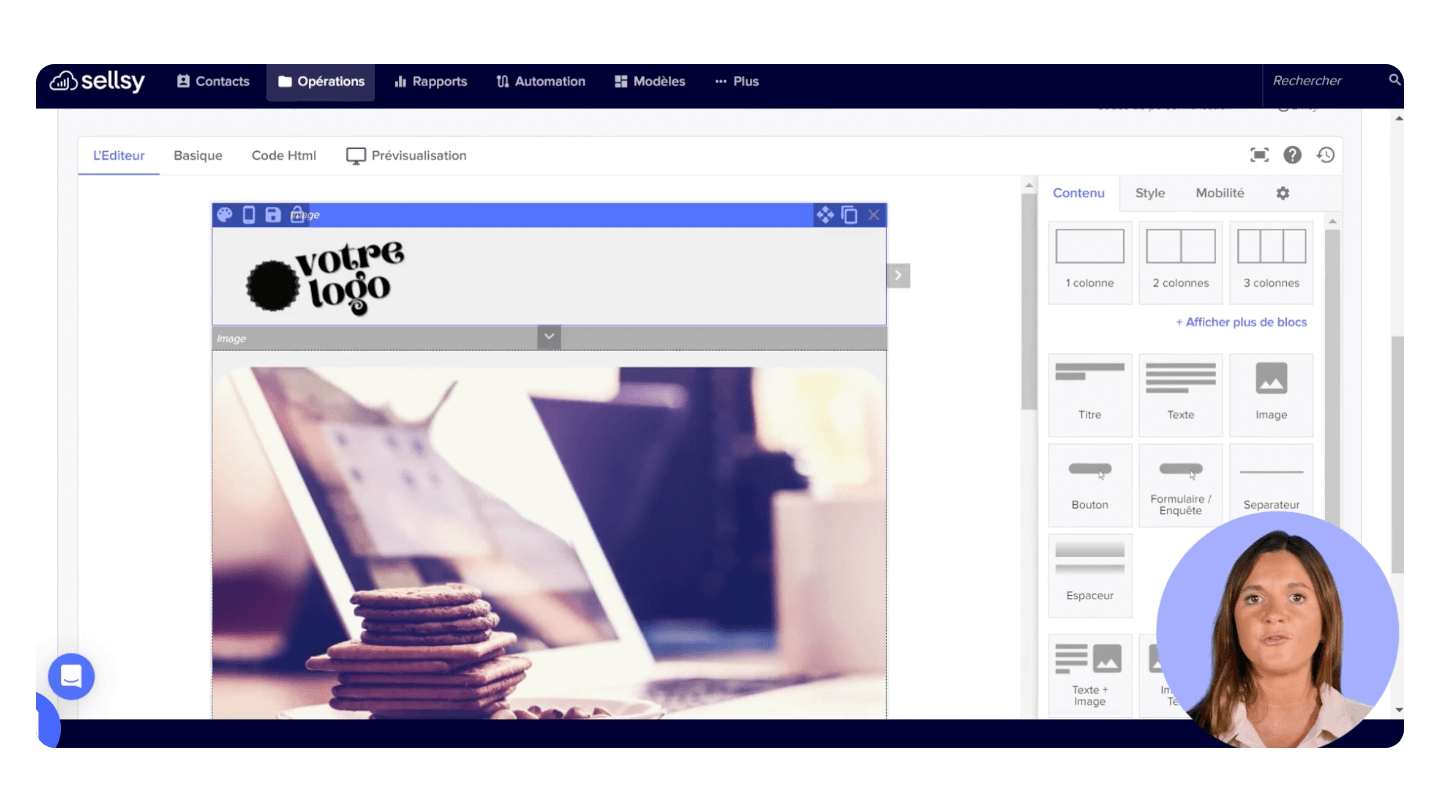
Sellsy has built a very complete marketing module: a visual editor and campaign manager for email and SMS, an editor for capture forms you can embed on your site, a satisfaction survey editor, a landing page editor, a Journey Builder for marketing automation and surprisingly advanced features for a generalist CRM, such as multivariate tests. The whole thing is simple to pick up and rests on a well-stocked template library. You can also import your own HTML email templates.
Sellsy lets you build contact segments from the information available and from marketing behaviour, then reuse them in targeted email or SMS campaigns.
Getting started, accessibility as a given
Sellsy’s interface is modern, clear and well designed. The software is pleasant to use and you find your bearings within a few tens of minutes. The left-hand menu gives access in a few clicks to every module: contacts, opportunities, invoicing, purchasing, banking, catalogue, cash management, accounting, marketing, reports.
You still have to plan for a learning curve of a few days to really take ownership of every feature. That is the direct flip side of such a broad functional scope: the more trades the tool covers, the more time it demands before it can be used seriously.
If you get stuck, you can still contact customer service by chat or by phone, or consult the many tutorials the vendor offers.
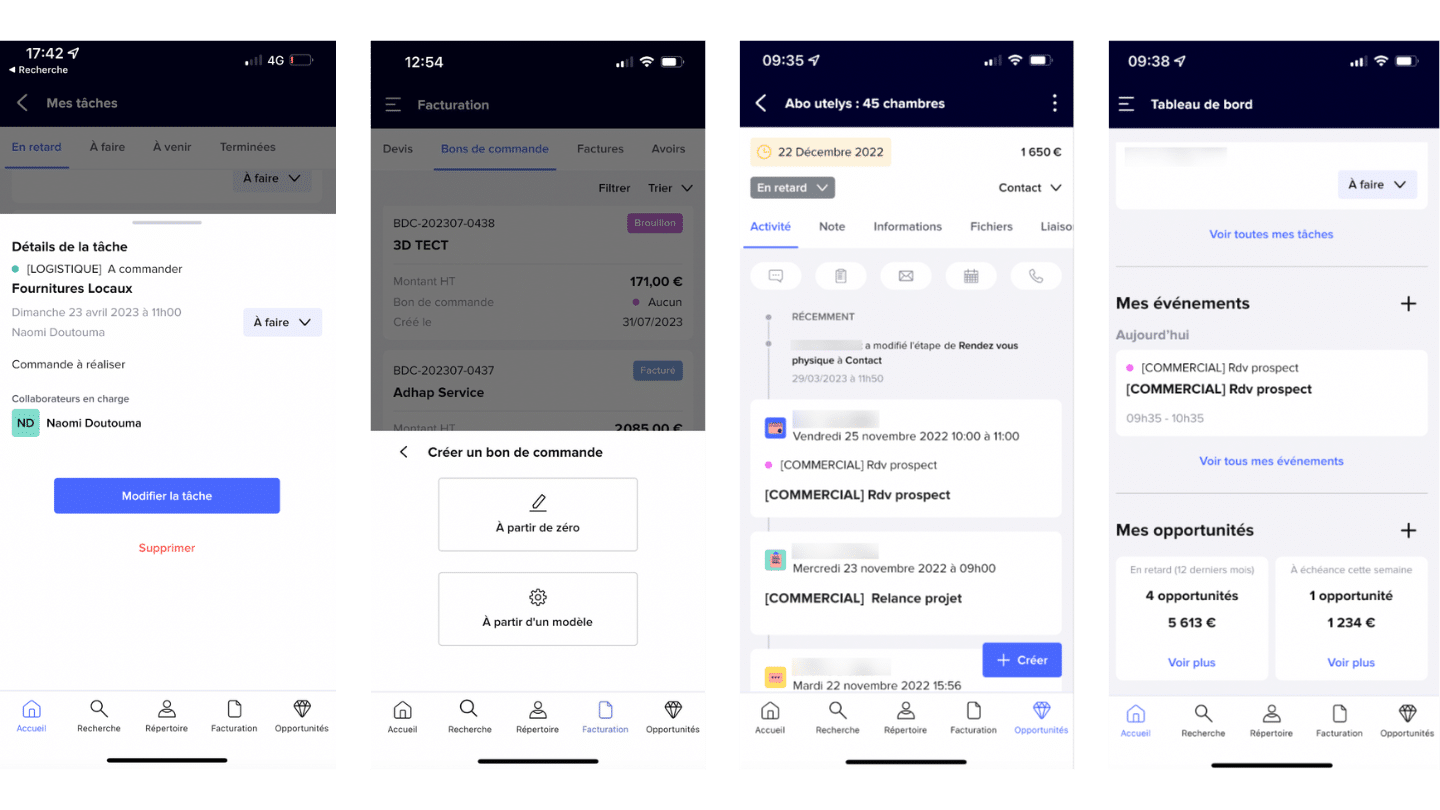
The mobile app is broadly well designed. It lets you manage contacts, look at the history of interactions, create quotes or invoices and receive automatic reminders on a smartphone or tablet. That is clearly a plus for companies with a field sales force.
An important point on security and confidentiality: both the software and the data are hosted in France.
Integrations, things are getting decent
Sellsy has built close to a hundred connectors with third-party tools, to link the CRM to your existing stack. The library notably offers:
- Stock management tools: Stockpit, Altior.
- Marketing tools: Plezi, HubSpot, Livestorm, Unbounce, Typeform, ActiveCampaign, Mailjet, Sarbacane, Mailchimp.
- Integration solutions such as Make (formerly Integromat) or Zapier.
- Accounting software such as Pennylane.
- Payment solutions such as Stripe, PayPal or GoCardless.
- Financial tools such as Revolut, LeanPay or Zenfirst.
- E-commerce CMSs such as Shopify, WooCommerce, Magento or PrestaShop.
On top of that, the Sellsy API lets you connect to other applications and meet more specific needs. It does require a developer, though, which is not nothing for a micro-business.
Customer support, effective in French and weaker internationally
A French-built piece of software based in France, Sellsy has an effective customer service that is easy to reach, by chat or by phone. The teams are available from 9am to 6pm, Monday to Friday.
A FAQ is also on offer, letting users find the answers to the most common questions themselves.
Paid support services are offered on top, notably on importing customer files or on training. To discover the software, the sales teams offer a 30-minute demo.
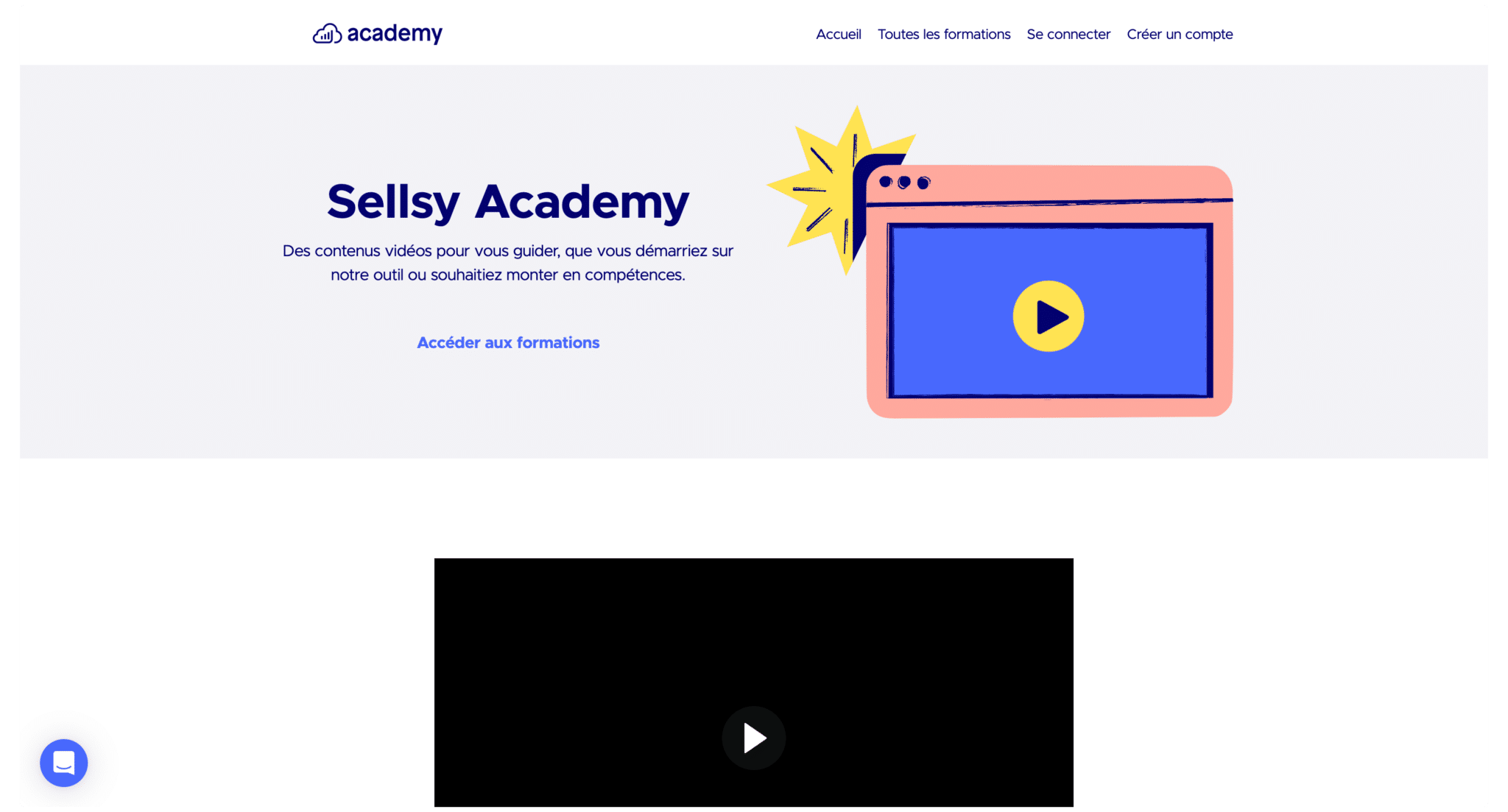
Finally, the Sellsy Academy lets you train on the tool for free. Short tutorial-format videos are published there and cover the essentials of every module.
One reservation, on the other hand, on international support, regularly criticised for its availability and its responsiveness. If your sales teams sit outside France, that is the point to check before you sign, and it is the one that will most likely decide the matter.
Pricing and value for money
Sellsy has no free plan. Whatever the plan you pick, however, you get 15 days of free trial with no commitment.
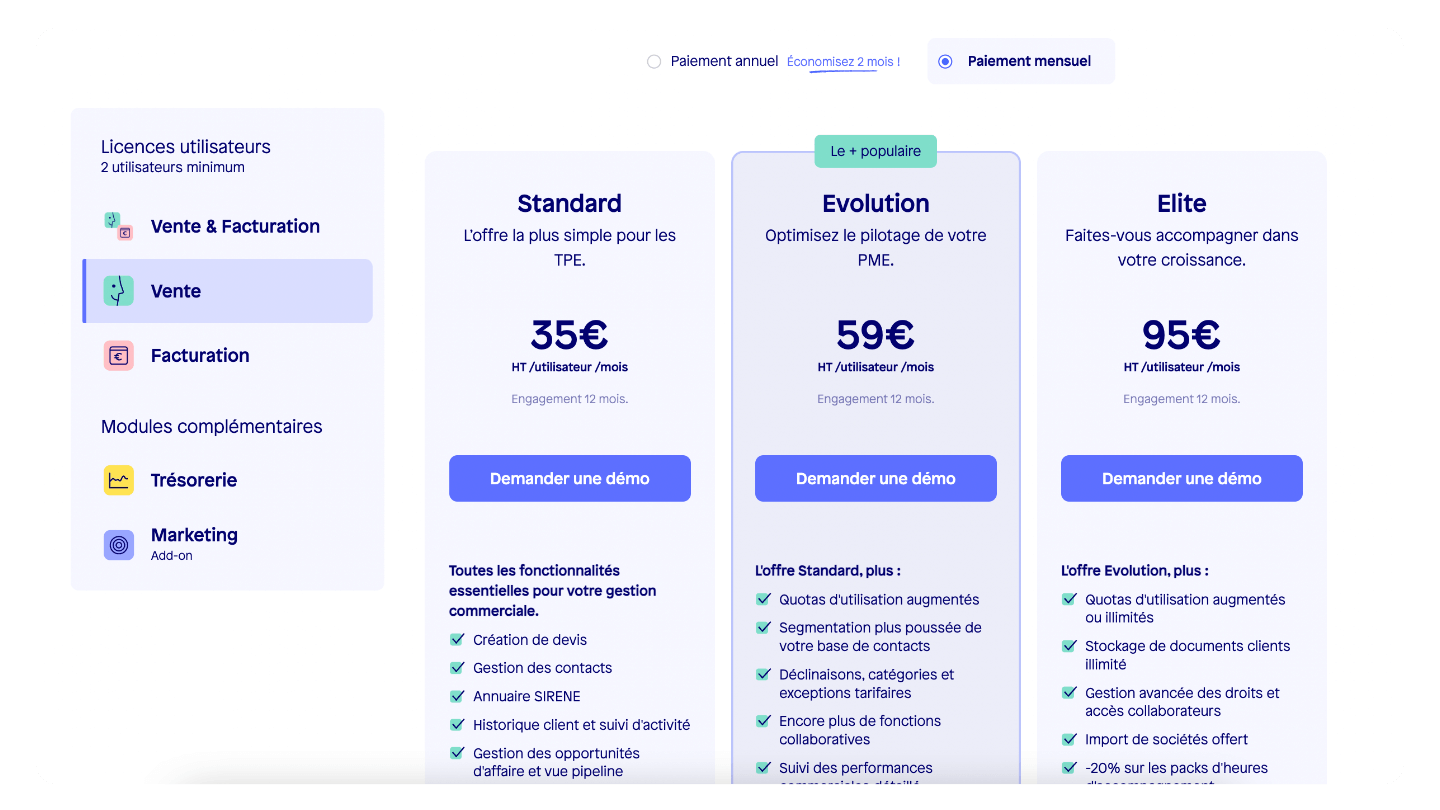
Every subscription commits you for 12 months and starts at 2 users. You can go for monthly payment to smooth the cash flow across the year, but annual payment saves you two months.
The grid works on two axes, depending on whether you use only the sales CRM suite, only the invoicing suite, or both. Prices are then broken down according to the level of support and the volume of use:
- The Standard plan, recommended for micro-businesses, at 35 euros per month per user, capped at 2 users, gives access to every contact base management feature, but with a limit of 3 custom fields to segment your customer file and 1 GB of document storage. Most prospecting features are available, but you are capped at 50 signatures a year. On marketing, the limit is 6,000 emails and 120 SMS a year, but it holds for every plan. Customer support is limited to chat, and access to reporting is restricted. The Standard plan goes to 59 euros per month per user for the Sales and Invoicing suite.
- The Evolution plan, recommended for SMEs, at 59 euros per user per month, capped at 5 users, widens access to features significantly. Field customisation becomes unlimited, storage goes to 10 GB, signatures to 200 a year, and detailed reports open up. Phone support becomes available. The Evolution plan is 107 euros per user per month for the Sales and Invoicing combo.
- The Elite plan, at 95 euros per user per month, available only after a demo and with no cap on the number of users, gives access to the whole of Sellsy’s functional richness. Most limits disappear: unlimited custom fields, unlimited number of reports, unlimited number of products. That plan targets larger SMEs and mid-caps. Budget 143 euros per user per month for the Sales and Invoicing suite.
The cash management add-on
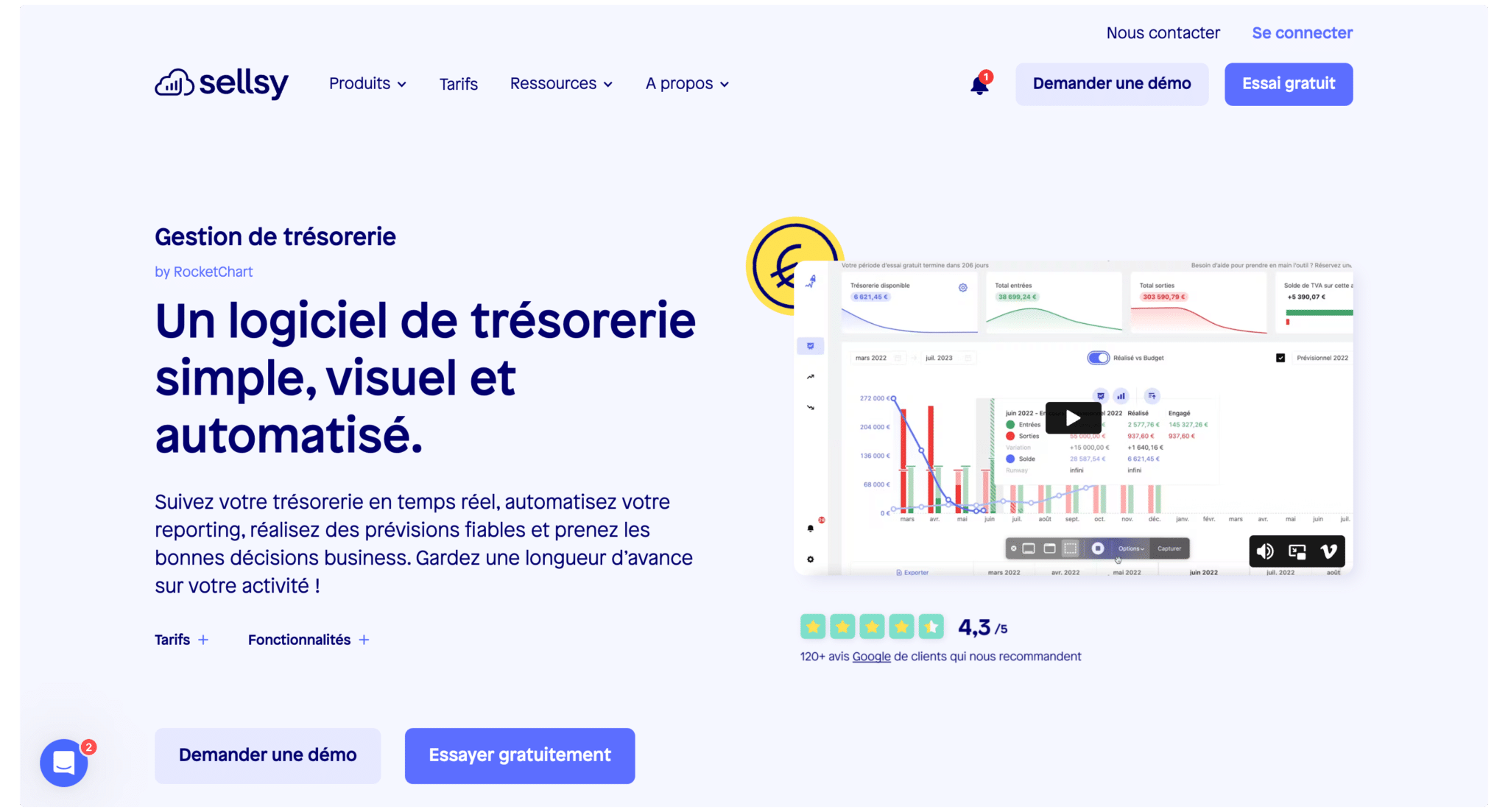
Sellsy offers a cash management add-on. The tool syncs with your bank accounts to allow precise tracking over time. You can build scenarios, import purchase and sales receipts, and centralise all your economic activity in one place. Budget 79 euros excluding tax a month for the Starter plan, 119 euros for the Evolution plan and 189 euros for the Elite plan. Here too, the commitment is annual, with the option to pay monthly.
The marketing campaign add-on
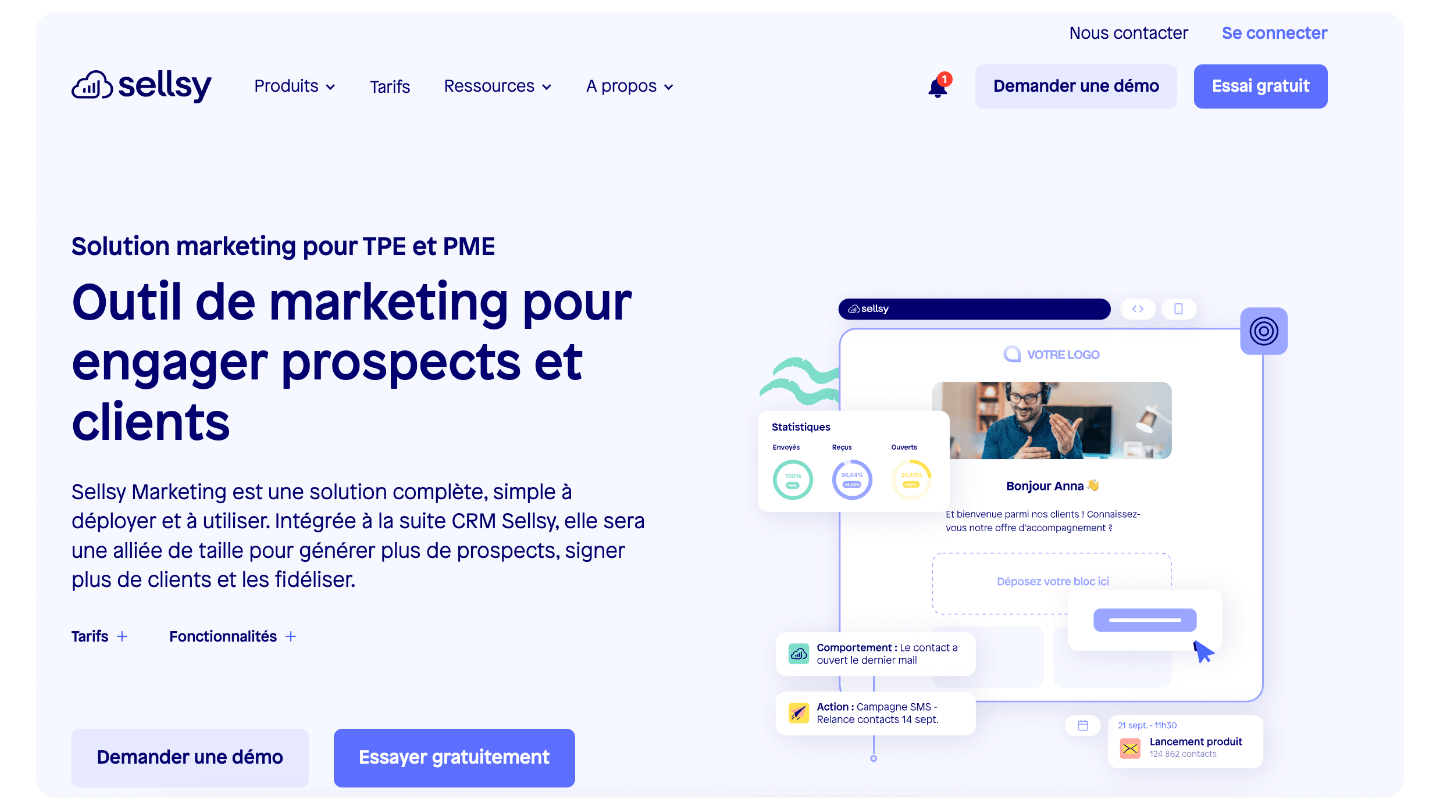
Sellsy now offers a tool dedicated to email and SMS marketing campaigns. It ships a campaign editor, a form editor and a landing page editor. It also lets you score prospects according to how they react to campaigns, set up marketing automation scenarios or build A/B and multivariate tests. The functional richness of Sellsy Marketing is rather impressive for a module built into a CRM.
The marketing add-on comes free by default with every Sales product customer, with a limit of 6,000 emails and 300 SMS a year. To raise the sending volumes and unlock the advanced features (marketing automation, A/B tests, dynamic segmentation), you have to take out a subscription at 59 euros a month with the Evolution plan or 119 euros a month with the Elite plan. The tool can also be used stand-alone, without being a CRM customer.