You have no idea what ChatGPT says about your company when a prospect asks it for advice. HubSpot offers a free tool to find out in two minutes: the AEO Grader queries three AI engines about your brand and gives you a score.
We ran it on noCRM as a test, then read the full report down to the footnotes.
HubSpot’s AEO Grader in two minutes
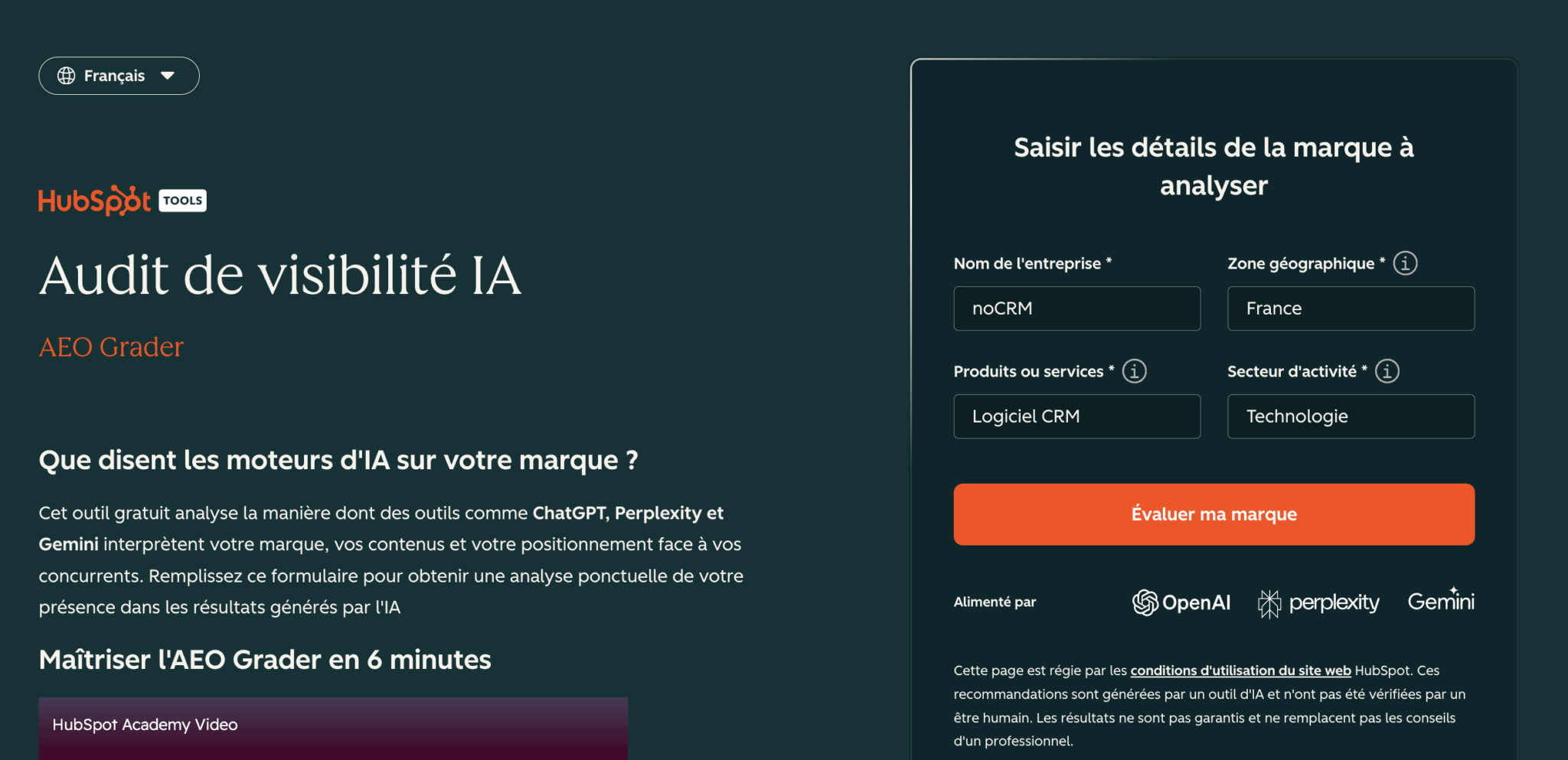
The AEO Grader belongs to HubSpot’s family of free tools, alongside the website grader and the persona generator. Its promise is to measure how AI answer engines talk about your brand.
The form fits in four fields: company name (not the website URL, because what gets analyzed here is a brand and its mentions, not a site), location, products or services, industry. You click, and the tool queries OpenAI, Perplexity and Gemini before showing a score per engine within a handful of seconds.
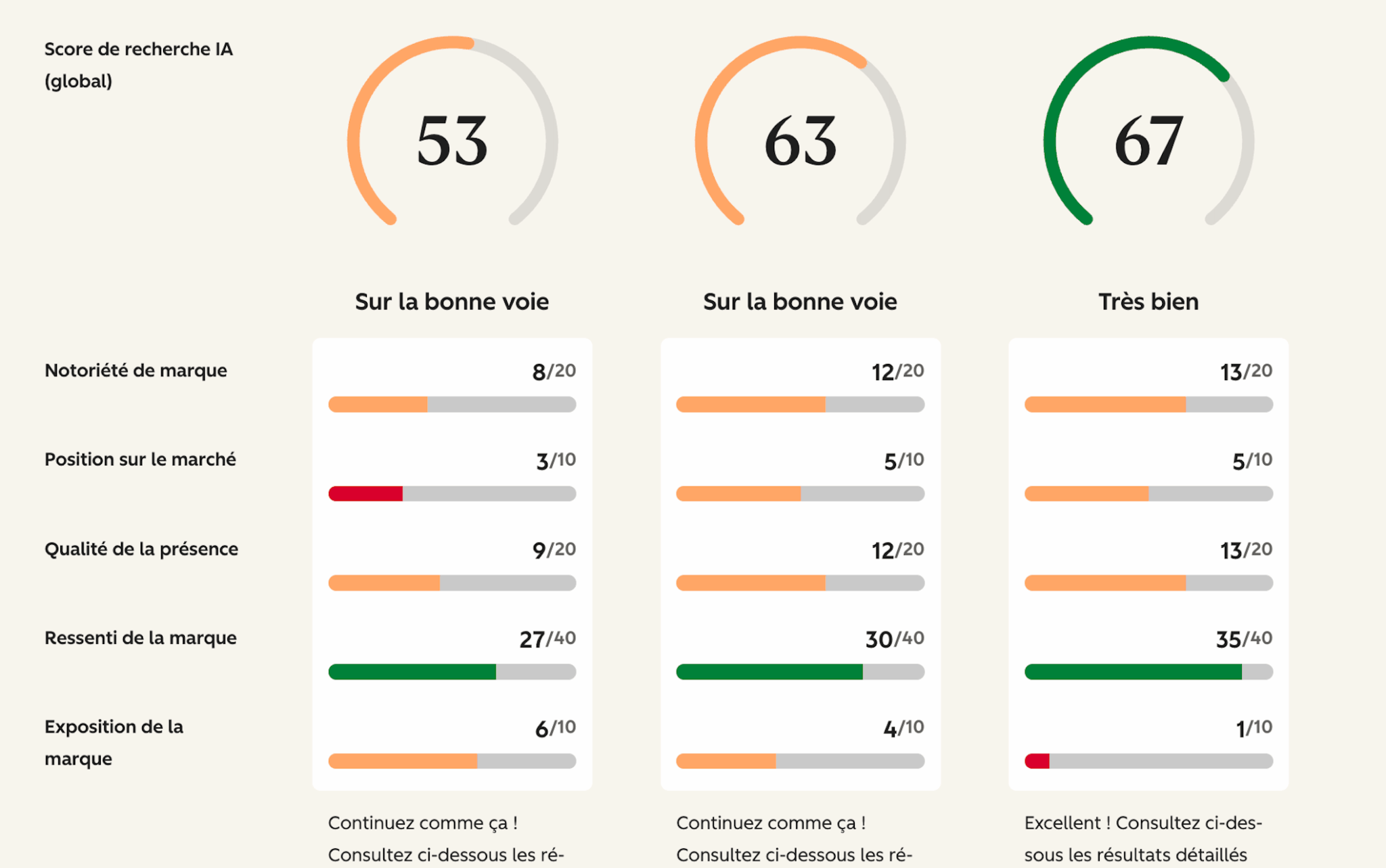
This score aggregates five dimensions, with a weighting that says a lot about the tool’s philosophy:
- Brand sentiment, scored out of 40 points. It is by far the heaviest, because HubSpot considers that the way AI talks about you matters more than the mere fact that it knows you.
- Brand recognition and presence quality, out of 20 points each.
- Exposure (your share of voice against competitors) and market position, out of 10 points each.
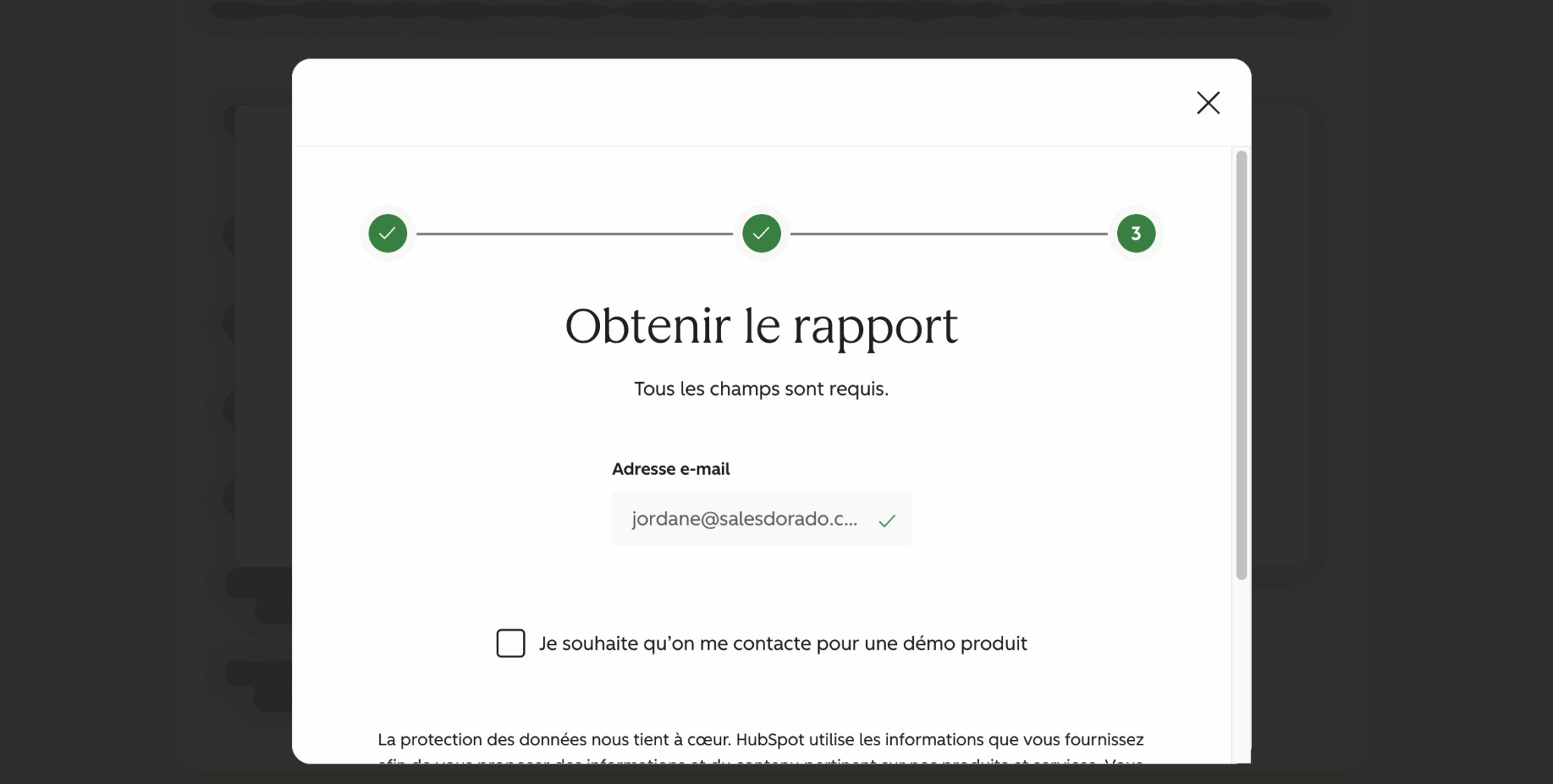
Scores show up instantly, but access to the detailed report requires an email address and offers a checkbox to be contacted by a sales rep. It is an openly assumed lead magnet, like every free HubSpot tool for the past ten years, but the report you get is well worth the email.
Do not confuse it with HubSpot AEO, the paid tool launched in April 2026. The Grader is a one-off, free diagnostic. HubSpot AEO is a continuous tracking platform at €49 per month, with 25 tracked prompts and 10 monitored competitors. The first answers “where do I stand today”, the second “how is it evolving”.
Our test of HubSpot AEO Grader on noCRM: three engines, three verdicts
For this test, we picked a brand our readers know well and that we do not publish: noCRM, positioned on “CRM software”, in France, technology sector.
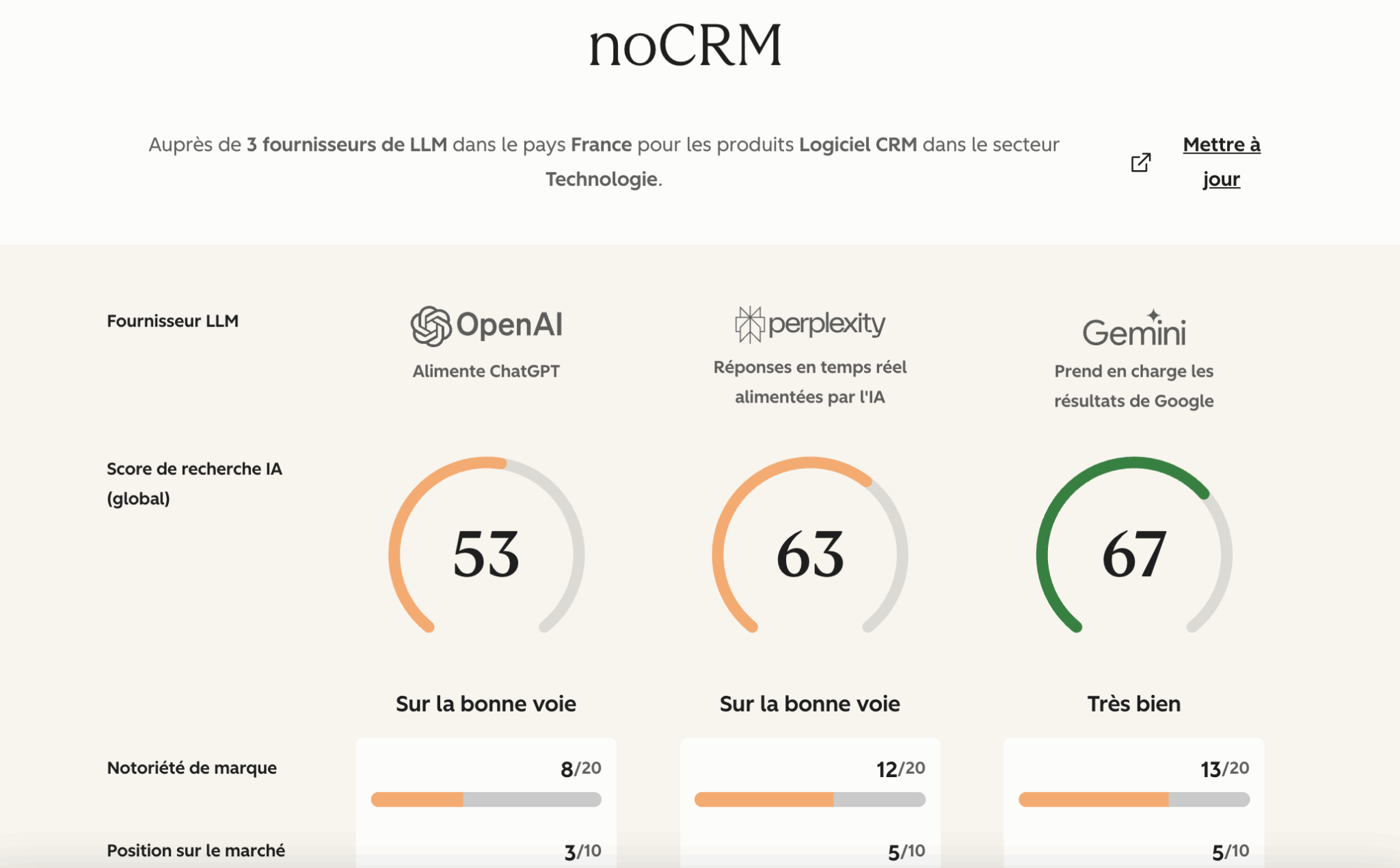
First lesson: the tool does not return one score, it returns three. One per engine. And the gap is far from anecdotal.
| Dimension | OpenAI | Perplexity | Gemini |
|---|---|---|---|
| Overall score | 53 | 63 | 67 |
| Brand recognition | 8/20 | 12/20 | 13/20 |
| Market position | 3/10 | 5/10 | 5/10 |
| Presence quality | 9/20 | 12/20 | 13/20 |
| Brand sentiment | 27/40 | 30/40 | 35/40 |
| Brand exposure | 6/10 | 4/10 | 1/10 |
Fourteen points separate the best score from the worst. Translated into a qualitative verdict, that gives “on the right track” at OpenAI and Perplexity, “very good” at Gemini.
Now look at the last row of the table. It tells something counter-intuitive that the overall score completely hides.
Gemini gives noCRM its best sentiment, 35 out of 40, and its worst exposure, 1 out of 10. OpenAI does the exact opposite: the weakest sentiment of the panel, 27 out of 40, but the best share of voice, 6 out of 10. In other words, ChatGPT cites noCRM relatively often but speaks less well of it, while Gemini says a lot of good things about it but almost never puts it forward against its competitors.
The Salesdorado takeThis is the most useful cross-reading in the whole report, and you have to go looking for it. High sentiment combined with low exposure means “liked but invisible”: the work to do is presence in comparison content and category pages. Low sentiment combined with decent exposure means “visible but badly told”: the work to do is on the sources that feed sentiment, customer reviews, use cases with figures, press coverage. Two opposite diagnoses, two opposite action plans.
Why the scores diverge so much: the answer is in the footnotes
We could have stopped there and concluded that the three engines perceive the same brand differently. That would miss the main point.
The PDF report ends with three lines in small print, easy to ignore, that specify the models queried and, above all, their knowledge cutoff date.
| Engine | Model used | Knowledge cutoff |
|---|---|---|
| OpenAI | GPT-5.4 mini | August 31, 2025 |
| Perplexity | Real-time search | None, active web browsing |
| Gemini | Gemini 3 Flash Preview | January 2025 |
At the time of the test, in July 2026, Gemini was therefore judging a brand on an eighteen-month-old corpus, OpenAI on an eleven-month-old corpus, and only Perplexity was looking at today’s web.
Part of the gap between the three scores therefore does not measure a difference in perception between engines. It measures a time lag. In practice: a company that launched a major product, raised funds or overhauled its positioning in 2026 will look weak at Gemini and decent at Perplexity, without its actual visibility having anything to do with that gap.
Two honest caveats are in order:
- First, this constraint is not specific to HubSpot: every GEO measurement tool queries models frozen at a given date, and most of its competitors document it nowhere. HubSpot does, even if it is in small print, and that is rather to its credit.
- Second, the models used are fast, lightweight versions, mini and flash, which makes sense for a free tool that has to answer in a few seconds, but remains different from what a prospect gets in the consumer interface of ChatGPT or Gemini.
In the full report, the text is worth more than the numbers
The detailed report is obtained in exchange for an email address, then downloaded as a PDF or shared with your team via a link. It is much richer than the on-screen preview.
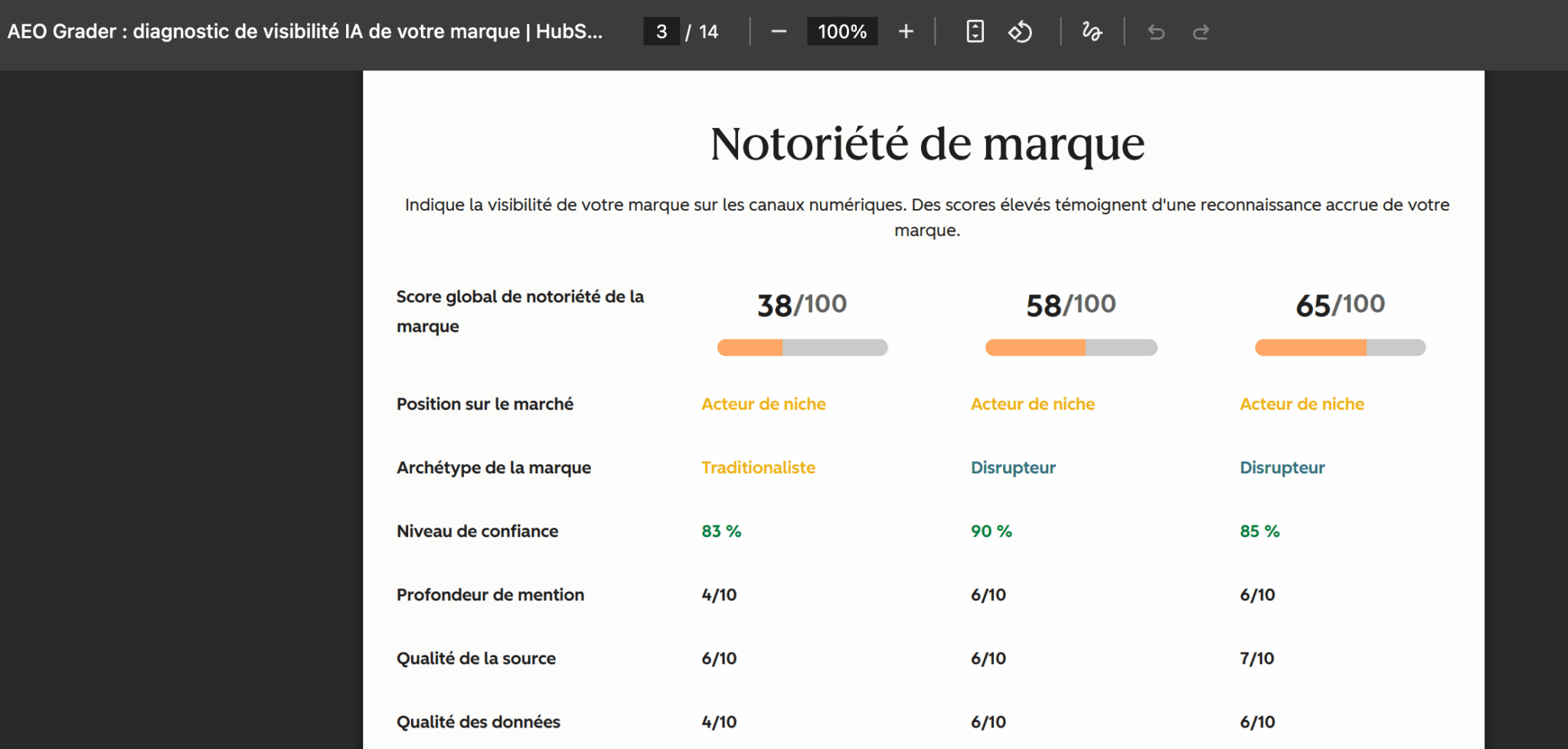
After going through it with a fine-tooth comb, our reading fits in one sentence: the figures call for caution, the qualitative analysis is excellent. Exactly the opposite of what the layout suggests.
What calls for caution
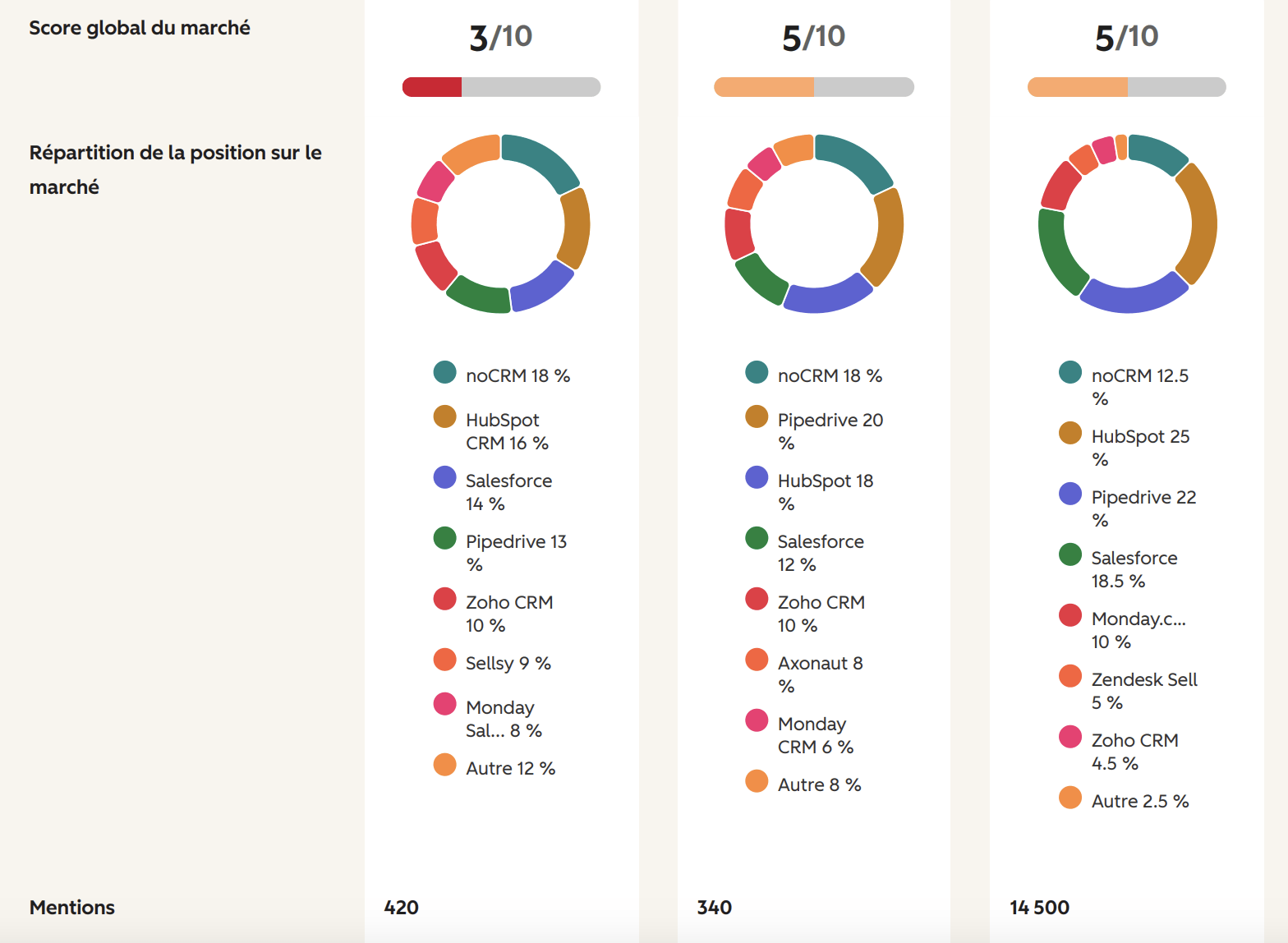
- Mention volumes. The report announces 420 mentions at OpenAI, 340 at Perplexity and 14,500 at Gemini. A factor of 43 on the same brand on the same day, with the largest volume attributed to the engine whose corpus is the oldest. These orders of magnitude are not comparable with each other.
- The market share pie chart. Two engines put noCRM at the top of French CRM with an 18% share, ahead of HubSpot and Salesforce, while all three columns describe noCRM as a niche player a few lines above. The apparent contradiction has an explanation: the chart measures a share of voice in AI answers on the queries tested, not an actual market share. The nuance is crucial and worth keeping in mind.
- Confidence levels. They range between 83 and 90% on conclusions that clearly diverge. High confidence relates to the internal consistency of the analysis, not to its accuracy.
- The brand archetype. OpenAI classifies noCRM as a traditionalist, Perplexity and Gemini as a disruptor. For a brand whose entire positioning rests on being anti-CRM, the first label is surprising and illustrates the effect of the available corpus well.
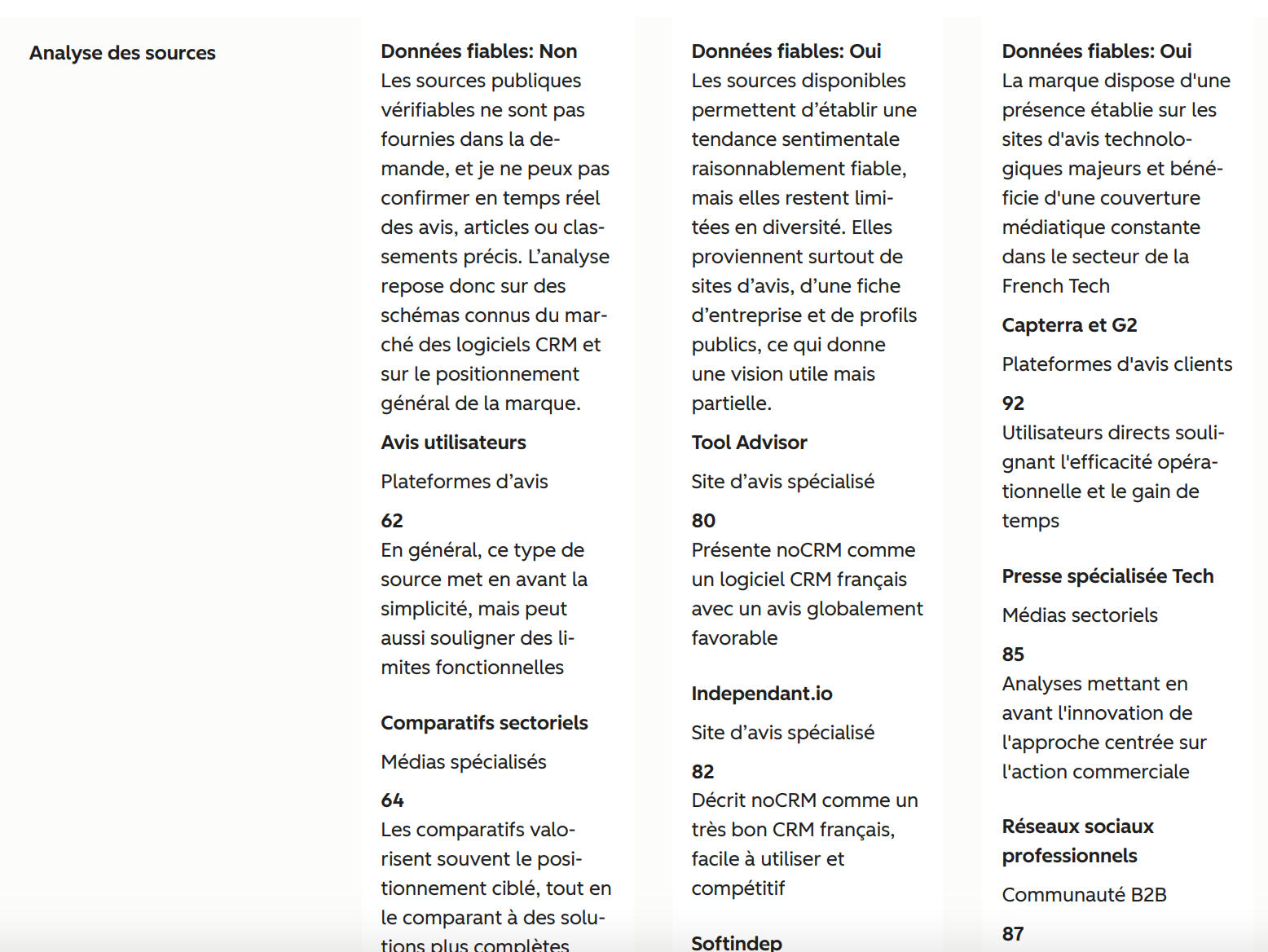
One point works in the tool’s favor: the “source analysis” section explicitly states, for OpenAI, that reliable data is not available and that the analysis relies on known patterns of the CRM market. The tool therefore flags on its own when it is extrapolating. You still have to read it, but the information is there, and many competing tools do not display it.
What holds up very well
- Named sources. Perplexity lists precisely the pages that feed its perception, with a score per source: specialized review sites, the company’s LinkedIn profile, an app store listing, a SaaS database. You can open them one by one and check. It is the most directly actionable part of the report.
- Narrative themes. The three engines converge: simple, sales-oriented CRM, lightweight alternative to traditional CRMs, anti-CRM positioning focused on sales action, French solution born in Paris in 2013. Anyone who knows noCRM will recognize a faithful summary. That is valuable, because these are the sentences that will come up in front of your prospects.
- The polarization indicator. Scored 38, 28 and 15 depending on the engine, it measures whether the market is divided about you. A low figure signals consensus, a high figure strong opinions. Few tools offer this reading, and it is strategically useful.
- Growth areas. Strengthen differentiation against generalist CRMs, develop the integration ecosystem, better address growing teams. It is not revolutionary, but it is accurate, consistent from one engine to the next and directly transferable into a content roadmap.
The Salesdorado takeOur reading advice: start with the narrative themes and the list of sources, not with the gauges. The sentences AIs use to describe your brand and the pages that feed them give you an immediate action plan. The scores mainly serve as a directional benchmark and a point of comparison between competitors.
The tool’s best use is not the one you think
Here is what the product page mentions in a simple FAQ question, even though it is by far the most profitable use case: the AEO Grader accepts any brand.
We have just demonstrated it, in fact. noCRM is not our brand, and nothing stopped us from auditing it in full.
So you can put your competitors under the microscope, for free, as many times as you like. For each one, you get the exact sentences AIs use about them, their strengths as the market perceives them, the archetype associated with them, the sources that carry their reputation and their share of voice against you.
The Salesdorado tipBlock out thirty minutes and run the audit on your brand, then on four competitors, keeping exactly the same location, product category and industry parameters. Without identical parameters, the comparison is worthless. You then get a reading grid that very few marketing teams have today: who gets cited, on which themes, with which sources. That is competitive intelligence work that would have taken several days two years ago.
Stepping back: where GEO really stands in 2026
A score without context is useless. Here is the framework this tool fits into.
#1 The shift is structural
B2B buyer behavior has changed faster than acquisition strategies. Nearly 60% of Google searches now end without a click, and ChatGPT has passed 900 million weekly users. At HubSpot, customers’ organic traffic fell by 27% in one year, while visitors referred by AI platforms convert 4.4 times better than classic organic traffic. In France, the arrival of Google’s AI Overviews completed the switch of the last major French-speaking market.
The consequence is simple: your prospect can form an opinion about your category, rule out your brand and shortlist a competitor without ever visiting a single website.
#2 A tool market that is exploding
The sector went from zero dedicated players at the end of 2023 to more than sixty listed products in 2026, fragmenting faster than SEO did in the 2000s.
Prices range from free to several hundred euros per month. Entry-level tools start around $29 for about fifteen tracked prompts, mid-range platforms sit around €90 to €150 per month, and enterprise solutions are negotiated on quote. A French offering is also taking shape, alongside the SEO suites that have all bolted on an AI visibility module.
In this landscape, the fact that the AEO Grader is free is an objective argument. For a team that has never measured anything, subscribing before even knowing whether the topic is strategic for them is the classic mistake.
#3 The methodological limit nobody should ignore
It needs to be said clearly, and it applies to the whole category: language models are not deterministic. Ask the same question twice and you will get two different answers.
Research on measuring visibility in generative search is unambiguous on this point. A query run only once can produce a result noticeably different from a second query run a few minutes later under identical conditions, so a single observation risks overestimating or underestimating a brand’s actual presence. The methodological conclusion that follows: AI visibility should be thought of as a probability of being mentioned, measured over repeated runs, not as a stable ranking.
What this means for you is very concrete: an AEO Grader score is a compass, not a management KPI. It points to a direction and sheds light on a diagnosis. It is not meant to appear in a monthly report or to serve as a numerical target for a team.
What really moves the needle
Improving your AI visibility depends less on tooling than on the sources the models consult.
Four levers come up systematically:
- Publish concrete proof with figures rather than promises.
- Keep a consistent message between your website and your third-party profiles.
- Get coverage in recognized sources.
- Structure your content so that a model can easily reuse it, with self-contained sections and direct answers.
Should you then move to HubSpot AEO?
The question is legitimate, because the whole Grader journey leads there. Our answer is nuanced.
The limits we have just documented are precisely the ones a continuous tracking tool fixes. Where the Grader generates standard queries on its own, HubSpot AEO tracks up to 25 prompts that you choose, the ones your buyers actually type. Where the diagnostic is one-off, tracking becomes continuous and lets you measure a trend rather than a snapshot. On top of that come tracking of 10 competitors and identification of the sources actually cited. At €49 per month with no HubSpot subscription required, the positioning is aggressive in a market where equivalent platforms often start higher.
The real differentiating argument lies elsewhere, though, and it only holds for some readers: for users of HubSpot CRM and Marketing Hub, prompts are generated from actual CRM data, customer conversations and saved segments, and recommendations plug directly into the content creation tools. You export nothing, you act right away. If you already live in HubSpot, the consistency is hard to beat. If you do not, compare calmly with the specialized platforms on the market, some of which cover more engines.