Every comparison of electronic signature software has you compare prices per user. That is precisely the wrong metric. The per-seat model bills you for every new person who sends a document, which turns your signature tool into a cost center as soon as the team grows.
Unlike that model, Certyneo offers a flat plan with a set number of users included and the same price whether you are one or ten. On the Standard plan, ten users cost €19 a month, where most competitors would bill you for ten licenses.
Does the product hold up behind the pricing promise? Which signature level should you pick for which document? And where are the limits of this still-young vendor? We opened an account and tested it.
What is Certyneo?
Certyneo is an electronic signature vendor compliant with the eIDAS regulation, positioned as a European alternative to the long-standing American platforms. The infrastructure is hosted by IONOS, in the European Union, which takes the data out of the scope of the Cloud Act and FISA.
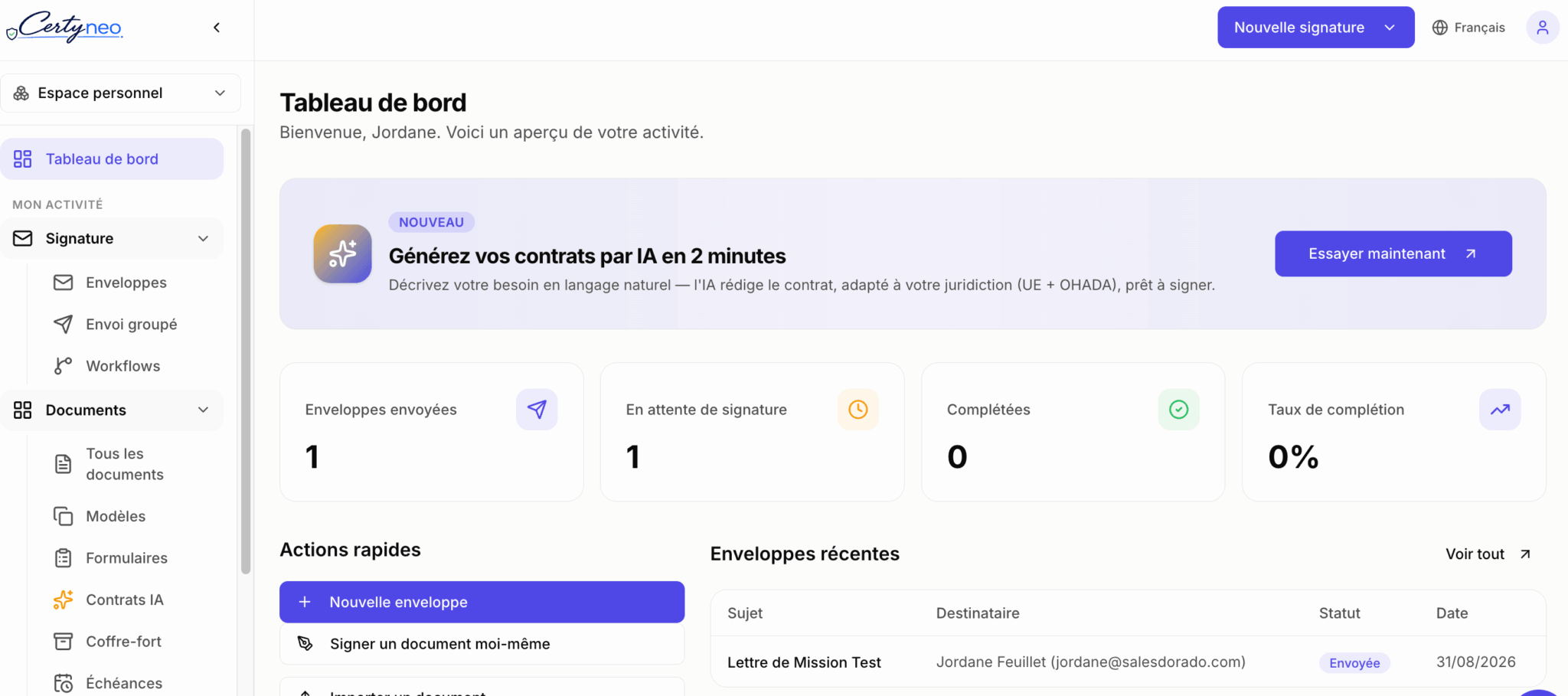
The platform is organized into three modules, with separate counters and subscriptions:
- Electronic signature, the core product, billed by the number of envelopes sent.
- AI Contracts, an AI contract generator that sits upstream of the signature.
- The digital vault, for archiving with evidential value and long-term retention.
This split works in your favor: you only pay for the building blocks you need, where other vendors force a full bundle from the very first tier.
The vendor publishes its roadmap and changelog openly. Over the last few months, the pace has been brisk: Slack, HubSpot and Salesforce connectors, public developer documentation, an interface in five languages, a Make connector, push notifications. Support for the European digital identity wallet planned under eIDAS 2.0 is on the roadmap, which puts it ahead of the market.
An overview of Certyneo’s main features
Creating and sending an envelope
An envelope groups one or more documents, signers and fields to fill in. The import accepts PDFs, Word files and images.
The editor displays the document and you drag the fields straight onto it: signature, initials, date, checkboxes, text fields. An automatic suggestion button detects the relevant areas, with good results on a structured document. It saves real time on a contract running to several pages.
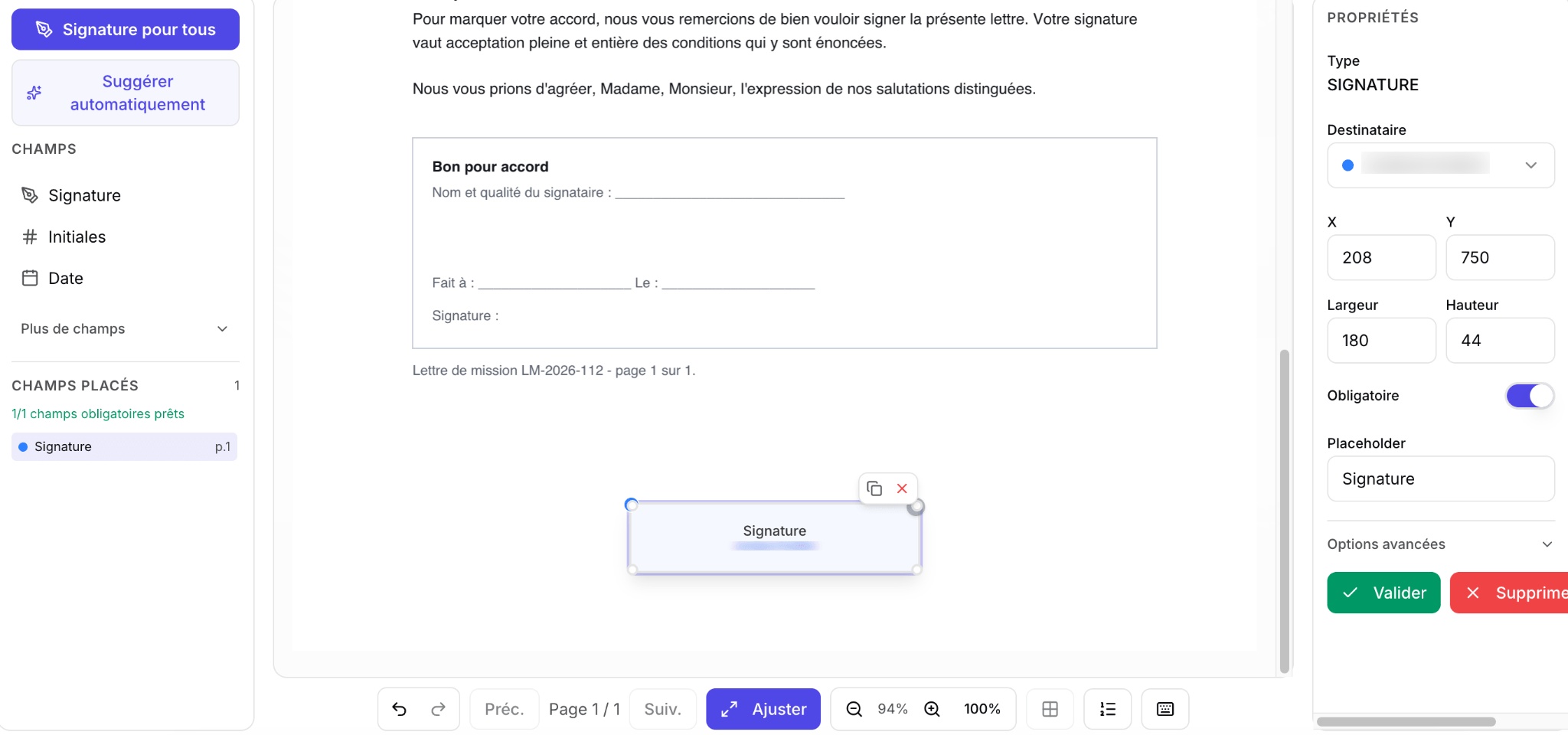
Each field has editable properties: assigned recipient, exact coordinates, dimensions, required or not. A counter permanently shows how many required fields are ready, which keeps you from sending an incomplete envelope. A simple detail, but one we would like to see more often.
The signing order can be set to sequential or parallel. Sequential is for when one approval depends on another, typically a purchase order that goes through the CFO before reaching the supplier. Automatic reminders and expiry dates are included.
Templates and bulk sending
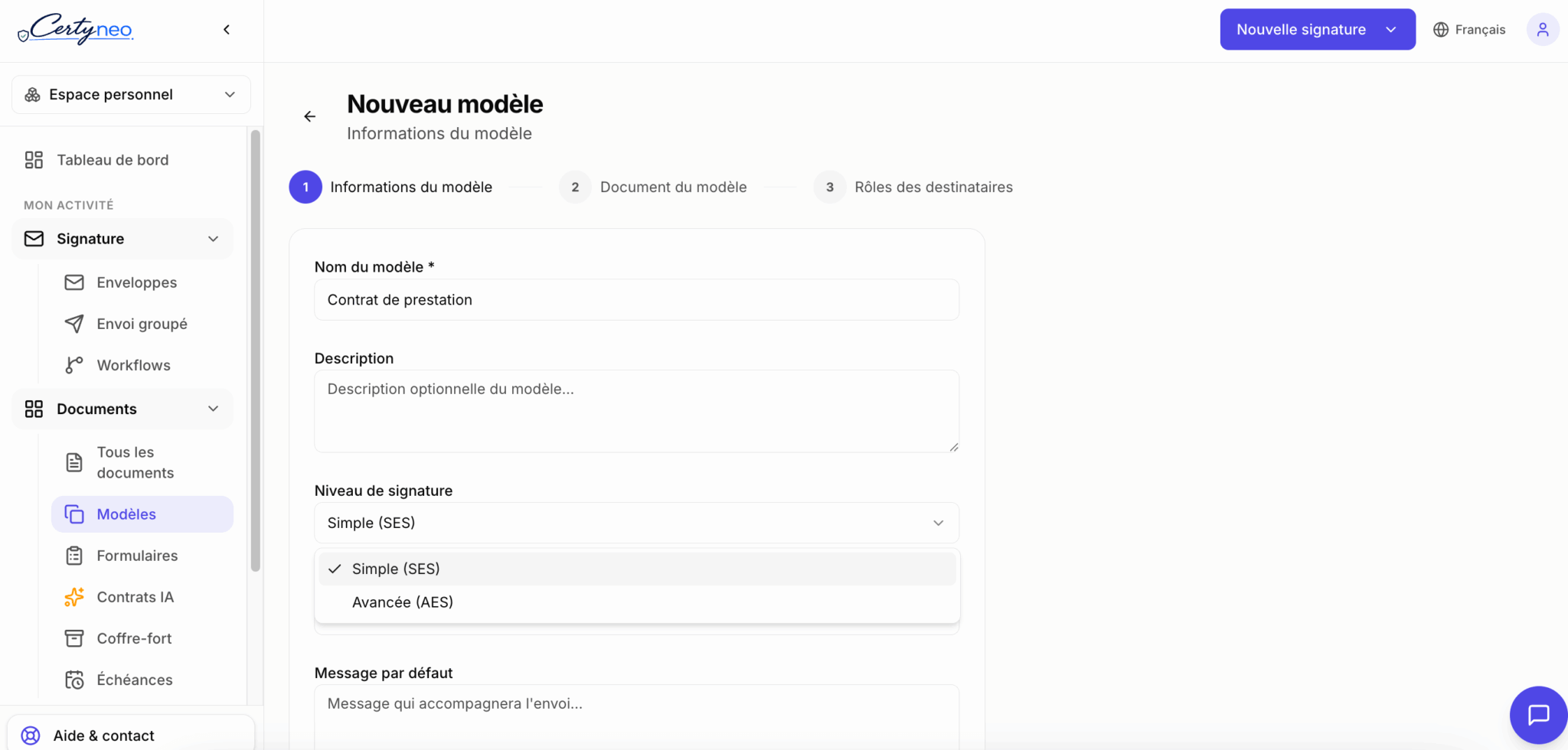
As soon as you regularly sign the same type of document, templates make the difference. Certyneo builds them in three steps: general information, reference document, then recipient roles. This notion of roles is well thought out: it saves you from re-entering the signers on every send.
Bulk sending works through a CSV import. You upload your list of recipients, Certyneo generates one envelope per row from the same document, with automatic reminders and real-time tracking. It is the mechanism you need for a terms and conditions overhaul or a campaign of contract amendments across several hundred files.
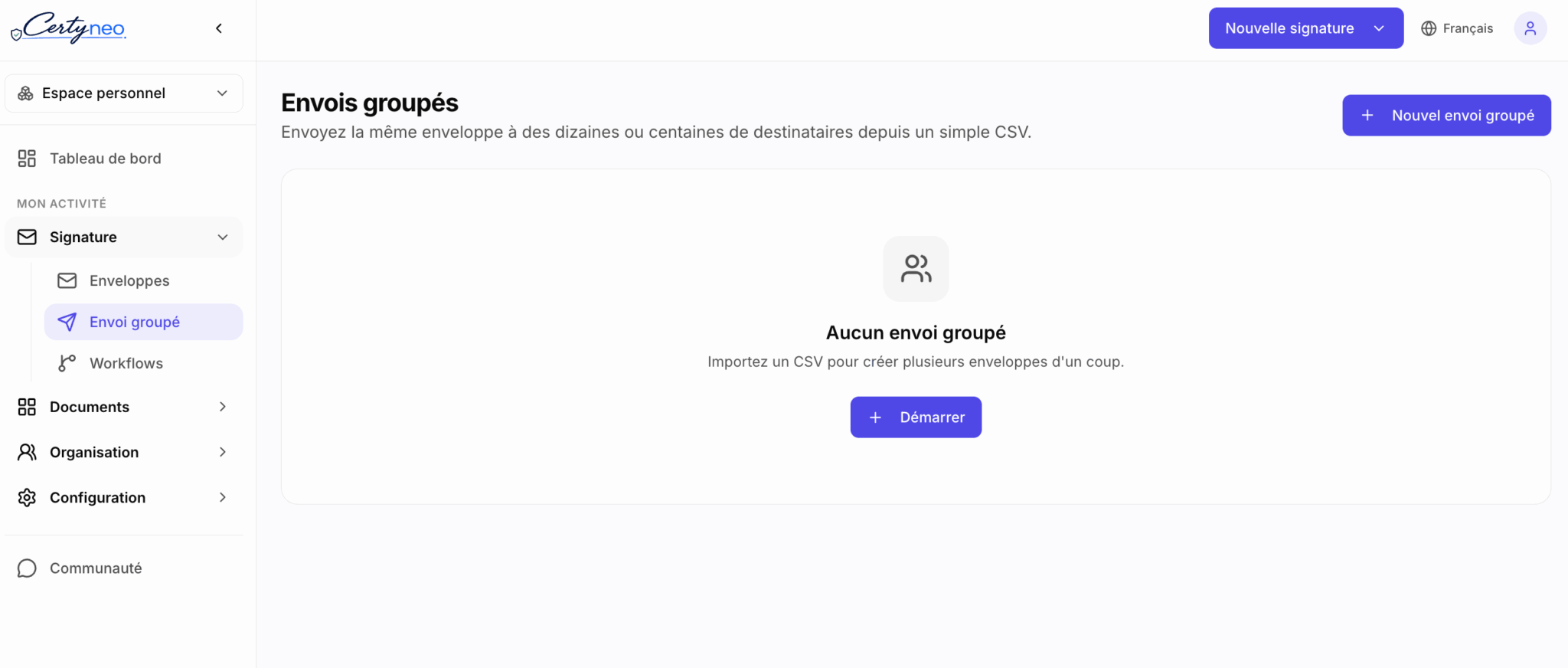
The feature is available from the Standard plan.
Business workflows
This is the most polished part of the product, and the one that convinced us most.
Certyneo offers a library of preconfigured signing sequences, filterable by line of business. The employee onboarding workflow chains the employment contract, the non-disclosure agreement, the internal rules and HR approval. The mutual termination agreement workflow places an internal approval step before the two-party signature. On the real estate side, you get the residential sale and the residential lease, with the move-in inspection report and the joint guarantor.
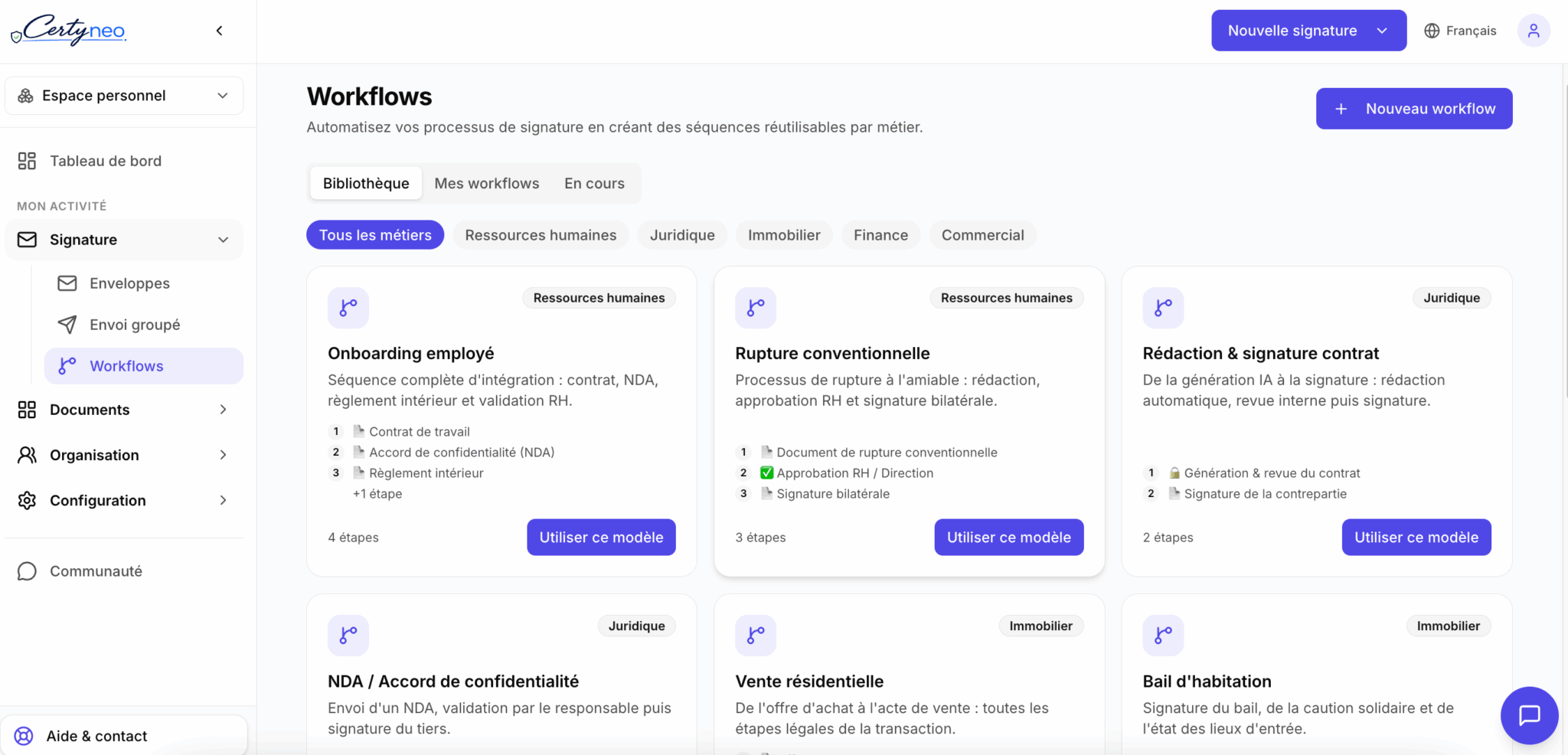
The steps match real processes, with the right approval points in the right places. For a recruitment firm or a real estate agency, for example, the setup time saved is considerable compared with a tool where everything has to be built. This is where Certyneo pulls furthest ahead of the general-purpose solutions.
Don’t start your test with a simple envelope: everyone knows how to get a PDF signed. Go straight for a business workflow from the library. That is where the real difference with competitors plays out, and it is usually what wins over HR and real estate teams.
The signer’s journey
The recipient gets an invitation email with a button leading to the signing page. No account to create, no app to install.
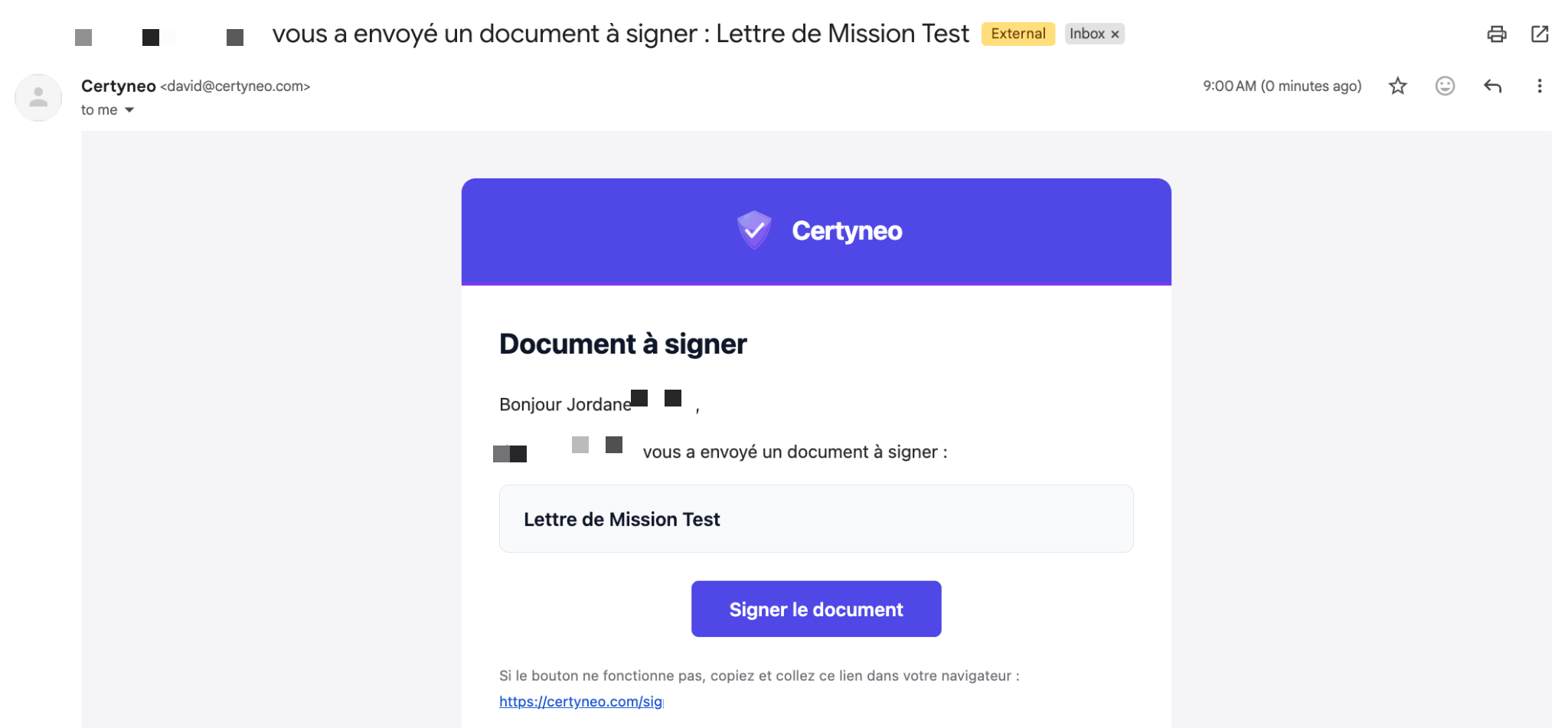
The signing page shows the document with the fields to fill in highlighted. The signature can be applied in three ways: drawn with the mouse or a finger, typed in a handwriting-style font, or uploaded as an image of a signature.
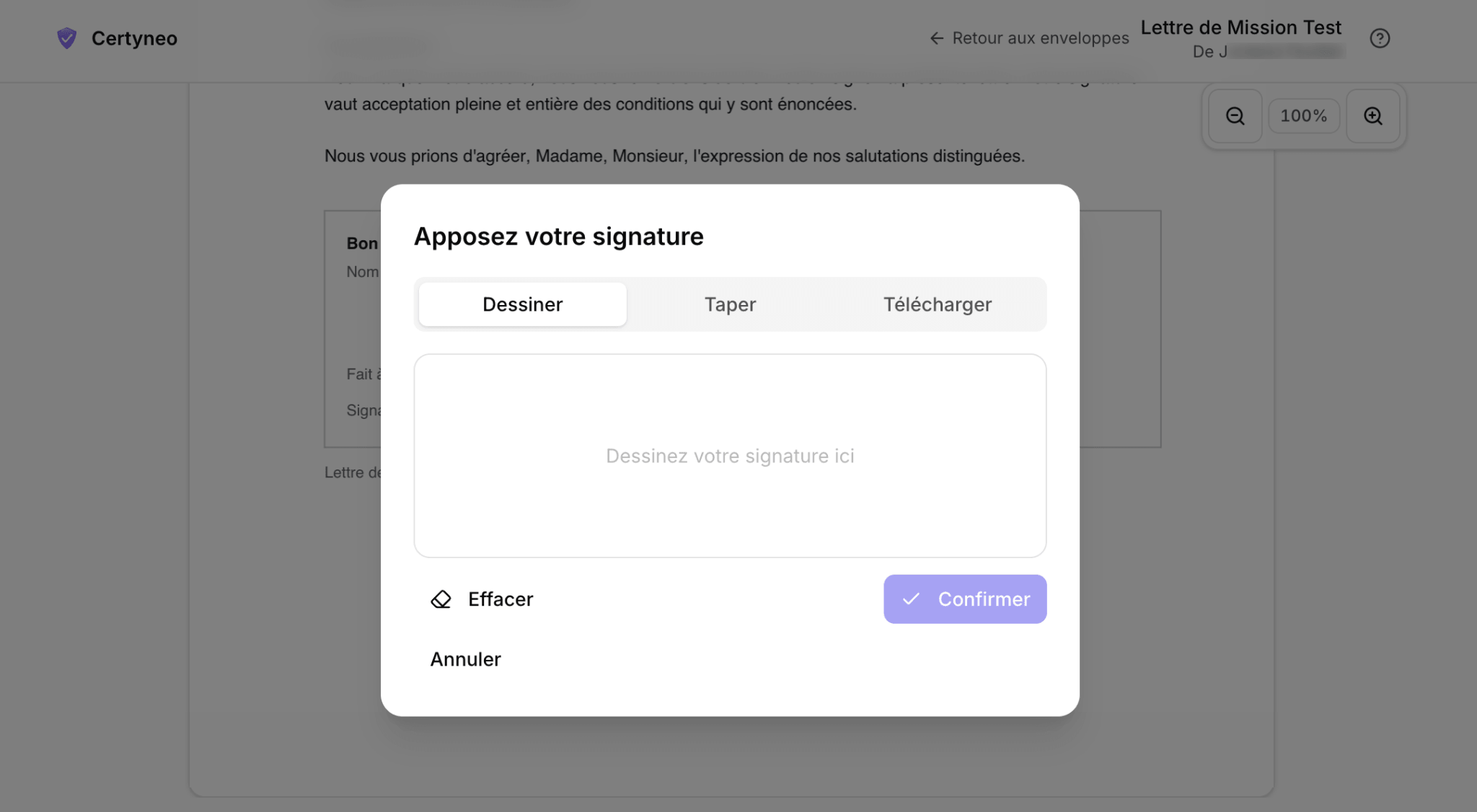
The whole thing takes under two minutes on a one-field document. It is clean, with no needless friction. On this ground, Certyneo stands comparison with the best on the market, and this is what matters most for your completion rate.
The AI contract generator
Certyneo includes an AI contract drafting module, upstream of the signature. You describe your need in plain language, choose a jurisdiction and a language, and the tool produces a draft contract in four steps.
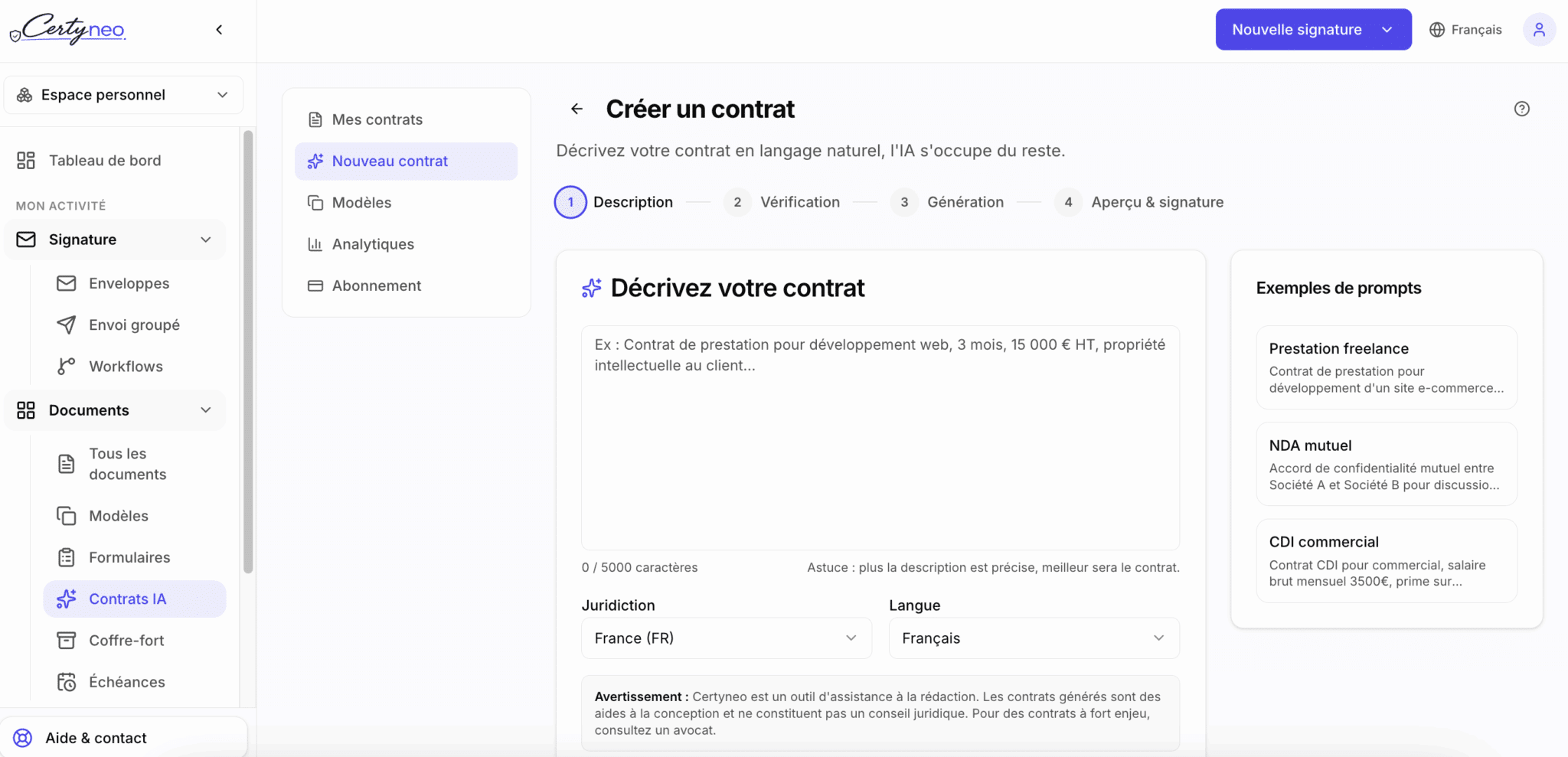
Sample prompts are offered: freelance services agreement, mutual non-disclosure agreement, permanent sales employment contract. Jurisdictions cover the European Union and the OHADA area. Drafting then signing in the same tool removes a round trip and an export.
To its credit, the vendor displays a warning under the input field, stating that generated contracts do not constitute legal advice and that a lawyer is still needed on high-stakes matters. That is the right position, and it is rarely stated this clearly by vendors selling legal AI.
The module is a separate subscription starting at €19 a month, with a 14-day trial.
Security, hosting and compliance
The three signature levels
Certyneo offers the three levels defined by the eIDAS regulation on a single account. You choose at the time of sending, envelope by envelope, without changing subscription. A real convenience compared with offers that lock the level into the plan.
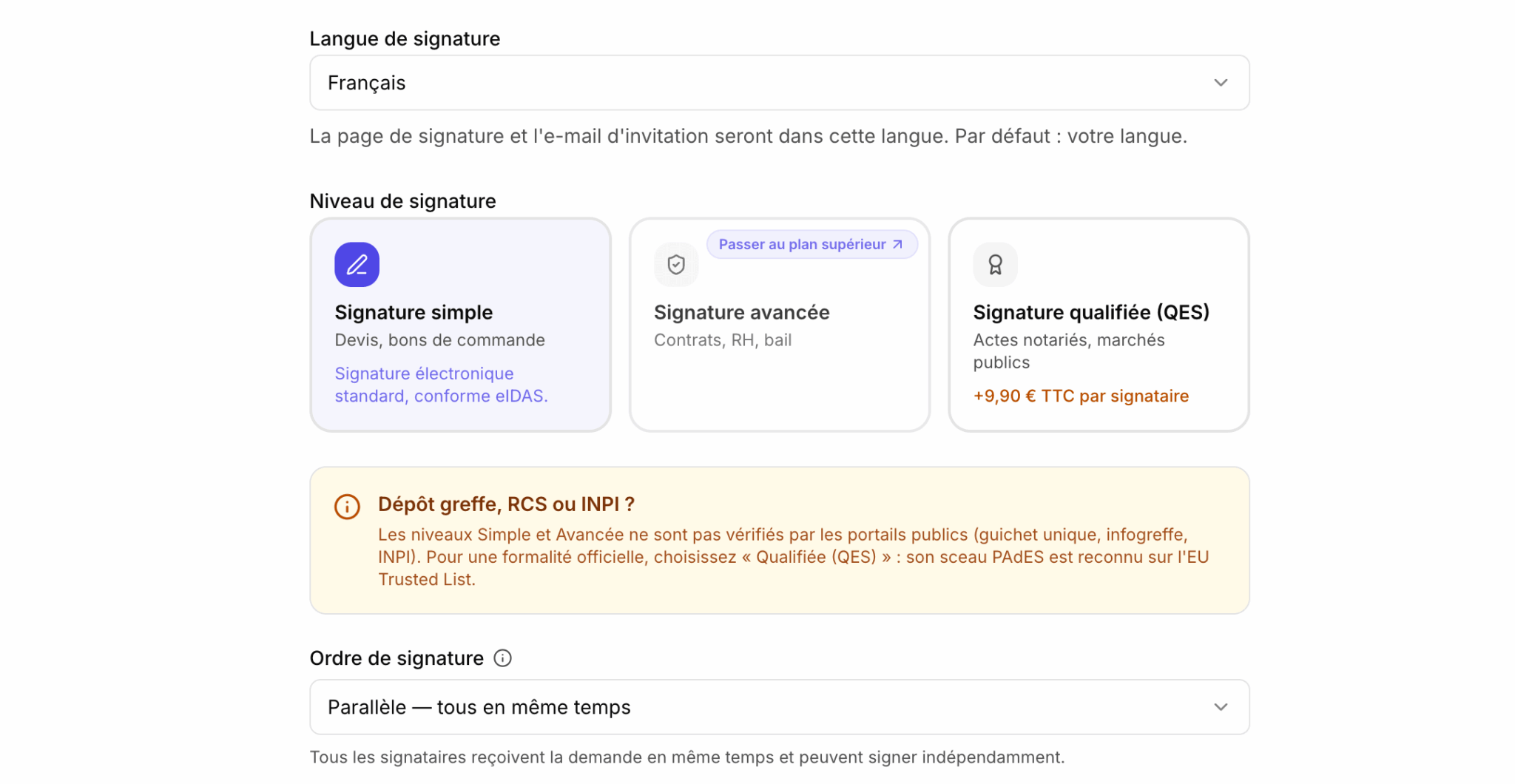
- The simple signature is included in all plans, the free one too. It covers quotes, purchase orders and documents with a low risk of dispute, in other words the vast majority of business volumes.
- The advanced signature adds authentication by an SMS code sent to the signer’s mobile. It is meant for contracts, HR documents and leases. It starts with the Personal plan at €9 a month.
- The qualified signature targets notarial deeds, official filings and public procurement. It is billed per use on every plan, the free one included: €9.90 excl. VAT per signer with a paid subscription, €14.90 excl. VAT without a subscription.
One reservation on the advanced level, though: identification relies on the SMS code alone, with no ID document check. Some competitors require proof of identity at the same level. For an employment contract or a mandate, the optional video identity capture usefully closes that gap.
We did not test the qualified signature, since triggering it is billed per use. If you need it for an official formality, ask the vendor to confirm in writing which qualified trust service provider issues the certificate. That is good practice with any platform.
Security and standards
On the technical fundamentals, Certyneo ticks the expected boxes:
- TLS 1.3 encryption in transit
- AES-256 at rest
- Timestamped audit trail on every step of an envelope’s life cycle
- SHA-256 fingerprint on signed documents
Signed documents follow the PAdES formats and RFC 3161 timestamping, which matters more than it seems: your documents remain verifiable and enforceable after your account is closed, with no dependency on the platform. 10-year archiving is included in all plans, the free one too, where some competitors charge for it as an option.
On certifications, the vendor has no published third-party audit yet. An ISO 27001 audit is announced for the end of 2026 and a SOC 2 Type II report for 2027. That is the normal timeline for a vendor that is scaling up, but if your procurement process requires a certification today, you will have to wait.
The free plan remains usable with no time limit, but its volume shrinks fast: 5 envelopes over the first 14 days, then 2 a month. Check that this volume is enough for you before relying on it. And Certyneo is not HDS certified: if your documents contain medical data in the body of the text, you need a certified host.
Certyneo pricing
Prices are monthly with no commitment, with a discount of about 16% for annual payment. No per-user surcharge, whatever the plan.
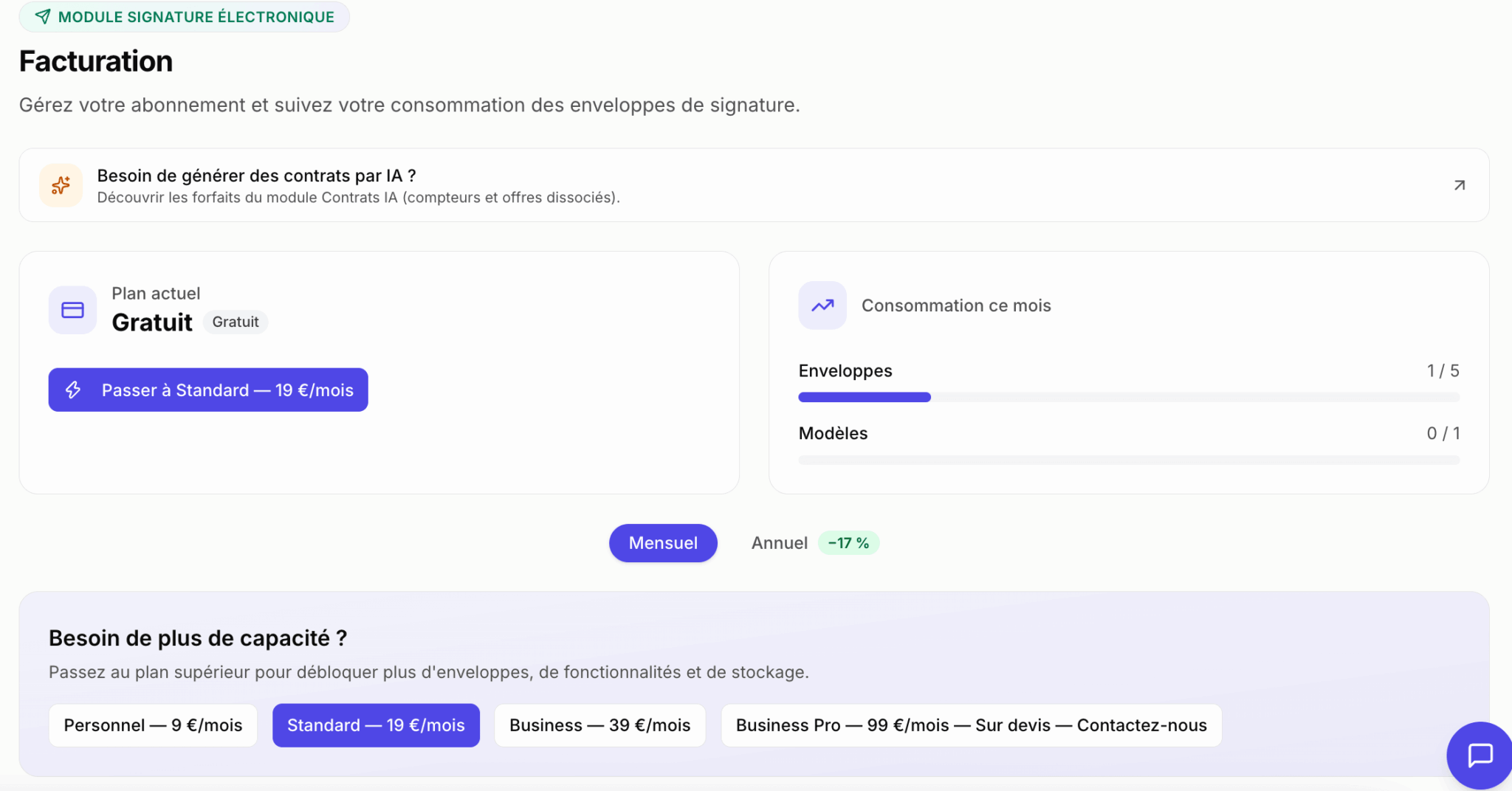
| Plan | Price excl. VAT / month | Envelopes | SMS included | Users | Key points |
|---|---|---|---|---|---|
| Free | €0 | 5 then 2 | None | 1 | Simple signature and 10-year archiving, no credit card |
| Personal | €9 | 25 | 25 | 1 | Unlocks the eIDAS advanced signature |
| Standard | €19 | 100 | 100 | 10 included | REST API, webhooks, custom branding, 25 templates, CSV bulk sending |
| Business | €39 | 300 | 300 | 25 included | Bulk sending, mobile web forms, payment collection |
| Business Pro | €99 | 1,000 | 1,500 | Unlimited | SAML SSO, high-frequency API, priority support |
| Enterprise | From €299 | On quote | Negotiated | Unlimited | Dedicated SLA, 24/7 support, custom data processing agreement |
The volume-to-price ratio is genuinely good. A hundred envelopes and ten users for €19 a month is below what the established players charge for an equivalent scope, and the gap widens as you equip more people.
Two useful clarifications to compare fairly with the competition:
- The displayed prices exclude VAT: add 20% VAT for a customer based in France. With annual payment, the Standard plan comes to €16 excl. VAT a month.
- A few items are billed outside the plan, namely the qualified signature per use, SMS beyond the quota in packs from €7 to €220, video identity capture, and the AI Contracts and digital vault modules.
The tipping point is around the fourth person equipped. Below that, the gap with a competitor billed per seat stays moderate. Beyond it, it becomes structural: five sales reps sending sales proposals cost the price of a single user at Certyneo. Run the numbers on your actual headcount, not on the entry price.
Integrations and API
This is the area where Certyneo surprises most. The vendor’s integrations page lists more than twenty, some of them still in beta (Salesforce, n8n, Jira and Confluence) or merely announced. The main ones fall into two families.
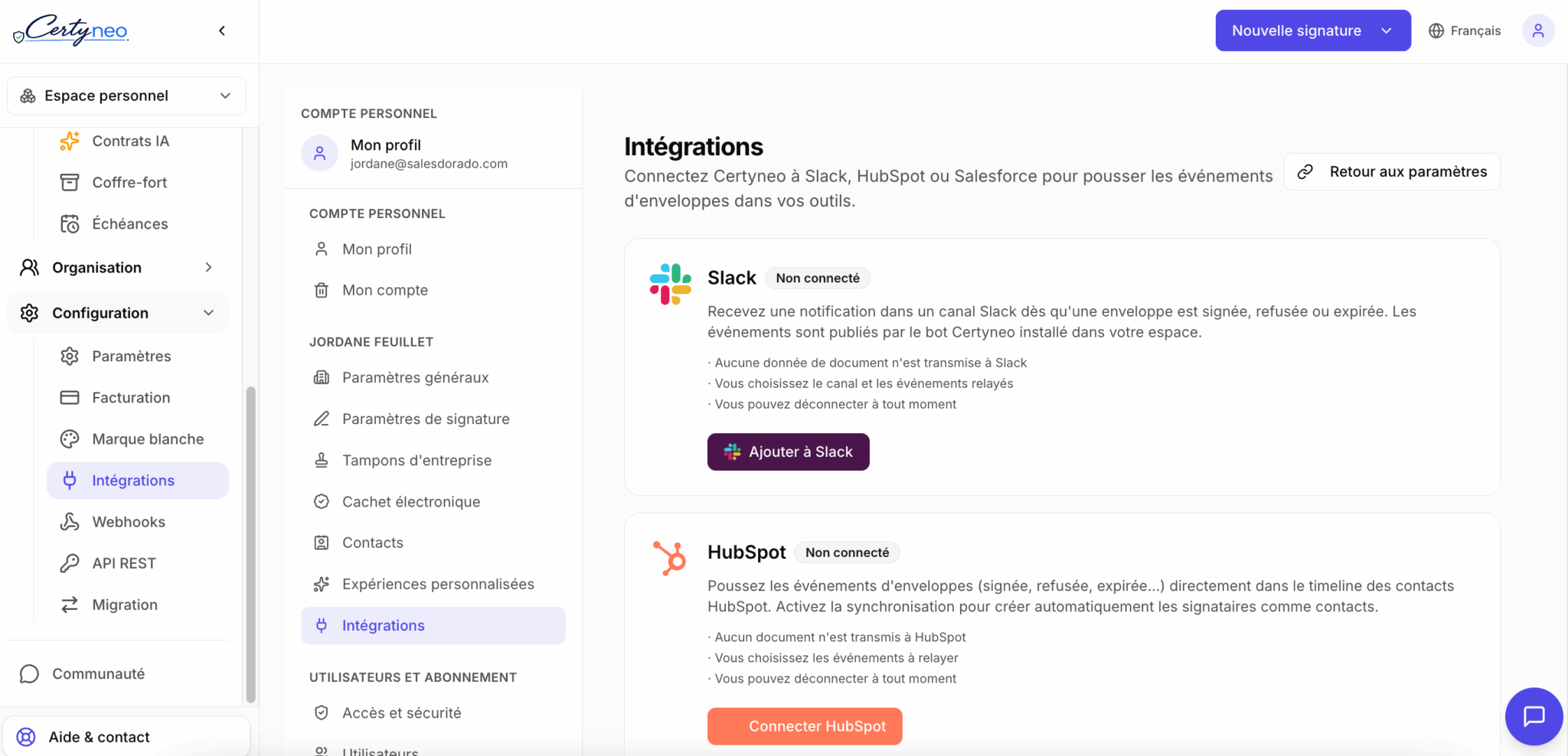
OAuth-authorized connectors, which plug in with one click from the settings:
- CRM: HubSpot, with envelope events pushed to the contact timeline, and Salesforce, which creates tasks on the matching contact, in production as well as in sandbox.
- Storage: Dropbox and Google Drive, read-only, to send a PDF for signature without downloading it locally.
- Collaboration: Slack for channel notifications and Notion to log every event in a database, which will interest legal and compliance teams.
API-key automation connectors, configured on the third-party tool’s side:
- Zapier, with triggers on envelope sent, signed, declined or expired. It opens access to more than 6,000 apps.
- Power Automate, with a custom connector in OpenAPI format to import in one click.
- Jira and Confluence, which let you send an attachment for signature from a ticket without switching tools.
- n8n, with the eleven signature events available on the Webhook node.
The REST API is documented in OpenAPI 3.1, with signed webhooks, official SDKs and an interactive playground. It is available from the Standard plan, which is rare at this price level.
For context, the established players generally offer CRM and Zapier connectors, without Make, Notion, n8n or Power Automate. On this precise ground, Certyneo is ahead of vendors that have been around for more than ten years.